



How The DRPA Built Organizational Trust and Fixed Public Perception
The Delaware River Port Authority experienced challenges within its culture until CEO John T. Hanson introduced improvisational exercises to bring the trust back.

The Ben Franklin Bridge Suspension Span & Anchorage Rehabilitation project is the largest in DRPA history.
Photos courtesy DRPA/PATCO
The Delaware River Port Authority (DRPA), and its subsidiary the Port Authority Transit Corp. (PATCO), turned to an unconventional method to repair its organization.
After noticing its culture suffered from a lack of communication and collaboration, John T. Hanson, CEO of DRPA and president of PATCO, introduced improvisational theatre exercises to bring everyone closer together.
Rebuilding a Reputation
Hanson had been the CFO of DRPA for nine years before stepping into his current role as CEO. During that time, he noticed issues within the organization.
“We saw that it was siloed and compartmentalized, which made communication not so great,” Hanson says. “There were other pressures from the outside, and we did not have the greatest reputation with the public, either.”
Hanson was able to see everything from the top, but he was not the one seeing it as the CEO at the time.
Christina Maroney, director, strategic initiatives, at DRPA, noticed the same problems.
“From my perspective, it was the support, the camaraderie, and the trust building that started to diminish at some point,” she explains.
Hanson and Maroney’s discussion about these issues led to DRPA’s Lean Government program, which was based on Lean Six Sigma.
According to Purdue University’s official website, five Lean Six principles are:
Work for the customer.
Find your problem and focus on it.
Remove variation and bottlenecks.
Communicate clearly and train team members.
Be flexible and responsive.
Hanson says the initial launch of this program involved 100 people. However, the Lean Six program was not bringing the change DRPA needed.
Maroney and others approached Hanson, saying change within the organization stalled and the next idea became about forming a leadership group.
The idea of improv was not thought about until Hanson read “To Sell is Human: The Surprising Truth About Moving Others,” by Daniel Pink, and “Group Genius: The Creative Power of Collaboration,” by R. Keith Sawyer.
“The theory is that innovation and creativity are not the result of the inspiration of one great creative thinker,” Hanson says. “Innovation and creativity really comes about as sparks among a group of people who are working together. He [Sawyer] pushes both musical improv and theatrical and dramatic improv.”
Hanson and Maroney built the leadership group sessions around the principles of improv.
The DRPA CEO took the steps to train in the improv world. Hanson performed with two ensembles with people who were from their early-20s to mid-30s. He brought in improvisers to help facilitate the sessions, and for the past several years the agency has had a part-time improviser on staff.

The DRPA/PATCO Solar Energy Project is expected to provide more than 50% of the total electricity consumption through solar energy for both PATCO and the DRPA.
Taking The Stage
DRPA is not doing improv for the sake of having fun. While fun is a byproduct of the sessions, Hanson calls it “applied improv.” The organization ties the theatrical exercises to a bigger lesson or initiative.
Before introducing improv to DRPA, Hanson learned to focus on others instead of being the star of the show.
“The idea of improv is to make my scene partners look good,” he explains. “You are taught if somebody comes up to you after the show and says, ‘Wow, you are the star,’ well then, you were awful. That is not your job to stand out and make everybody else look bad. Your job is to make the other people look good.”
Hanson’s idea was to apply that lesson to a business. The improv sessions allowed others to build trust by being vulnerable in a structured environment.
Ricardo DeOliveira, a bridge director at DRPA, admitted he was uncomfortable when the agency approached other employees with the idea of improv.
“I didn’t really understand what improv principles were about,” DeOliveira explains. “After being experienced and exposed to it, I started enjoying it.”
It is hard to see the metrics behind the improv sessions, but DeOliveira could tell they were making a difference.
"I’ve built so many relationships with people from other departments, and if it wasn’t for those exercises, I would have never had the opportunity to build those kinds of relationships,” DeOliveira says.

PATCO is investing $29.3 million to reopen its Franklin Square Station and address improvements to the station’s civil, structural, mechanical, and electrical systems.
The Show Goes On
The improv sessions are paying off within the DRPA/PATCO team, but it’s also paying off within the region.
“It’s about what we can accomplish on behalf of the region, while developing ourselves and doing what makes us more effective in achieving things,” says Hanson.
DATCO/PATCO now has several projects underway.
In 2021, the DRPA began the largest project in its history, the Ben Franklin Bridge Suspension Span & Anchorage Rehabilitation project. The $216.9 million project includes dehumidifying the main suspension cables, rehabilitation of the North and South walkways, maintenance painting and miscellaneous steel repairs, replacing decorative lighting, and widening the entrance of one of the bridge’s pedestrian walkways.
Before the Ben Franklin Bridge Suspension Span & Anchorage Rehabilitation project, DRPA began a solar energy project, which is expected to provide more than 50% of the total electricity consumption through solar energy for PATCO and the DRPA. The 22-megawatt solar energy project installed more than 50,000 solar panels at eight facilities.
Another project in the works is the PATCO Franklin Square Station reopening.
PATCO is reopening its Franklin Square Station to provide better transportation access to a growing area in Philadelphia. The $29.3 million project renovates existing infrastructure to enable the station to become fully functional and in line with the existing PATCO stations. The project will address improvements to the station’s civil, structural, mechanical, and electrical systems and provide access in compliance with the Americans with Disabilities Act (ADA).
These projects are a reflection of the organization’s new reputation.
Hanson says he would recommend applying improv within an organization if they are experiencing what DRPA has in the past.
“I would suggest you get a team together and start to talk about it and learn a little bit about it,” he explains. “Then, you do just what we do. We improvise, you take a step, you pay attention, and you react to it at the top of your intelligence.”
The show must go on for DRPA, but the improv is here to stay.
The organization is working on another initiative with the All Aboard Program.
“We’ll be hosting in-person sessions with high-level applied improv concepts to advance our culture,” Maroney says. “It’ll be open to all employees at all levels of the organization.”
Employees have expressed interest in the improv sessions, but it’s all about working toward the same goal.
“We have to do it in a meaningful and purposeful way so that people are getting something, there are takeaways, and there are outcomes,” Maroney says.
More Rail
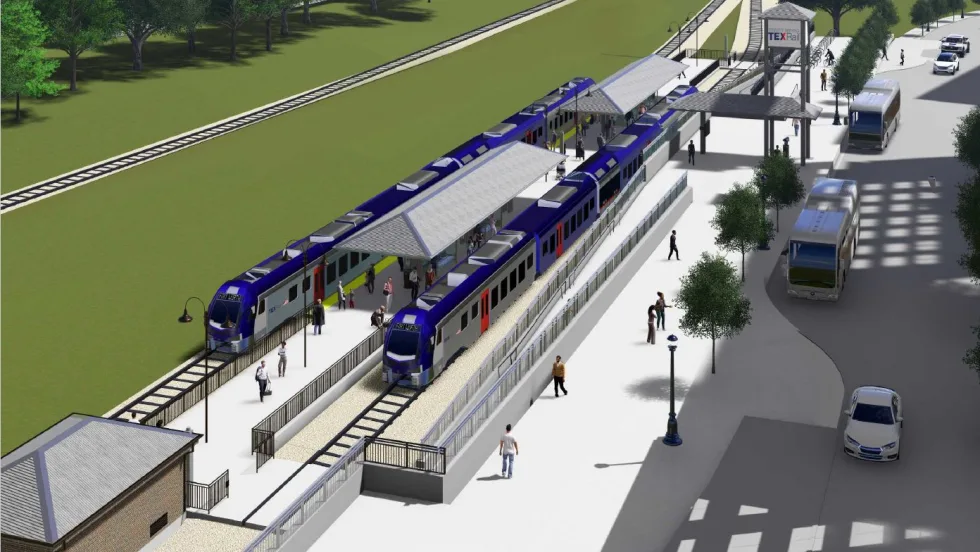
Trinity Metro Breaks Ground on $270M TEXRail Extension
The 2.1-mile extension will connect Fort Worth’s Medical District and Near Southside to downtown, surrounding communities, and Dallas-Fort Worth International Airport.
Read More →
Bringing Austin’s First Light Rail System to Life
Austin Transit Partnership CEO Greg Canally discusses the city's nearly 10-mile light rail project, its collaborative approach to project delivery, the importance of community engagement, and the milestones ahead as construction approaches in 2027.
Read More →
Metra Draft Plan Outlines Costs, Service Improvements for Regional Rail
The Systemwide Network Plan identifies infrastructure needs and potential investments to expand all-day, bidirectional rail service across the Chicago region.
Read More →
Amtrak Completes First Street Tunnel Upgrades, Restores Service
The nine-day construction project included replacing aging track infrastructure and modernizing switch systems near Washington Union Station.
Read More →
FRA Announces $2.3B for Passenger, Freight Rail Projects Nationwide
The CRISI Grant Program funding will support rail infrastructure improvements, safety upgrades, and projects aimed at improving freight and passenger rail service across 45 states and Washington, D.C.
Read More →
Caltrain’s Electrification Drives a New Era of Ridership Growth
The railroad’s shift to electric service has brought more frequent trains, stronger customer satisfaction, and increased ridership, earning it APTA’s Outstanding Public Transportation System award.
Read More →
FTA Advances $164M Broward County Commuter Rail Project
The proposed 10.5-mile commuter rail extension would connect Fort Lauderdale and Aventura, expanding passenger rail options in South Florida.
Read More →
New York MTA Launches Historic $1.9B Signal, Track Modernization Project
Funded in part by congestion pricing revenue, the project will replace nearly century-old signals along the A and C lines in Brooklyn and Queens.
Read More →
LA Metro Breaks Ground on East San Fernando Valley Light Rail Project
The 6.7-mile line will add 11 stations along Van Nuys Boulevard, expand access to jobs and regional transit connections, and support Metro’s broader efforts to improve mobility as rail ridership grows.
Read More →
CSA Group Releases Climate Resilience Standard for Transit, Passenger Rail
Developed with support from the Standards Council of Canada, CSA D700 guides assessing climate-related risks and planning adaptation measures for transit and passenger rail systems.
Read More →