




Take a Look: MBTA Announces New Green Line Car Exterior Paint Design
MBTA Completes Expedited Track Work on Green Line
With unencumbered access to Green Line stations, crews were able to accomplish station enhancements and amenity upgrades like new flooring and lighting, which further improved the customer experience.
January 30, 2024
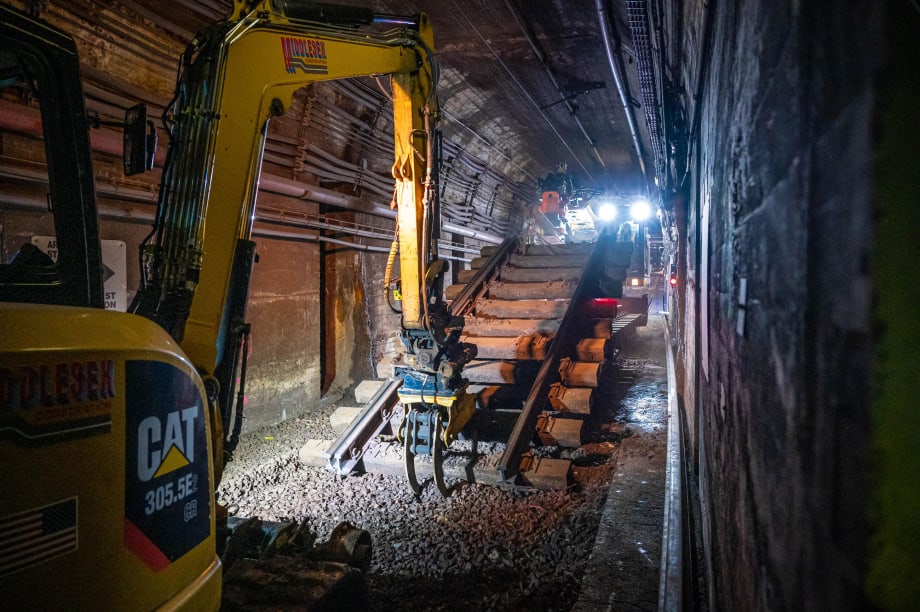
Crews accomplished track work and other upgrades along the Green Line.
Photo: MBTA
3 min to read
The Massachusetts Bay Transportation Authority (MBTA) announced the successful and on-time completion of track work on the Green Line, which removed 16 safety-related speed restrictions.
Additionally, a 17th speed restriction on the Green Line between Haymarket and Government Center stations was shortened by over 500 feet.
How the MBTA Crew Accomplished the Track Work
Crews accomplished this work due to unencumbered access to track areas while Green Line train service was suspended on the B branch from Babcock Street to Kenmore, on the E branch between Heath Street and Copley, and in the downtown area between Kenmore and North Station for 10 days from Jan. 3-12 and for 13 days from Jan. 16-28.
Additionally, during scheduled weekend and evening service diversions over the last several weeks between North Station and Union Square as well as Medford/Tufts, crews from GLXC, the design-build contractor, have completed track work that has alleviated all current tight gauge conditions along both Green Line Extension branches.
“Our team was able to lift even more speed restrictions than were planned and significantly shorten another. This continues to be indicative of the new way the MBTA is doing business," said MBTA GM/CEO Phillip Eng. "I thank our riders for their patience as we know shuttle bus service replacement can be challenging, especially in the winter months. Thank you as well to the MBTA forces, working side by side with our crews from multiple contractors to deliver on the commitments we made.”
With unencumbered access to Green Line stations, crews were able to accomplish station enhancements and amenity upgrades like new flooring and lighting, which further improved the customer experience.
Through planning and coordination between contractor crews and multiple MBTA Operations departments, the MBTA was able to maximize the shutdown time by having numerous contractor crews and MBTA personnel working side-by-side and collaboratively within the underground Green Line tunnel area.
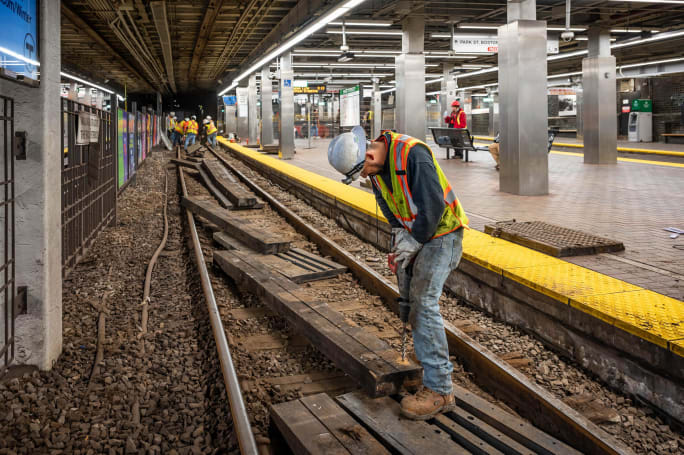
Crews performed tie replacement work during the Green Line shutdown.
Photo: MBTA
Critical Work on Green Line
Among this critical work:
Over 1,300 ties were replaced.
Nearly 10,800 feet of rail was replaced.
Nearly 8,900 feet of track was resurfaced and tamped.
12 switches were replaced/rehabilitated.
Approximately 7,300 feet of overhead catenary wire was replaced between Haymarket and Boylston stations.
Structural repairs were completed on the roofs of Boylston and Copley stations.
Tunnel inspections were performed between Haymarket and North Station.
At Copley station, repair work was completed on three in-station columns with additional infrastructure upgrades accomplished.
A new elevator sump pump was installed at Arlington station.
Substation maintenance and electrical repairs were completed.
Water infiltration repairs were completed within the Green Line tunnel.
Critical signal and power system repairs were completed.
Improvements were accomplished at the Park Street communication room.
Structural inspections were accomplished at stations throughout the Green Line shutdown.
Other in-station work also took place along the Green Line to further enhance the rider experience, including cleaning, sanding, and painting wood benches; performing tactile repairs; stairway upgrades and repairs, including handrail repairs; installing/replacing station signage; painting columns and ceilings at station platforms; painting stair risers, doors, and door frames; performing flooring/tile repairs; replacing lights; patching spalls on concrete columns; replacing/cleaning light covers; and more.
The MBTA further maximized this shutdown by coordinating site access with utility partners. With the service shutdown, Comcast was able to access property adjacent to the MBTA to expand maintenance access points and upgrade existing equipment, which was a project that had been previously delayed nine months.
The Boston Water and Sewer Commission (BWSC) also completed CCTV inspections of 20 maintenance access points and connecting sewer lines of the utility network between Brigham Circle and Health Street stations along Huntington and South Huntington Avenues.
More Rail

New York MTA Advances Final Contract for Second Avenue Subway Expansion
Contract Four is the largest in the Second Avenue Subway Phase 2 project and includes construction of station infrastructure, tracks, and signals for the subway expansion, MTA officials said. Work on Contract Four will begin in 2027.
Read More →
San Diego MTS Breaks Monthly Trolley Ridership Record
Agency officials said July’s ridership indicates MTS’s continued recovery from the pandemic.
Read More →
Report Examines NJ TRANSIT Reliability, Funding Challenges
The Garden State Initiative analysis examines the roles of Amtrak infrastructure, fleet management, and agency operations while recommending a more performance-based approach to improving reliability.
Read More →
Stadler, CapMetro Sign Long-Term Rail Fleet Support Agreement
Beginning in 2027, Stadler will provide on-site technical expertise, spare parts support, training, and obsolescence management to help extend the reliability and longevity of CapMetro’s GTW fleet.
Read More →
Biz Briefs: Alstom Lands Canadian Contract, LYT to Supply California TSP, and More
In METRO's latest installment, we take a look at recent news from Complete Coach Works, Beep, FlixBus, and more partnerships making headlines across the transportation sector.
Read More →
CATS Gold Line Marks 5 Years of Service, 2.8M Passenger Trips
With a six-mile expansion planned, the Charlotte streetcar is positioned to connect more neighborhoods and major transit hubs across the region.
Read More →
Why Simulating Pedestrian Movement Has Become Essential for Modern Rail Stations
Pedestrian microsimulation is helping rail planners identify bottlenecks, test station designs, and prepare complex transit hubs for growing passenger volumes.
Read More →
Amtrak Begins Major Construction at New York’s Sunnyside Yard
The new maintenance facility will support Amtrak’s Airo trainsets while improving maintenance efficiency and turnaround times in New York.
Read More →
Chicago Leaders Unveil Plans for O’Hare Airport Express Train
The privately developed project would offer a 15-minute trip between downtown and O’Hare’s Terminal 2, with trains operating every 15 minutes on a dedicated track. The service would use battery-electric trains and three existing freight rail rights-of-way.
Read More →
OCTA Maps Out 30-Year Strategy to Protect Coastal Rail Corridor
The draft feasibility report identifies strategies to protect the coastal rail line for decades as the agency continues near-term stabilization and sand placement efforts.
Read More →