



CVSA reminds motorcoach industry of federal ELD mandate deadline
According to FMCSA, there will be no extensions or exceptions made and no "soft enforcement" grace period.


FMCSA implemented the ELD rule to make it easier and faster to accurately track, manage, and share record of duty status information, and to help improve road safety and reduce the number of crashes.
MCI
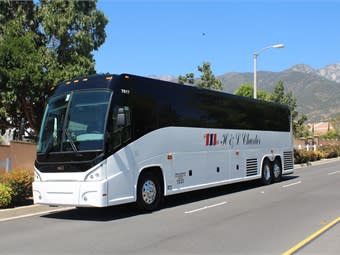
FMCSA implemented the ELD rule to make it easier and faster to accurately track, manage, and share record of duty status information, and to help improve road safety and reduce the number of crashes.
MCI
Starting Dec. 17, 2019, all motor carriers and drivers subject to the U.S. Department of Transportation's Federal Motor Carrier Safety Administration (FMCSA) electronic logging devices (ELD) final rule must use an ELD. The deadline also pertains to grandfathered automatic onboard recording devices (AOBRDs), which will no longer be allowed under the Federal Motor Carrier Safety Regulations to provide records of duty status as a substitute to a required ELD. Motor carriers utilizing an AOBRD must have a fully operational ELD installed by Dec. 17, 2019.
According to FMCSA, there will be no extensions or exceptions made to the Dec. 17, 2019, ELD rule deadline. In addition, the Commercial Vehicle Safety Alliance (CVSA) stated that inspectors will begin fully enforcing the ELD rule on Dec. 17, 2019, with no "soft enforcement" grace period.
If a commercial motor vehicle driver is required to have an ELD and the vehicle is not equipped with a registered compliant ELD, the driver is considered to have no record of duty status, which also applies to a driver still using an automatic onboard recording device after the AOBRD to ELD transition deadline of Dec. 17.
According to the North American Standard Out-of-Service Criteria, a property-carrying driver who does not have a record of duty status in his or her possession when one is required will be declared out of service for 10 hours and a passenger-carrying driver without a record of duty status when one is required will be placed out of service for eight hours.
CVSA-certified roadside inspectors use the North American Standard Out-of-Service Criteria to identify conditions that preclude further operation of a commercial motor vehicle by its driver for a specified amount of time, or for some conditions, until the violation is corrected.
The April 1, 2019, North American Standard Out-of-Service Criteria specifies the out-of-service conditions related to deficiencies of record of duty status and hours-of-service rules and regulations.
In addition, CVSA's Inspection Bulletin regarding hand-held and electronic logging devices outlines the requirements for devices used to record drivers' hours of service, according to 49 CFR Part 395 Subpart B – Electronic Logging Devices.
FMCSA implemented the ELD rule to make it easier and faster to accurately track, manage, and share record of duty status information, and to help improve road safety and reduce the number of crashes.
An ELD automatically records a driver's driving time and other hours-of-service data.
Hours-of-service rules and regulations were developed to minimize driver fatigue and improve safety for everyone on the road.
In addition, ELDs monitor a vehicle's engine data, such as when the engine is running, whether the vehicle is moving, miles driven, or duration of engine operation.
More Security and Safety

Transit Agencies Highlight Safety Gains at National Summit
Leaders from 15 major transit systems shared crime-reduction results and safety initiatives while discussing the role of continued federal support.
Read More →
DART Launches Major Security, Fare Enforcement Initiative
The 90-day demonstration will deploy coordinated security teams at five light rail stations while testing controlled access and gathering data to guide future investments.
Read More →
RTD Launches NextRide App to Consolidate Trip Planning, Fares, Security Reporting
The app expands on RTD’s existing NextRide web application and allows customers to view real-time vehicle locations and service alerts, purchase and store digital fares, and access customer support.
Read More →

TAPTCO Updates OSHA Compliance Training for Transit Maintenance Operations
The revamped program addresses 26 OSHA standards for maintenance facilities, with TAPTCO pointing to training, documentation, and everyday shop hazards as continuing challenges for transit operations.
Read More →
How VaporVision Adds Value to Transit Door Systems
Wabtec engineers explain how the system improves doorway detection, strengthens diagnostics and gives transit agencies and OEMs greater operating flexibility.
Read More →
FRA Announces $5.3B in Rail Investments, Including $2B for Amtrak
Funding will support grade-crossing improvements, infrastructure upgrades, and new Amtrak equipment in 23 states.
Read More →
Chicago, Maryland Expand Non-Law-Enforcement Safety, Rider Support
The CTA and MTA are launching new programs aimed at de-escalation, crisis response, rider assistance, and greater transparency.
Read More →
LA Metro, City of West Hollywood, and Partners Advance Smarter Bus Lane Enforcement
The award-winning partnership combines AI-powered detection with human oversight to improve bus reliability, accessibility, and enforcement efficiency.
Read More →
LA Metro Reports 57% Decline in Homelessness on Transit System Since 2024
The agency's latest homelessness count offers new data on how care-based services and cross-sector partnerships can complement traditional transit security strategies.
Read More →
FTA Launches 'Transit Moves America' Dashboard to Highlight Agency Safety and Performance
The online dashboard transforms National Transit Database information into a public-facing resource that allows users to compare transit agencies on key operational and safety metrics.
Read More →