



Optibus Launches Timetable Optimization
In initial trials of Timetable Optimization, customers saw an additional 5% reduction in required vehicle count, deadheads, and operational expenses.
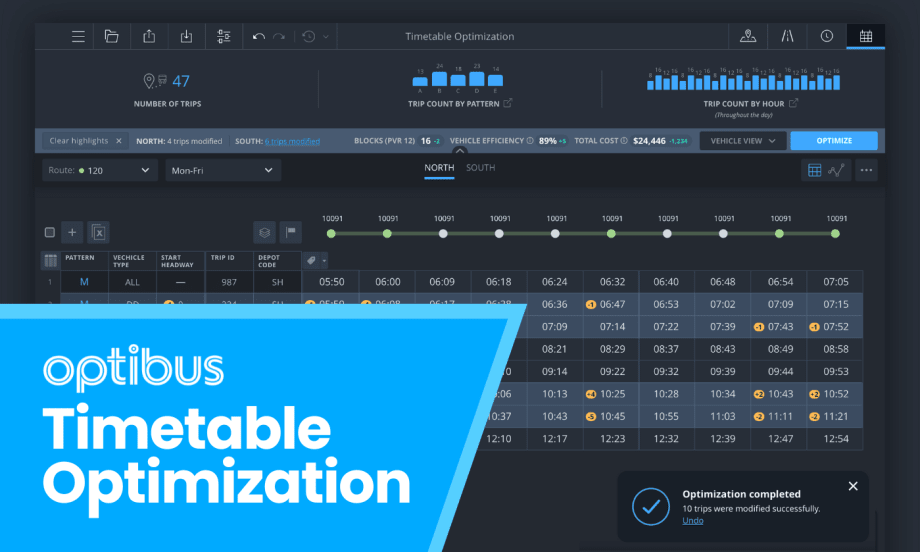
The feature is included within Optibus’ Planning module, which streamlines planning by housing all functions on a single, end-to-end platform.
Photo: Optibus
Optibus announced the launch of Timetable Optimization, which allows customers to minimize costs and peak vehicle requirements (PVR) for operating services while improving timetables and maintaining service quality.
The launch follows successful beta trials with Arriva Portugal and Chartered Speed in India, among others. In initial trials of Timetable Optimization, customers saw an additional 5% reduction in required vehicle count, deadheads, and operational expenses.
“Timetable Optimization from Optibus allowed TST, an Arriva Group company, to decrease the work time on timetables by delivering a more efficient solution, not only increasing the operational efficiency but also the planning productivity,“ said Duarte Cunha of the planning department of TST, an Arriva Group Company.
Optibus’ optimization algorithms improve the efficiency of the timetable and apply changes to both trip directions, saving time by eliminating the labor and guesswork involved in manually offsetting trips.
Optibus’ dashboard visualizes changes that occurred through optimization, including stop times, number of trips modified in each direction (e.g. 4 Northbound, 8 Southbound), and the impact on business metrics including blocks (PVR), vehicle efficiency (%), and total cost.
Timetable Optimization is a solution that calculates costs while accounting for daily fixed costs (for both drivers and vehicles), drivers’ hourly wages, distance unit cost per vehicle, and custom preferences regarding layovers, route connections (e.g. interlining), and the deadhead catalog.
“The quality of a transport system can be measured by the quality of the software used to build and operate it. Timetable Optimization is one more Optibus capability that replaces inefficient, legacy processes with a powerful digital platform backed by optimization algorithms and cloud computing. Planners can now predict better than ever the impact of their timetables, leading to a new level of service quality, cost savings, and work efficiency,” said Amos Haggiag, CEO/co-founder, Optibus.
The feature is included within Optibus’ Planning module, which streamlines planning by housing all functions on a single, end-to-end platform. Other solutions separate planning processes and data into different silos.
More Technology

From Hardware to Digital Partner: Luminator Charts Its Next Chapter
CEO Magnus Friberg discusses Luminator’s shift toward becoming a digital partner, the growing importance of software and interoperability, and how AI can help agencies improve operations and passenger experience.
Read More →
Beyond the Checklist: A Structured Approach to Transit Maintenance
Reliability-Centered Maintenance helps transit agencies move beyond routine checklists to focus limited resources on the assets and failures that have the greatest impact on safety, reliability, and service.
Read More →
NJ TRANSIT Advances Bus Technology Upgrades Across Statewide Fleet
More than 1,500 buses now feature upgraded technology designed to improve arrival predictions and provide free Wi-Fi, with deployment expected to reach nearly 2,000 buses by the end of 2026.
Read More →

Building a Flexible Path to Transit Electrification
John Hroncich discusses BAE Systems’ modular and scalable approach, lessons learned from decades of real-world operations, and how agencies can identify electrification strategies that fit their fleets.
Read More →
Biz Briefs: Alstom Lands Canadian Contract, LYT to Supply California TSP, and More
In METRO's latest installment, we take a look at recent news from Complete Coach Works, Beep, FlixBus, and more partnerships making headlines across the transportation sector.
Read More →
From Legacy Silos to Conversational Intelligence
What if transit leaders could ask any operational question and get a trusted answer in seconds? Conversational AI is transforming how agencies use their data.
Read More →
USDOT Announces Rail Vehicle Replacement Grants, Chattanooga AV Shuttle Funding
More than $191 million in federal funding will help three transit agencies replace aging rail vehicles and support a new autonomous shuttle service in Chattanooga.
Read More →
Bus Tech Talk: Keeping Transit Technicians Ahead of the Technology Curve
LA Metro’s Obed Mejia discusses technician training, evolving maintenance technology, fleet replacement, and strategies for getting the most out of today’s transit fleets.
Read More →
Biz Briefs: RIPTA Unveils New Frontrunners, Clevland RTA Adds New Siemens, and More
In METRO's latest installment, we take a look at recent news from Siemens, Prevost, Dodge, and more partnerships making headlines across the transportation sector.
Read More →
Why Simulating Pedestrian Movement Has Become Essential for Modern Rail Stations
Pedestrian microsimulation is helping rail planners identify bottlenecks, test station designs, and prepare complex transit hubs for growing passenger volumes.
Read More →