



Transit Signage, Wraps and Graphics Benefit Passengers, Operators
Companies specializing in custom transportation materials are using large format printing, digital imaging, and durable, reusable materials — sometimes in conjunction with data-efficient bar coding — to benefit both passengers and operators.
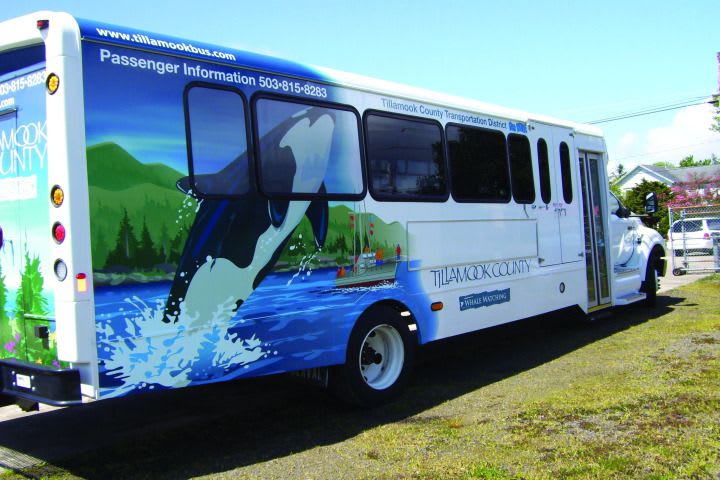
The aim of Gillespie Graphics in designing large bus and train decals and wraps is often to develop a unified appearance for community transit systems, thus creating a recognizable and eye-catching presence that passengers will become familiar with.
The aim of Gillespie Graphics in designing large bus and train decals and wraps is often to develop a unified appearance for community transit systems, thus creating a recognizable and eye-catching presence that passengers will become familiar with.
Transit agencies and fleet owners have the potential to establish an identity in the communities they serve through use of today's growing transit product options. Customizable signage, bus wraps and graphics are just a few of the options available.
Companies specializing in custom transportation materials are using large format printing; digital imaging; and durable, reusable, and easy-to-replace materials, sometimes in conjunction with data-efficient bar coding, to benefit passengers and operators alike. We spoke to four custom graphics companies to get their take on today's most valuable graphics products for use in the transit industry.
Gillespie Graphics
According to Tim Allen, director, sales and marketing, for Gillespie Graphics, longevity is one of the most essential qualities of the company's transit graphics. Operating since 1921 in Wilsonville, Ore., the company specializes in permanent, large format graphics and decals, and offers full graphic design, manufacturing and installation services for its decal and full wrap graphics; short run bus signs; transit maps and temporary promotional graphics.
Gillespie Graphics ensures the longevity of its products by utilizing high-quality inks and materials to produce graphic elements for buses and trains; the result is a durable product that can withstand the wear and tear of everyday use. The company offers the longest product warranties in the industry, according to Allen.
The majority of the company's large format graphic materials are printed using large format digital printing on pressure sensitive vinyl. If the design covers the windows of the transit vehicle, a perforated vinyl will be used. The perforated vinyl allows passengers to see out through small holes, but people outside the vehicle can appreciate the design.
"The industry has developed more durable and user friendly products to the make the task of adding graphics much easier of a decision for our customers," Allen explains. "Train graphics not only need to be eye-catching, but also functional."
Gillespie Graphics incorporates reflective materials into its graphics in key areas to address safety issues associated with transit vehicles, giving the products a dual purpose. These reflective areas can be incorporated into the pressure sensitive vinyl itself.
The aim of Gillespie Graphics in designing large bus and train decals and wraps is often to develop a unified appearance for community transit systems, thus creating a recognizable and eye-catching presence that passengers will become familiar with. The company's work for Lincoln County Transit, located in Newport, Ore., showcased the county's attractions. The design was applied to 30 to 35 buses and vans, establishing a unique transit identity.
Working with smaller municipalities has allowed Gillespie Graphics to assist communities in growing rider participation and conceptualizing a design for transit equipment that embodies the spirit of the community.
In 2009, Tim Gillespie, an accounts manager at Gillespie Graphics, received the Outstanding Public Transportation Business Member Award by the Oregon Transit Association. He merged community and transportation by participating in the South Metro Area Regional Transit (SMART) Art program, in which 200 local students create transportation-themed artwork annually. One student's winning artwork is incorporated into the graphics of the local fleet and displayed on the side of a bus.
"We have found a niche utilizing design to help our customers in communicating their vision of community involvement, pride, tourism and what makes the area unique," Allen says. "When we have had the opportunity to use creative graphics, our customers have said that their ridership has grown in very large percentages and, in some cases, doubled. A person would much rather ride buses with a unique colorful graphic that shows pride in the community than one with just a few logos on it."
Roemer Industries
Roemer Industries, based in Masury, Ohio, has been providing solutions to graphic identification needs for 70 years. For the transit industry, the company offers warning and safety labels, tags and markers, signage and 2D Barcode Symbologies. The ISO-certified company has provided linear barcode labels for transit car numbering, identification and instruction placards and durable signage for the transit industry, for both small and large orders.
Roemer Industries utilizes state-of-the-art printing technologies to create its products. The company employs a variety of processes including etching, flexographic printing, screen printing, thermal transfer printing, engraving, metal-photo, deep etch, emboss, digital printing, casting, vinyl cutting, doming, sub-surface and any combination of these techniques.
Products can be ordered with a number of different graphic overlays. Warning and safety labels can be ordered with high performance photoluminescent lighting (HPPL) overlays. Signage with HPPL overlays is self-illuminating and can be exposed to light and discharged infinitely to produce a yellowish green light. These products have a service life of 20 years or more and are easily adhered to the surface of transit vehicles using a variety of adhesives or fasteners that can be cut to a specified length or kitted for individual applications.
The barcode technology offered by Roemer Industries can be adopted for use on transit plates, signage, passenger cars and car numbering. 2D Barcode Symbologies can be scaled to various sizes and are appropriate for use as small identification marks. These barcodes allow for reduced errors, as the data encoding schemes can still be read when damaged or scratched. A handheld barcode imager or smart phone is required to scan 2D barcodes.
Of the 2D Barcode Symbologies, Roemer Industries suggests Quick Response (QR) Codes as a viable solution to transit needs. This code can hold as much data as a standard barcode in one-tenth of the space. This technology can be integrated for use at bus stops and transit shelters to give passengers the ability to scan and receive information, such as bus schedules, fare prices, and arrival and departure times, according to Roemer Industries. QR Codes can be incorporated into a number of materials, including aluminum, stainless steel, polyester and vinyl, which are suitable for commercial transit applications. The company provides numerous printing and graphics options for 2D Barcode Symbologies.
[PAGEBREAK]Turbo Images
Specializing in fleet graphic solutions, Canada-based Turbo Images provides design services, project guidance, printing, and installation and removal services to customers in both the U.S. and Canada.
Turbo Images has its own design firm within the company called Turbo Studio. The firm is responsible for assisting the company's clientele in the design and implementation of custom graphics that accurately portray the unique message of each client.
"We guide our customers into how they should display their name and what type of image they should use to make an impact on their mobile vehicle," explains Esther Morissette, vice president, marketing and public relations, at Turbo Images. "We design and go back and forth with the customer until they reach a decision through our guidance and, then after that we print, ship and install."
Morissette says the latest trend in transit is the use of space on vehicles to cultivate advertising revenue. The company provides a unique service by utilizing their customer database to find buses and other vehicles with advertising space available for clients looking to purchase this space. They can then provide the graphic design and marketing services to the potential advertiser.
For such projects, Turbo Images offers a new product called Re-Gripp, a removable and reusable graphic banner that is adhered to a Velcro frame. The product uses no metal or screws and does not damage the surface of the vehicle. The company also offers bus wraps and graphics for any size vehicle. Turbo Images manufactures its designs using large format printers, digital imaging, screen printing, 3DSS (a tridimensional spraying system that acts as an alternative to paint) or MarbleX concept, which replicates the appearance of marble.
Turbo Images has provided graphic solutions to AC Transit in Oakland, Calif., and the Golden Gate Bridge, Highway and Transportation District in San Francisco. They have also provided graphics for Greyhound; SunLine Transit in Thousand Palms, Calif.; and Chevron, in conjunction with AC Transit, during a special campaign to promote hybrid buses and alternative fuels in the Bay Area.
"I would say it's wrapping with colorful, powerful and precise message graphics," Morissette says of today's latest transit needs. Fleet owners and transit agencies alike benefit from well-designed graphic elements and high quality transit products "because [vehicles are] really just mobile billboards going around cities."
Located in Twinsburg, Ohio, Visual Marking Systems (VMS) offers decals, fleet graphics, station signage, system maps, HPPL emergency egress signage and retro-reflection emergency access markings for the transit industry. The company works closely with authorities, consultants and builders to create custom finish products for its clients.
"One of the latest trends in transit graphics is meeting FRA and APTA standards," says Krista Kahle, marketing specialist for VMS. "It is important to provide graphics that keep each authority in regulation with the governing authorities to the transit world."
The company provides graphics in full compliance with FRA and APTA standards to help clients enhance passenger safety and adhere to new and current laws. The company is also concerned with extending the longevity of its products by using the correct materials and adhesives. A pioneer in environmentally friendly printing, VMS uses UV inks, which don't require solvents and produce lower emissions than other inks, on polycarbonate.
VMS was the first certified provider of HPPL signage in the U.S. The signage exceeds the minimum requirements set by APTA for 90 minutes of luminescence in total darkness, and is fully compliant with both APTA and FRA standards.
Similarly, the company produces Braille graphics and signs that adhere to Americans with Disabilities Act (ADA) regulations by incorporating raised letters and icons. The company is also equipped to provide signs indicating seating for disabled and wheelchair-bound passengers that are ADA compliant.
VMS has worked with the Greater Cleveland Regional Transit Authority (RTA) to create customized signage for the kiosks along the RTA route.
"Cleveland RTA wanted a customized kiosk at each station that reflected the shops, government and tourist attractions in the surrounding area," Kahle explains. The individualized kiosks helped to give the RTA a community-centric identity, and allowed passengers to gain a better understanding of the area at each RTA station, Kahle says. By the project's completion, VMS had produced custom signage for 30 to 40 distinctive kiosks.
Digital large format printing is used to make its graphic products. The company produces a line of transportation signs and marking material called TransGrafix, which is resistant to chemicals, graffiti, other types of vandalism and weather damage. This means that the products are easy to clean and maintain and can withstand typical wear and tear.
More Bus

New York MTA Plans Largest Bus Fleet Upgrade in More Than a Decade
The agency is seeking manufacturers for 650 new CNG buses to replace aging vehicles, improve reliability, and advance its broader fleet modernization strategy.
Read More →
Building a Flexible Path to Transit Electrification
John Hroncich discusses BAE Systems’ modular and scalable approach, lessons learned from decades of real-world operations, and how agencies can identify electrification strategies that fit their fleets.
Read More →
Bus Tech Talk: Keeping Transit Technicians Ahead of the Technology Curve
LA Metro’s Obed Mejia discusses technician training, evolving maintenance technology, fleet replacement, and strategies for getting the most out of today’s transit fleets.
Read More →
Biz Briefs: RIPTA Unveils New Frontrunners, Clevland RTA Adds New Siemens, and More
In METRO's latest installment, we take a look at recent news from Siemens, Prevost, Dodge, and more partnerships making headlines across the transportation sector.
Read More →
People Movement: Holly Arnold Joins Transdev and More
In this edition, we also cover recent appointments and announcements at Pace, CamTran, MCI, and more, showcasing the individuals helping to shape the future of transportation.
Read More →
The High Cost of Transit Buses: Industry Leaders Look to Procurement Reform
Transit leaders and policymakers examine how standardized bus designs, streamlined procurement, and predictable funding could help agencies stretch budgets and deliver better service.
Read More →
The Business Voice Behind Public Transportation
As chair of APTA’s Business Members Board of Governors, Ray Melleady explains how more than 850 business members are partnering with transit agencies to advance funding, innovation, and industry-wide collaboration.
Read More →
From Surviving to Thriving: Building Stronger Transportation Organizations
Bus Business Consultants founder Brian Dickson shares lessons on leadership, organizational health, and creating options for long-term success in a changing transportation industry.
Read More →
Finding the ‘Happy Medium’: Optimizing Maintenance Without Sacrificing Reliability
The key to maintenance optimization isn’t doing less work—it’s doing the right work at the right time on the right assets.
Read More →
LA Metro, City of West Hollywood, and Partners Advance Smarter Bus Lane Enforcement
The award-winning partnership combines AI-powered detection with human oversight to improve bus reliability, accessibility, and enforcement efficiency.
Read More →