



Palm Tran helps small DBEs gain access to opportunity
The Palm Beach Partners Business Matchmaker Conference & Expo attracted more than 400 participants from numerous business disciplines.

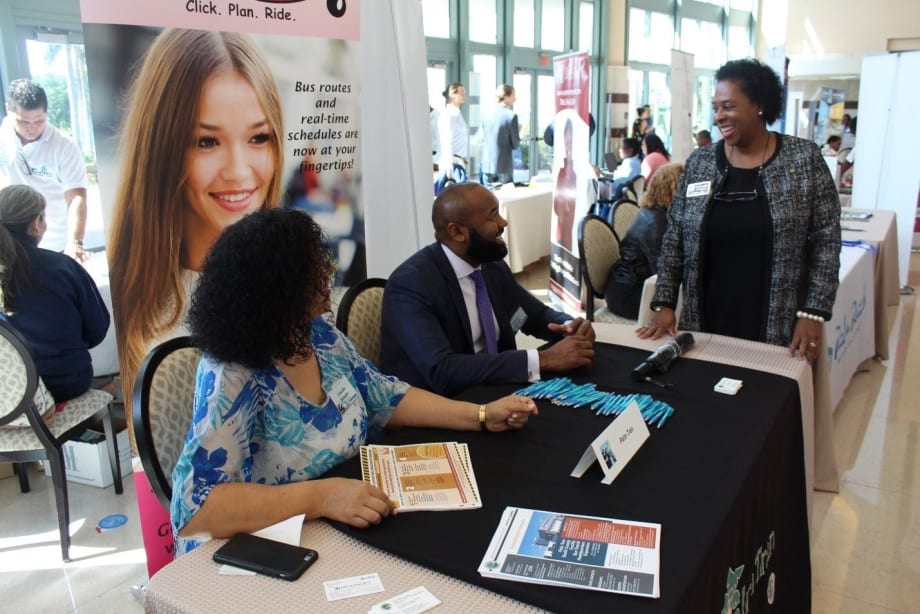
From left to right, Palm Tran DBE Grants Coordinator Claudia Salazar and Executive Director Clinton B. Forbes answer questions from vendors.

From left to right, Palm Tran DBE Grants Coordinator Claudia Salazar and Executive Director Clinton B. Forbes answer questions from vendors.
West Palm Beach, Fla., Palm Tran is helping disadvantaged businesses find their perfect match by sponsoring the recent 2017 Palm Beach Partners Business Matchmaker Conference & Expo. Now in its 11th year, the conference unites small, minority/women-owned, and disadvantaged business enterprises (SBE, M/WBE, and DBE) with professionals and government agencies in the hopes of developing and building strategic partnerships. The theme for this year’s expo was: “Charting the Course: Navigating Business Connections.”
“Palm Tran is passionate about promoting a level playing field for businesses owned and operated by disadvantaged individuals,” said Palm Tran Executive Director Clinton B. Forbes. “The conference is key to reducing barriers to entry and educating small business enterprises how to thrive in the public sector.”
The Palm Beach Partners Business Matchmaker Conference & Expo attracted more than 400 participants from numerous business disciplines. Business owners participate in 10-minute power talks, lectures, and workshops with government agencies and private corporations. Topics included: how to build your credit, how to obtain a small business loan, and how to build connections and contract opportunities with government agencies.
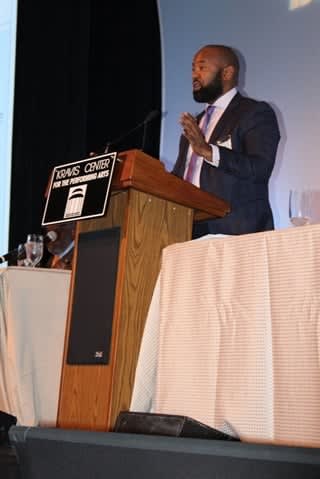
Palm Tran Executive Director Clinton B. Forbes presenting a workshop on upcoming Palm Tran initiatives.
The biggest hurdle small and disadvantaged business enterprises face is they do not understand what the bidding process entails. Those who attend the conference gain guidance on securing contracting opportunities with the county,” said Palm Tran DBE Grants Coordinator Claudia Salazar. “I love the project because of the questions. Businesses learn they have a plethora of places to turn to.”
During the conference, Forbes led a workshop presenting a system overview of Palm Tran and highlighting upcoming projects. He highlighted the Palm Tran South County Facility Expansion Project in Delray Beach and the Route Performance Maximization Project (RPM) — the latter of which will enhance and speed up Palm Tran’s system. Forbes outlined the difference between a small business enterprise and a disadvantaged business enterprise and explained the certification process.
“Palm Tran has exciting projects in the works that will require DBE and SBE participation. It was important to educate and build relationships with those who can contribute,” Forbes said. “The conference enables business owners to become leaders themselves and serve as examples of what happens when opportunities are embraced.”
Major corporations and government entities in attendance included: the South Florida Water Management District, the Palm Beach County Board of County Commissioners, the School District of Palm Beach County, City of West Palm Beach, City of Riviera Beach, Center for Technology Enterprise and Development, and Paragon Florida Inc.
More Management

METRO Opens Submissions for 2026 Motorcoach Awards
Nominations are now being accepted for METRO Magazine’s Operator of the Year and Innovative Operator of the Year awards.
Read More →
New York MTA Advances Final Contract for Second Avenue Subway Expansion
Contract Four is the largest in the Second Avenue Subway Phase 2 project and includes construction of station infrastructure, tracks, and signals for the subway expansion, MTA officials said. Work on Contract Four will begin in 2027.
Read More →
Transit Agencies Highlight Safety Gains at National Summit
Leaders from 15 major transit systems shared crime-reduction results and safety initiatives while discussing the role of continued federal support.
Read More →

NITA Names New Leadership, Expands Reduced-Fare Program at First Board Meeting
The new regional transit authority appointed its first board chair and interim executive director while extending reduced fares across CTA, Metra, and Pace for eligible riders.
Read More →
Beyond the Checklist: A Structured Approach to Transit Maintenance
Reliability-Centered Maintenance helps transit agencies move beyond routine checklists to focus limited resources on the assets and failures that have the greatest impact on safety, reliability, and service.
Read More →
APTA 2026 Nominating Committee Selects Leadership Slate, Names Chair and Vice Chair Nominees
Leadership changes will help shape the association’s priorities and its representation of the transportation industry during the 2026–2027 term.
Read More →
DART Launches Major Security, Fare Enforcement Initiative
The 90-day demonstration will deploy coordinated security teams at five light rail stations while testing controlled access and gathering data to guide future investments.
Read More →
Advancing Fare Collection Through Technology and Innovation
Learn about delivering 1300 gates at 91 stations while managing fare evasion. Explore the large scale deployment, solution customization and real-world results that affect the region. Prepare for deployment in your region now.
Read More →
Game Day in Motion: Moving Millions During the 2026 World Cup
Between packed transit stations and team motorcoaches, see how agencies and operators across North America tackled the transportation demands of the 2026 FIFA World Cup.
Read More →
Surface Transportation Extension Averts Shutdown, Leaves Transit Funding Gap
The stopgap keeps federal transportation programs moving, but missing advance funding could complicate the transit and rail projects agencies are planning next.
Read More →