




Love of the Game: Valley Metro Rail Serves 250K During Super Bowl LVII
Phoenix Rising FC Partners with Valley Metro
Phoenix Rising FC and Valley Metro announced a partnership to deliver an easygoing matchday experience for fans of the club.
February 27, 2023
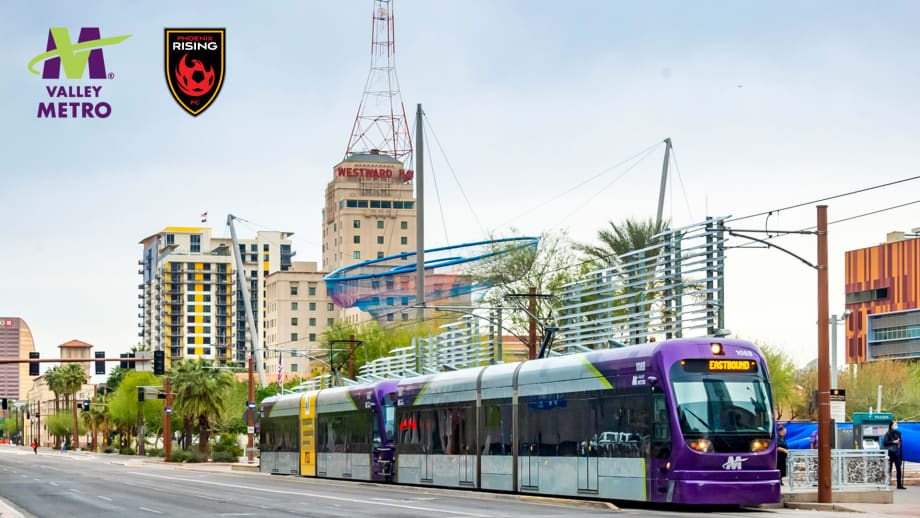
The partnership includes dedicated signage at the 38th St/ Washington station, located a few hundred feet from Rising’s stadium.
Photo: Valley Metro
3 min to read
Phoenix Rising FC announced fans can now use their tickets as their Valley Metro Rail fare when traveling by rail to the 38th St/Washington station on matchdays.
The partnership features branding initiatives, including dedicated signage at the 38th St/ Washington station, located a few hundred feet from Rising’s stadium.
Perfect Match
The opportunity to develop the partnership with Rising became natural due to the proximity of their new stadium to the 38th St/Washington light rail station, according to Hillary Foose, director of communications and strategic initiatives at Valley Metro.
“Valley Metro Rail has had a successful ticket partnership, called RailRide, with the Footprint Center in downtown Phoenix since 2009,” Foose said. “Footprint Center, which is located next to a light rail station, is a multi-purpose arena home to the Phoenix Suns, Phoenix Mercury, and many other sporting events and concerts. The RailRide partnership has served as a model for other sports and transit partnerships around the country.”
Foose added that this partnership model can be applied to professional teams located in an arena or stadium in close proximity to the transit system.
Homefield Advantage
Valley Metro and Rising outlined the benefits of this partnership, highlighting how fans of the club are the biggest winners.
Rising fans can ride Valley Metro Rail, with their fare covered, at any of the 35 stations across the Valley, leaving any worries about traffic and parking behind, according to Valley Metro.
“The benefits for the arena or sports team are primarily an incentive for their fans to use transit and reduce parking needs and traffic congestion,” Foose said. “It also provides a safe and enjoyable travel experience to and from the events. For the fans, it can save money and time and offers a fun, convenient way to get to their destination without needing to purchase fare.”
For Valley Metro, the program will attract new riders to the system, incorporate transit into the overall fan experience, connect the agency with community institutions, and provide guaranteed revenue and streamlined boarding.
“One of the biggest advantages of the club being in central Phoenix is the access our fans now have to the Valley Metro Station at 38th St/Washington,” said Bobby Dulle, Rising president. “Both downtown Phoenix and Mill Avenue are just five stops away from the stadium. Partnering with Valley Metro to provide safe transportation to and from our matches is a win for us and the neighborhood. I can’t wait to see our fans enjoy the local businesses and watch the local community grow.”
Match tickets will double as valid light-rail fare on the day of the event four hours prior to the start of the event, through the end of the transit day.
At the end of the day, Valley Metro and Rising aim for the best gameday experience for riders and fans.
“This type of partnership makes it possible for families to enjoy going together to events,” Foose said. “Riding the train is exciting for youth and the journey becomes part of the overall experience. We look forward to the Phoenix Rising FC season opener on April 1 and seeing how their fans can so easily access the matches and then conveniently travel to and from bars and dining establishments in Phoenix, Tempe, and Mesa.”
More Management

METRO Opens Submissions for 2026 Motorcoach Awards
Nominations are now being accepted for METRO Magazine’s Operator of the Year and Innovative Operator of the Year awards.
Read More →
New York MTA Advances Final Contract for Second Avenue Subway Expansion
Contract Four is the largest in the Second Avenue Subway Phase 2 project and includes construction of station infrastructure, tracks, and signals for the subway expansion, MTA officials said. Work on Contract Four will begin in 2027.
Read More →
Transit Agencies Highlight Safety Gains at National Summit
Leaders from 15 major transit systems shared crime-reduction results and safety initiatives while discussing the role of continued federal support.
Read More →

NITA Names New Leadership, Expands Reduced-Fare Program at First Board Meeting
The new regional transit authority appointed its first board chair and interim executive director while extending reduced fares across CTA, Metra, and Pace for eligible riders.
Read More →
Beyond the Checklist: A Structured Approach to Transit Maintenance
Reliability-Centered Maintenance helps transit agencies move beyond routine checklists to focus limited resources on the assets and failures that have the greatest impact on safety, reliability, and service.
Read More →
APTA 2026 Nominating Committee Selects Leadership Slate, Names Chair and Vice Chair Nominees
Leadership changes will help shape the association’s priorities and its representation of the transportation industry during the 2026–2027 term.
Read More →
DART Launches Major Security, Fare Enforcement Initiative
The 90-day demonstration will deploy coordinated security teams at five light rail stations while testing controlled access and gathering data to guide future investments.
Read More →
Sponsored•September 9, 2026
Advancing Fare Collection Through Technology and Innovation
Learn about delivering 1300 gates at 91 stations while managing fare evasion. Explore the large scale deployment, solution customization and real-world results that affect the region. Prepare for deployment in your region now.
Read More →
Game Day in Motion: Moving Millions During the 2026 World Cup
Between packed transit stations and team motorcoaches, see how agencies and operators across North America tackled the transportation demands of the 2026 FIFA World Cup.
Read More →
Surface Transportation Extension Averts Shutdown, Leaves Transit Funding Gap
The stopgap keeps federal transportation programs moving, but missing advance funding could complicate the transit and rail projects agencies are planning next.
Read More →