



Md. MTA Revises Opening Date for Purple Light Rail Line
The schedule change reflects delays in completion of utility relocation activities, the challenges and complexities of completing construction in a dense urban environment with significant pedestrian and vehicular traffic, and more.

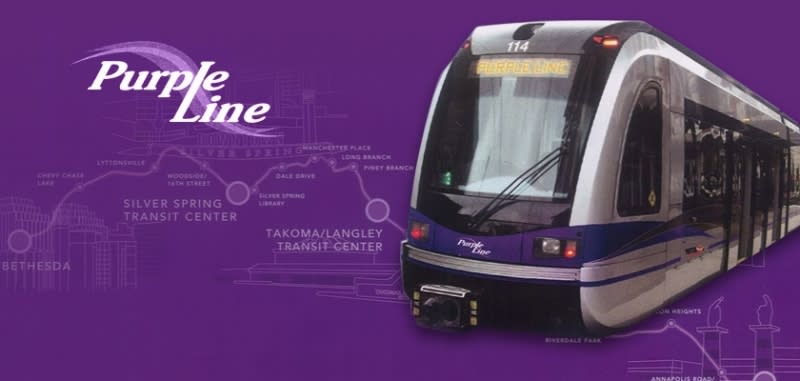
The Purple Line project’s history includes two highly uncommon events: a set aside, and later reinstatement, of a key federal government environmental approval in 2016 and the replacement of the design-build contractor in 2022.
Photo: MTA MDOT
The Maryland Department of TransportationMaryland Transit Administration and Purple Line Transit Partners are seeking Board of Public Works approval of a modification to the Purple Line Public-Private Partnership Agreement that extends the contractual deadline for achieving Revenue Service Availability to Spring 2027.
“Updating the schedule to reflect the challenges we are facing on the project is an important step in accountability and delivering a project that the region can be proud of,” said Maryland Transit Administrator Holly Arnold. “We are thankful to our partners and the community for their support and patience as we work to complete the Purple Line.”
New Schedule
The schedule change reflects delays in completion of utility relocation activities, the challenges and complexities of completing construction in a dense urban environment with significant pedestrian and vehicular traffic, the ongoing national workforce and supply chain issues, and the unique history of the Purple Line Light Rail Project.
The project’s history includes two highly uncommon events: a set aside, and later reinstatement, of a key federal government environmental approval in 2016 and the replacement of the design-build contractor in 2022. The new design-build contractor faced unexpected conditions as some construction sites that sat dormant for nearly two years were reopened.
“We understand the impacts that prolonged construction creates for the residents and businesses along the Purple Line alignment and will continue to minimize disruptions where possible,” said Ray Biggs, II, Purple Line project director. “We are also focused on improving collaboration with stakeholders and third parties to maximize the ability to advance the rate of construction. For example, this summer, the University of Maryland, College Park, agreed to a closure of Campus Drive and Union Lane to help expedite construction on campus by enabling the contractor to complete construction quicker than if they were working around vehicular traffic.”
Purple Line Progress
Work on the Purple Line continues to advance. The project is more than 50% complete, and construction is actively progressing along the entire alignment from New Carrollton to Bethesda at 60 active construction sites with approximately 700 workers.
A significant amount of construction activity currently underway, including utility relocation work and replacement and upgrading of storm drain systems, has less of an impact visually than building a station but is inherently critical to the completion of the overall project.
More recognizable activities underway include several Purple Line stations currently under construction, including Bethesda, Connecticut Ave, Lyttonsville, Manchester Place, Silver Spring, Silver Spring Library, Campus Drive UMD, Riverdale Park – North, and Glenridge; bridge and retaining wall construction, including completion of Talbot Avenue in Silver Spring; light rail track being laid at several locations, including Ellin Road, the Plymouth Tunnel, and Campus Drive at the University of Maryland; and vertical excavation (blasting) of a 130-foot shaft at the Bethesda station that will connect future Purple Line riders to the Washington Metropolitan Area Transit Authority Metro’s Red Line.
Additionally, work continues to prepare the Glenridge Operations and Maintenance Facility to start receiving light rail vehicles in early 2024.
Mitigating Further Delays
The Maryland Transit Administration and Purple Line Transit Partners collaborated over the last several months to identify and mitigate delays, where possible, and to reach agreement on an equitable resolution of project delays.
In addition to the extension of the project’s Revenue Service Availability deadline, the Maryland Transit Administration will provide net compensation to Purple Line Transit Partners of $148 million, including an increase of $205 million paid during the construction period, less a $57 million reduction to payments made during the operations and maintenance period. The compensation amount reflects the additional cost of continuing construction activities during the extended period. The agreement is subject to approval by the Board of Public Works and is scheduled for review July 19.
The Maryland Transit Administration and Purple Line Transit Partners meet weekly to review construction progress, anticipate potential schedule impacts, and develop mitigation strategies to reduce the risk of further delays. A project of this size and complexity will face many challenges that will require the project team to develop alternative solutions and strategies to mitigate cost and schedule impacts.
Mitigation strategies may include rescheduling certain work to run concurrently rather than sequentially, resequencing work activities, extending work hours, adding additional crews, revising maintenance of traffic plans, and ordering materials in advance to ensure timely delivery.
“Together with the Maryland Transit Administration and our design-build contractor, Maryland Transit Solutions, we’re doing everything in our power to identify innovative solutions to fast-track progress,” said Purple Line Transit Partners CEO Doran Bosso. “Purple Line Transit Partners values the partnership we have with the Maryland Transit Administration to deliver this important project to the citizens of Maryland, and we strive to be good neighbors to the communities impacted by construction.”
Moving Ahead
Purple Line Transit Partners is developing a grant program to support community initiatives and to provide tangible resources to organizations in Prince George’s and Montgomery counties that work to improve the lives of local residents. The community grant program will be in addition to grants available through a partnership with the Maryland Department of Commerce and Montgomery and Prince George’s counties to local businesses negatively affected through revenue loss by the construction of the Purple Line.
The Purple Line is a critical infrastructure project that will expand transit opportunities between Prince George’s and Montgomery counties, two of the most populated counties in the state. The 16.2-mile, 21-station light rail line will offer convenient east-west transit access for jobs, school, shopping, and recreation and will provide connections across the region with links to five branches of Washington Metropolitan Area Transit Authority’s Metrorail, three MARC commuter rail lines, Amtrak, and a host of regional and local bus services.
The project will relieve vehicle traffic in the National Capital region — one of the most congested areas of the country — and will spur economic growth through community revitalization and job creation. Project construction supports more than 6,000 jobs, with a goal of 26% for design services going to small and minority-owned businesses and 22% for construction going to small and minority-owned businesses.
In addition, the Maryland Department of Transportation, Montgomery and Prince George’s counties, and private developers are actively expanding opportunities for Marylanders through transit-oriented development and economic development activities along the Purple Line corridor.
More Rail
Amtrak, CN Reach Agreements to Strengthen Passenger Rail Service, Safety
The agreement resolves a more than decade-long proceeding before the Surface Transportation Board concerning the terms and conditions for Amtrak services, such as the City of New Orleans, Illini/Saluki, and Wolverine.
Read More →
New York MTA Advances Final Contract for Second Avenue Subway Expansion
Contract Four is the largest in the Second Avenue Subway Phase 2 project and includes construction of station infrastructure, tracks, and signals for the subway expansion, MTA officials said. Work on Contract Four will begin in 2027.
Read More →
San Diego MTS Breaks Monthly Trolley Ridership Record
Agency officials said July’s ridership indicates MTS’s continued recovery from the pandemic.
Read More →
Report Examines NJ TRANSIT Reliability, Funding Challenges
The Garden State Initiative analysis examines the roles of Amtrak infrastructure, fleet management, and agency operations while recommending a more performance-based approach to improving reliability.
Read More →
Stadler, CapMetro Sign Long-Term Rail Fleet Support Agreement
Beginning in 2027, Stadler will provide on-site technical expertise, spare parts support, training, and obsolescence management to help extend the reliability and longevity of CapMetro’s GTW fleet.
Read More →
Biz Briefs: Alstom Lands Canadian Contract, LYT to Supply California TSP, and More
In METRO's latest installment, we take a look at recent news from Complete Coach Works, Beep, FlixBus, and more partnerships making headlines across the transportation sector.
Read More →
CATS Gold Line Marks 5 Years of Service, 2.8M Passenger Trips
With a six-mile expansion planned, the Charlotte streetcar is positioned to connect more neighborhoods and major transit hubs across the region.
Read More →
Why Simulating Pedestrian Movement Has Become Essential for Modern Rail Stations
Pedestrian microsimulation is helping rail planners identify bottlenecks, test station designs, and prepare complex transit hubs for growing passenger volumes.
Read More →
Amtrak Begins Major Construction at New York’s Sunnyside Yard
The new maintenance facility will support Amtrak’s Airo trainsets while improving maintenance efficiency and turnaround times in New York.
Read More →
Chicago Leaders Unveil Plans for O’Hare Airport Express Train
The privately developed project would offer a 15-minute trip between downtown and O’Hare’s Terminal 2, with trains operating every 15 minutes on a dedicated track. The service would use battery-electric trains and three existing freight rail rights-of-way.
Read More →