Equity, Technology Drive Link21’s Public Engagement Campaign
Public engagement is critical to Link21’s success. When projects omit this early engagement, they risk encountering opposition that can slow work and increase costs, as well as creating a project that could harm communities.
by Sadie Graham and Nicole Franklin
May 12, 2023
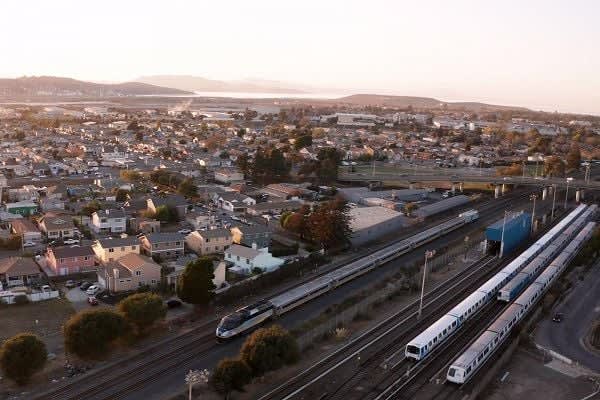
The Link21 program, formerly known as the New Transbay Rail Crossing, will connect BART and regional rail while also improving access to jobs and affordable housing in the region.
Photo: Link21
7 min to read
The Northern California Megaregion — consisting of the 21 counties in the San Francisco Bay area, Sacramento area, Monterey Bay area, and Northern San Joaquin Valley — is home to 12.7 million people, more than 30% of California’s population.
A historically strong technology sector, in addition to agriculture, health services, education, and government, make the megaregion a center of innovation, creativity, and growth. By 2050, the population is forecast to grow to 14.9 million.
Ad Loading...
Public Transit Filling A Need
Growth and prosperity in the megaregion, however, have not been shared fairly by all. Even though megaregional GDP continues to rise, incomes for many have not increased enough to keep pace with the escalating cost of living, particularly housing costs. Road and freeway congestion is also among the nation’s worst.
Though rail service provided by the San Francisco Bay Area Rapid Transit District (BART) and numerous regional rail operators, such as Capitol Corridor, provide an alternative to crowded roadways, transit limitations in the Transbay corridor between Oakland and San Francisco prevent passenger rail from effectively meeting the megaregion’s growing needs.
The lack of increased reliable transportation choices undermines community stability and limits opportunities for residents and businesses for years to come.
To address this imminent need, BART and the Capitol Corridor Joint Powers Authority (CCJPA), which operates the Capitol Corridor intercity rail service across seven counties in the San Francisco Bay and Sacramento areas, partnered to advance the Link21 Program.
The program aims to transform the megaregion’s passenger rail network into an equitable, faster, safer, and more integrated system. The State of California, regional rail operators, and transportation planning and funding agencies serve as program partners.
Ad Loading...
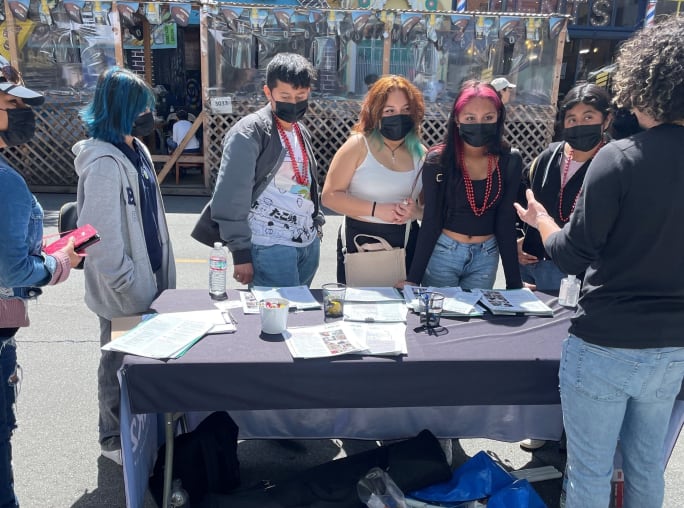
Link21 team members engaged with more than 100 community members at San Francisco’s annual Cesar Chavez Festival in August 2022.
Photo: Link21
Expanding the Look of Public Engagement
Public engagement is critical to Link21’s success. From the outset of work, the Link21 team recognized that early engagement in the program’s initial planning phase was essential for successful work. When projects omit this early engagement, they risk encountering opposition that can slow work and increase costs, as well as creating a project that could harm communities.
BART and CCJPA initiated community engagement at the earliest stages of the program. Efforts went beyond creating general awareness. Instead, the Link21 team carefully identified key foundational pieces of work, like the draft goals and objectives, that should be developed in partnership with communities. This allowed the Link21 team to develop a decision-making framework that is rooted in stated community needs and desires.
Commitment to Advancing Equity
As Link21 develops, the program team is emphasizing partnerships with communities that have been marginalized to ensure that their experiences and needs are reflected in the work.
This has included “co-creating” key elements of early Link21 work with members of these communities. In co-creation, the Link21 team partners with community-based organizations (CBOs) to host workshops with community members that are often excluded from the public participation process.
BART and CCJPA compensate both the CBO and participants for their time and lived expertise. Working with trusted local organizations and providing compensation help overcome barriers to participation. The Link21 team worked with a local equity advisor — Reflex Design Collective — to develop a successful co-creation platform.
Ad Loading...
Co-creation is designed to allow marginalized communities to directly influence key pieces of Link21's work. In three rounds of co-creation, the Link21 team has worked with more than 30 CBOs and 770 community members on topics such as the program’s goals and objectives, desired passenger rail improvements, and service goals and the identification of priority populations — Link21’s definition for the census tracts most impacted by inequity today.
The Link21 team aims to maintain long-term relationships with CBOs and community members by identifying additional points for co-creation as work advances.
In addition to the co-creation workshops, the Link21 team reached another 1,500 people from marginalized communities through demographically targeted polls and hundreds more through surveys. When COVID-19 retreated enough for safe in-person meetings, grassroots community meetings and events were added to outreach efforts.
The public engagement team is working to address and integrate the priorities cited during these listening efforts into the Link21 Program.
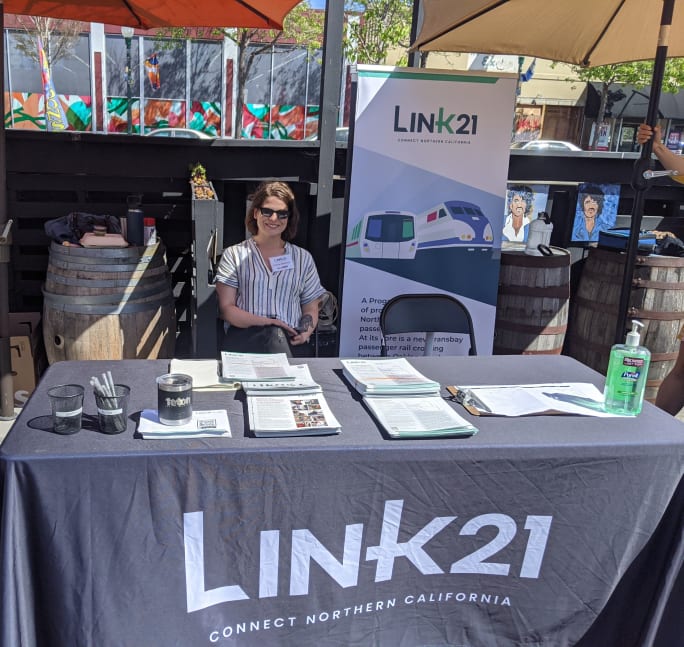
In April 2022, Link21’s table at the West End Mercantile in Alameda continued building awareness about the Program’s planning efforts.
Photo: Link21
Leveraging Technology for Broader Reach
Link21’s sheer geographic magnitude represents a daunting outreach challenge. Diversity of audience needs within the megaregion is a compounding factor.
Ad Loading...
One of the tools used to help the team better understand existing and future travel patterns and needs, a state-of-the-art megaregional market analysis, was used to gather and evaluate origin and destination data. This data helped determine where passenger rail improvements may have the greatest benefit and identify locations with the most potential to attract new travelers who would take the train if easy access to fast, frequent, direct, and uncrowded rail service were available.
Link21’s market analysis, the most comprehensive travel analysis ever performed for the megaregion, has been widely used by other megaregional agencies.
Overcoming COVID-19 Hurdles
The COVID-19 pandemic required innovative and creative uses of technology to reach more people safely and on their timelines. The team developed a comprehensive engagement and outreach plan that addressed the needs of its various audiences — from elected officials and public agencies to the general public, marginalized community members, and transportation partners.
Because of the large stakeholder base, the team included several members who had existing relationships in the various communities and had a good sense of the transportation challenges.
When public meetings, which traditionally had been held in-person, shifted to virtual formats, the Link21 team implemented strategies to make them as interactive as possible, offering online polls and providing real-time results, as well as live Q&A sessions.
Ad Loading...
Public meetings are recorded and posted on the Link21 website — along with transcriptions in English, Spanish, and traditional Chinese — the three languages available on the Link21 website. People can use the website to view information on their schedules and at their own pace while learning more about the program.
The Link21 team also is leveraging technology to advance equity and to manage and integrate the massive number of public comments collected through the Public Involvement Management Application (PIMA), a virtual platform for inclusive stakeholder and citizen engagement developed by HNTB. As people sign up for workshops or other meetings, many of which can be hosted through PIMA, the ZIP Codes they provide are charted in PIMA’s geographic information system (GIS).
The resulting maps allow outreach team members to pinpoint subregion-specific issues so they can swiftly address concerns. Outreach efforts can be further tailored or increased in areas where engagement may be lower than desired.
For the Link21 Program, HNTB added a discussion tracker tool, which maintains individualized records of interactions with stakeholders. When, for example, Link21 representatives meet with elected officials, partner agencies, CBOs, or members of the public, they can review all previous conversations to respond expressly to that audience’s earlier questions or issues of concern.
PIMA also allows the evolution of project-related concerns to be monitored over time. Members of the public can use a favorability meter to indicate their thoughts about the program. This allows the program to track public sentiment over the life of the project. Tracking conversations with stakeholders also helps meet relevant National Environmental Policy Act (NEPA) requirements.
Ad Loading...
Social media and digital advertising are additional components the team uses to communicate Link21 messaging and to engage an increasingly wide swath of communities that have been marginalized.
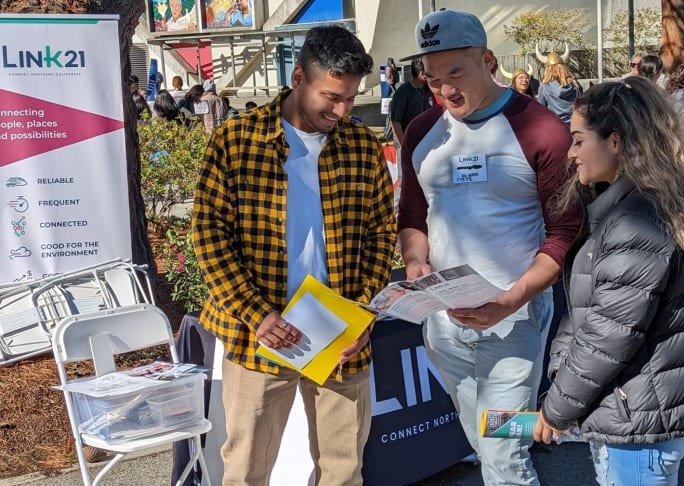
At San Francisco State University in November 2022, the Link21 team connected with more than 300 students to build project awareness and understand their travel needs.
Photo: Link21
Ongoing Measurements For Successful Public Engagement
To measure success, the Link21 team sets goals for attendance and interactions at virtual and in-person events, monitors the use of key messaging in articles written about the program, reviews website and social media analytics, and, most importantly, tracks engagement and input from priority populations.
These measurements ensure that Link21 is creating understanding among target audiences so the project can garner informed feedback. Data from tools used in public engagement efforts inform decision-making and future outreach efforts.
To date, Link21’s public engagement efforts have touched more than 7,000 stakeholders, including thousands within priority populations and representatives of more than 3,000 organizations. Outreach team members are cognizant of other agencies’ needs, as well, and maintain an attitude not of competition but of mutual uplift.
Deep investment in broad and equitable outreach in the pre-planning and planning phases elevates the potential for Link21 to avoid project delivery delays, realize equitable outcomes, and achieve the goal of creating an integrated passenger rail network in Northern California.
Ad Loading...
About the Author: Sadie Graham is Director and Nicole Franklin is the Engagement & Outreach Manager for Link21, San Francisco Bay Area Rapid Transit District
The new microtransit zone connects residents to key destinations as Charlotte Area Transit System rolls out the first phase of its 2055 Transit System Plan.
San Antonio's VIA Metropolitan Transit reported the highest bus ridership growth among major Texas transit systems. Federal Transit Administration data ranked it second among the nation's 50 largest transit systems.
Developed with support from the Standards Council of Canada, CSA D700 guides assessing climate-related risks and planning adaptation measures for transit and passenger rail systems.
ETA founder and CEO John Maglio explores the evolution of transit technology, the importance of reliable systems, and how stronger partnerships can help agencies improve operations and the passenger experience.
The new plan outlines improvements to service reliability, accessibility, communication, and the overall rider experience across Central Ohio's transit system.
Innovations in autonomous and zero-emission transportation, standout transit systems, and industry leadership took center stage among this year's honorees.
Transit leaders, manufacturers, and industry professionals gathered in Chicago to explore new technologies, share ideas, and discuss the future of public transportation.