



New York Gov. Announces Statewide Cybersecurity Strategy
The Strategy articulates, for the first time, a set of high-level objectives for cybersecurity and resilience across New York.

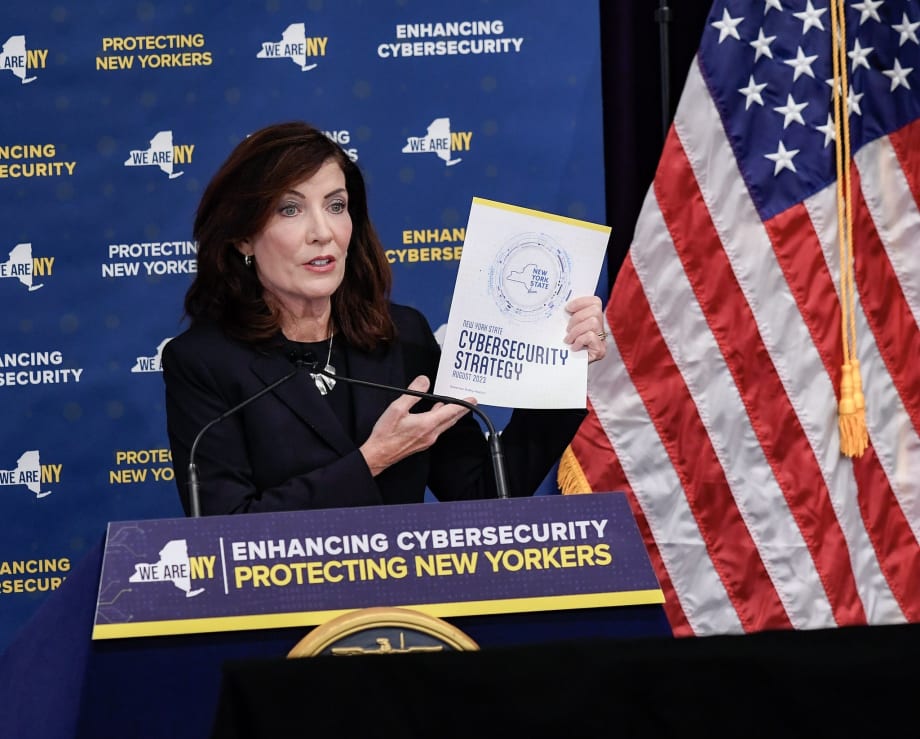
New York State’s cybersecurity strategy provides public and private stakeholders with a roadmap for cyber risk mitigation and outlines a plan to protect critical infrastructure, networks, data, and technology systems.
Photo: Marc Hermann
New York Gov. Kathy Hochul announced the first-ever statewide cybersecurity strategy aimed at protecting the State’s digital infrastructure from today’s cyber threats.
The Strategy articulates, for the first time, a set of high-level objectives for cybersecurity and resilience across New York. It clarifies agency roles and responsibilities, outlines how existing and planned initiatives and investments knit together into a unified approach, and reiterates the State's commitment to providing services, advice, and assistance to county and local governments.
New York State’s cybersecurity strategy provides public and private stakeholders with a roadmap for cyber risk mitigation and outlines a plan to protect critical infrastructure, networks, data, and technology systems.
"Our interconnected world demands an interconnected defense leveraging every resource available," Gov. Hochul said. "This strategy sets forth a nation-leading blueprint to ensure New York State stands ready and resilient in the face of cyber threats."
New York’s Strategy
The strategy unifies New York’s cybersecurity services to safeguard critical infrastructure, personal information, and digital assets from malicious actors. It also provides a framework to align the actions and resources of both private and public stakeholders, including county and other local governments.
New York's cybersecurity strategy is not just about protecting our digital assets. It is about ensuring the safety and security of all New Yorkers and maintaining the ability to function and thrive in the digital age. This strategy highlights the Governor's commitment to cybersecurity, not just for State Government systems but for New Yorkers everywhere, as a core responsibility of the State.
The Announcement
Gov. Hochul announced her commitment to bolster New York State’s centralized cybersecurity during this year’s State of the State address. The historic $90 million investment for cybersecurity included in the Fiscal Year 2024 Budget made $30 million in shared services funding available to assist local governments in strengthening their own defenses against cyber threats.
The initiative signaled a new and stronger collaboration between the state and its local governments on this critical and evolving issue. A part of this strategy includes providing $500 million to enhance New York State’s healthcare information technology and primarily cybersecurity infrastructure, as well as $7.4 million to expand the New York State Police’s Cyber Analysis Unit, Computer Crimes Unit, and Internet Crimes Against Children Center.
The state’s comprehensive cybersecurity strategy is defined by three central principles:
Unification
Resilience
Preparedness
When taken together, New York State can lean on these tenets to present a unified and more resilient defense against new and more sophisticated cyber threats; preventing the vast majority of attacks but also isolating, controlling, and mitigating potential threats; and preparing, adapting, and always being ready for the cyber challenges of the future. The strategy offers a blueprint for cybersecurity stakeholders across New York, from State agencies to local governments, to understand how they fit into a larger plan. The blueprint provides objectives, lines of effort, and a commitment from the Governor that they can use when doing future planning and program design.
Gov. Hochul also signed legislation to expand New York's technology talent pool and provide funding to help ensure that New York-based employers are able to hire and retain necessary cybersecurity personnel. She acknowledged the importance of strengthening this sector during the announcement, which was attended by recent graduates of the MTA’s Operational Technology Cybersecurity Program.
More Security and Safety

Transit Agencies Highlight Safety Gains at National Summit
Leaders from 15 major transit systems shared crime-reduction results and safety initiatives while discussing the role of continued federal support.
Read More →
DART Launches Major Security, Fare Enforcement Initiative
The 90-day demonstration will deploy coordinated security teams at five light rail stations while testing controlled access and gathering data to guide future investments.
Read More →
RTD Launches NextRide App to Consolidate Trip Planning, Fares, Security Reporting
The app expands on RTD’s existing NextRide web application and allows customers to view real-time vehicle locations and service alerts, purchase and store digital fares, and access customer support.
Read More →

TAPTCO Updates OSHA Compliance Training for Transit Maintenance Operations
The revamped program addresses 26 OSHA standards for maintenance facilities, with TAPTCO pointing to training, documentation, and everyday shop hazards as continuing challenges for transit operations.
Read More →
How VaporVision Adds Value to Transit Door Systems
Wabtec engineers explain how the system improves doorway detection, strengthens diagnostics and gives transit agencies and OEMs greater operating flexibility.
Read More →
FRA Announces $5.3B in Rail Investments, Including $2B for Amtrak
Funding will support grade-crossing improvements, infrastructure upgrades, and new Amtrak equipment in 23 states.
Read More →
Chicago, Maryland Expand Non-Law-Enforcement Safety, Rider Support
The CTA and MTA are launching new programs aimed at de-escalation, crisis response, rider assistance, and greater transparency.
Read More →
LA Metro, City of West Hollywood, and Partners Advance Smarter Bus Lane Enforcement
The award-winning partnership combines AI-powered detection with human oversight to improve bus reliability, accessibility, and enforcement efficiency.
Read More →
LA Metro Reports 57% Decline in Homelessness on Transit System Since 2024
The agency's latest homelessness count offers new data on how care-based services and cross-sector partnerships can complement traditional transit security strategies.
Read More →
FTA Launches 'Transit Moves America' Dashboard to Highlight Agency Safety and Performance
The online dashboard transforms National Transit Database information into a public-facing resource that allows users to compare transit agencies on key operational and safety metrics.
Read More →