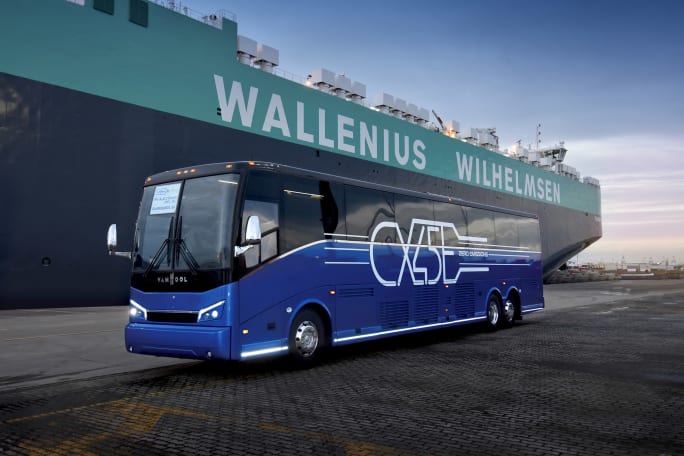
In the latest look at what's going on in the transit and motorcoach industries, METRO features the latest news from Cubic, The Routing Company, Alexander Dennis, and Van Hool.
The Enviro100EV “big small bus” and Enviro400EV “crowd-shifter” have a future-proof battery system designed to maximize use before battery replacement becomes necessary.
Photo: Alexander Dennis/METRO Magazine
3 min to read
Alexander Dennis Ups Warrantable Energy on Battery Supply
Alexander Dennis is driving value through longevity with battery supply partner Impact Clean Power Technology by increasing the warrantable energy throughput of its next-generation electric buses.
The Enviro100EV “big small bus” and Enviro400EV “crowd-shifter” have a future-proof battery system designed to maximize use before battery replacement becomes necessary. Drawing on the versatility of NMC cell chemistry, the company has increased the longevity and value offered to operators of its next-generation electric buses, which improves the already class-leading warrantable energy throughput to a massive 1.6GWh over eight years for the Enviro400EV with 472kWh battery, or 1.2GWh with 354kWh battery.
Ad Loading...
On the Enviro100EV, an energy throughput of 1.2GWh can be warranted when the bus is fitted with the larger 354kWh battery system, or 800,000kWh for the 236kWh battery option.
TRC Unveils New Tool for Dispatchers
The Routing Company (TRC) is launching The Hub — a single interface providing a comprehensive operational overview and management for dispatchers.
The Hub™, a project led by TRC Software Engineer Neal Stanard, is located in the Pingo Dashboard and allows users to see all elements — shifts, vehicles, drivers, and trips — in one place. It is a departure from industry standard, which requires users to manage operations from different pages and thus reduces valuable local context.
With operational overview provided in one place, The Hub™ gives users the context they need, where and when they need it, ultimately helping them understand how all elements work together to make the best service decisions.
Van Hool said with the closure, its B&C (Bus & Coach) division would keep its knowledge center, research & development, prototype building, and after-sales in Koningshooikt, which is located in Northern Macedonia.
Photo: Van Hool
Van Hool Moves All Bus, Coach Production to Macedonia
Van Hool presented the outlines of its Van Hool Recovery Plan to employee representatives at a special works council. The company expressed its intention to strategically refocus its activities toward market segments where customers consciously choose the high quality of Van Hool products.
Ad Loading...
The implementation of the Van Hool Recovery Plan is designed to enable a sustainable future under its own steam for the company. As part of the plan, in the period 2024-2027, Van Hool will implement a necessary restructuring at the Koningshooikt, Belgium site, which will result in the departure of about 1,100 employees.
Van Hool said with the closure, its B&C (Bus & Coach) division would keep its knowledge center, research & development, prototype building, and after-sales in Koningshooikt, which is located in Northern Macedonia.
Cubic Introduces Handheld Reader for Umo Product
Cubic Transportation Systems (CTS) released its innovative Umo Handheld Reader, pairing CTS’s software application with Samsung’s commercial, off-the-shelf device for easy and seamless electronic fare collection on buses, trains, and more.
The Umo Handheld Reader is a welcome addition to Cubic’s cloud-based Umo platform, which is designed to enhance how riders experience and pay for public transportation. Additional benefits of the Umo Handheld Reader include its accessibility for smaller transit operations with limited budgets, providing seamless integration into their existing services while expanding to new vehicles or shuttles for paratransit and on-demand transport services.
Additionally, as transit agencies’ networks evolve and new vehicles are added, the Umo solution can adapt and expand rapidly, meeting changing demands. Finally, with 5G LTE support built-in, the reader offers high-speed connectivity, facilitating efficient and speedy data transfers.
The agency is seeking manufacturers for 650 new CNG buses to replace aging vehicles, improve reliability, and advance its broader fleet modernization strategy.
John Hroncich discusses BAE Systems’ modular and scalable approach, lessons learned from decades of real-world operations, and how agencies can identify electrification strategies that fit their fleets.
LA Metro’s Obed Mejia discusses technician training, evolving maintenance technology, fleet replacement, and strategies for getting the most out of today’s transit fleets.
In METRO's latest installment, we take a look at recent news from Siemens, Prevost, Dodge, and more partnerships making headlines across the transportation sector.
In this edition, we also cover recent appointments and announcements at Pace, CamTran, MCI, and more, showcasing the individuals helping to shape the future of transportation.
Transit leaders and policymakers examine how standardized bus designs, streamlined procurement, and predictable funding could help agencies stretch budgets and deliver better service.
As chair of APTA’s Business Members Board of Governors, Ray Melleady explains how more than 850 business members are partnering with transit agencies to advance funding, innovation, and industry-wide collaboration.
Bus Business Consultants founder Brian Dickson shares lessons on leadership, organizational health, and creating options for long-term success in a changing transportation industry.
The award-winning partnership combines AI-powered detection with human oversight to improve bus reliability, accessibility, and enforcement efficiency.