



New York MTA Approves Central Business District Toll Rates
The approved toll rates align with rates recommended by the Traffic Mobility Review Board on Nov. 30, and put forward for public review by the MTA Board on Dec. 6, with a handful of clarifications provided.

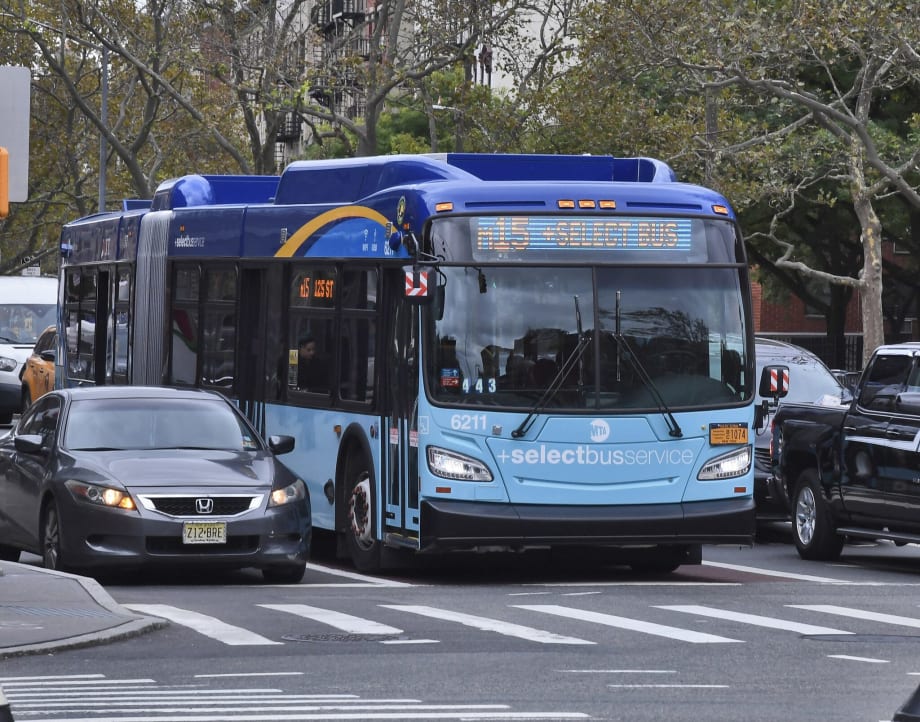
Trucks and some buses will be charged a toll of $24 or $36 during the day to enter the congestion relief zone in Manhattan below 60th Street, depending on their size and function, and $6 or $9 at night.
Photo: MTA/Marc A. Hermann
Following a robust public comment period in which the agency received 25,600 written comments and heard from 386 speakers at four public hearings, The New York Metropolitan Transportation Authority (MTA) board, in its capacity as the board of the Triborough Bridge and Tunnel Authority, approved Central Business District toll rates by a vote of 11 to 1.
The approved toll rates align with rates recommended by the Traffic Mobility Review Board on Nov. 30, and put forward for public review by the MTA Board on Dec. 6, with a handful of clarifications provided.
Central Business District Tolling Rates
Passenger vehicles and small commercial vehicles — sedans, SUVs, pick-up trucks, and small vans — paying with a valid E-ZPass will be charged $15 during the day and $3.75 at night, when there is less congestion, to enter the congestion relief zone in Manhattan below 60th Street. They will be charged no more than once a day.
“Today’s vote is one of the most significant the board has ever undertaken, and the MTA is ready,” said MTA Chair/CEO Janno Lieber. “In advance of day one of tolling, we’ve increased service on 12 subway lines, advanced redesigns of the entire NYC bus network, and implemented the largest service increase in LIRR history. And there’s more to come with the funds raised from congestion pricing — more accessible stations, modernized subway signals, and new expansion projects like Phase 2 of the Second Avenue Subway and Metro-North Penn Station Access.”
Tolling Fees, Exemptions
Trucks and some buses will be charged a toll of $24 or $36 during the day to enter the congestion relief zone in Manhattan below 60th Street, depending on their size and function, and $6 or $9 at night. Yellow taxi, green cab and black car passengers will pay a $1.25 toll for every trip to, from, within or through the zone; customers of app-based for-hire vehicles will pay $2.50.
As previously proposed, qualifying authorized emergency vehicles and qualifying vehicles carrying people with disabilities will be exempt. As will school buses contracted with the NYC Department of Education, buses providing scheduled commuter services open to the public, commuter vans licensed with the NYC Taxi and Limousine Commission, and specialized government vehicles.
As previously proposed, a 50% discount will be available for low-income vehicle owners and a tax credit is available for low-income residents of the Central Business District.
More Management

LIT Marks 10-Year Milestone at Annual Summit
Hosted by the COTA from September 10 to 13, the Summit carried the theme “Celebrating 10 Years of Excellence, Leadership, and Impact,” with every part of the program honoring the people, agencies, and partners who built LIT over its first decade.
Read More →
People Movement: Dan Dipert Coaches Adds Third-Generation Leader, Keolis Names New Valley Metro VP/GM, and More
In this edition, we also cover recent appointments and announcements at the Wabtec, SilverRide, HNTB, and more, showcasing the individuals helping to shape the future of transportation.
Read More →
METRO Opens Submissions for 2026 Motorcoach Awards
Nominations are now being accepted for METRO Magazine’s Operator of the Year and Innovative Operator of the Year awards.
Read More →

New York MTA Advances Final Contract for Second Avenue Subway Expansion
Contract Four is the largest in the Second Avenue Subway Phase 2 project and includes construction of station infrastructure, tracks, and signals for the subway expansion, MTA officials said. Work on Contract Four will begin in 2027.
Read More →
Transit Agencies Highlight Safety Gains at National Summit
Leaders from 15 major transit systems shared crime-reduction results and safety initiatives while discussing the role of continued federal support.
Read More →
NITA Names New Leadership, Expands Reduced-Fare Program at First Board Meeting
The new regional transit authority appointed its first board chair and interim executive director while extending reduced fares across CTA, Metra, and Pace for eligible riders.
Read More →
Beyond the Checklist: A Structured Approach to Transit Maintenance
Reliability-Centered Maintenance helps transit agencies move beyond routine checklists to focus limited resources on the assets and failures that have the greatest impact on safety, reliability, and service.
Read More →
APTA 2026 Nominating Committee Selects Leadership Slate, Names Chair and Vice Chair Nominees
Leadership changes will help shape the association’s priorities and its representation of the transportation industry during the 2026–2027 term.
Read More →
DART Launches Major Security, Fare Enforcement Initiative
The 90-day demonstration will deploy coordinated security teams at five light rail stations while testing controlled access and gathering data to guide future investments.
Read More →
Advancing Fare Collection Through Technology and Innovation
Learn about delivering 1300 gates at 91 stations while managing fare evasion. Explore the large scale deployment, solution customization and real-world results that affect the region. Prepare for deployment in your region now.
Read More →