



Massachusetts Lands $102M in Federal Grants
The funding will benefit projects in communities across the state, including Longmeadow, Adams, North Adams, Williamstown, Pittsfield, Southbridge, Quincy, Boston, Somerville, and Revere.

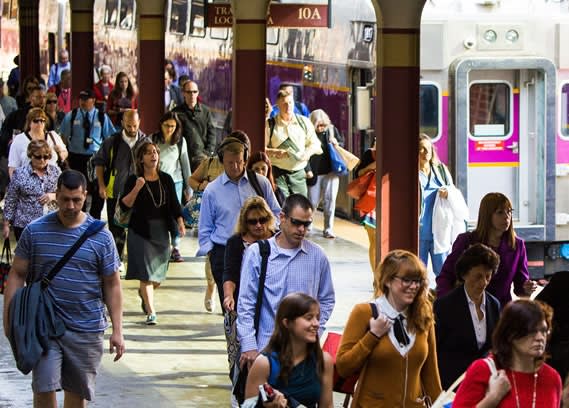
The Healey-Driscoll Administration has secured more than $9 billion in federal funding grants since taking office.
Photo: MBTA
The Healey-Driscoll Administration and Massachusetts Congressional Delegation are celebrating that Massachusetts has won more than $102 million for transportation infrastructure projects under federal funding programs from the U.S. Department of Transportation.
The funding will benefit projects in communities across the state, including Longmeadow, Adams, North Adams, Williamstown, Pittsfield, Southbridge, Quincy, Boston, Somerville, and Revere.
Federal Funding Plans
Several grant awards have a statewide impact, including a $14.4 million grant from the Charging and Fueling Infrastructure (CFI) Program to deploy Electric Vehicle (EV) charging infrastructure at state-owned Park and Ride properties and Massachusetts Bay Transportation Authority (MBTA) station parking lots.
Other awards include $17.3 million for the Ashuwillticook Trail in Berkshire County, which will fund planning and design of a nearly 10-mile pedestrian and cyclist path, and $2 million to reconnect neighborhoods at Boston’s Mattapan Square.
“Massachusetts continues to bring home major federal dollars to make our roads, bridges, paths and rails more safe, reliable, and connected,” said Gov. Healey. “We’re so proud of MassDOT, the MBTA and municipalities across the state who put forward strong applications and won, often with the help of our team at the Office of Federal Funds and Infrastructure. I’m grateful to the Biden-Harris Administration for their continued investment in transportation infrastructure across Massachusetts, as well as to our amazing Congressional delegation for their partnership.”
Grants Awarded
The federal grant awards being announced total more than $102 million dollars and include the following:
More than $43 million for the McGrath Boulevard Project in Somerville, which will reconnect neighborhoods bifurcated by McGrath Highway by replacing the viaduct with new street-level bike and pedestrian infrastructure, providing safe access to schools, jobs, parks, businesses, and other critical destinations.
More than $17 million to support expansion of the Ashuwillticook Trail in Berkshire County by funding the design of a five component, nearly 10-mile off-road shared use path. This path will connect residents and visitors to an array of cultural and community assets in North Adams, Adams, and Williamstown, a network of public hiking trails in the surrounding forestlands, recreation opportunities along the Hoosic River, and the regional shared use paths to the north and south.
More than $14.4 million from the Charging and Fueling Infrastructure Discretionary Grant Program for MassDOT and the MBTA to install approximately 458 Level 2 charging ports and 14 Level 3 charging points at approximately 30 locations across Massachusetts. The chargers will be installed at the state’s Park and Ride properties and MBTA station parking lots.
More than $10 million for the City of Quincy for the Southern Artery, (Route 3-A) Multi-Modal Transportation Project, an initiative to make Complete Streets improvements to approximately 0.5 miles of the Southern Artery from Sea Street/Coddington Street to Pond Street.
Almost $7.9 million for Southbridge for the Hamilton Street Transportation Project to fund the construction of Complete Streets improvements along approximately 0.8 miles of Hamilton Street from Main Street to Hook Street.
More than $4 million for the MBTA’s High-Risk Grade Crossing Elimination Master Plan initiative, which will have the MBTA evaluate 52 high-risk, high-priority pedestrian and roadway grade crossings throughout the greater Boston regional rail network.
Approximately $2 million to the City of Boston to reconnect two long-separated sides of the neighborhood of Mattapan, connecting them to natural resources, and to multimodal transportation networks.
Approximately $2 million to the MBTA for the JFK/UMASS Station Redesign & Replacement Project, which will bring the station into a state of good repair, increase accessibility, enhance environmental resiliency, and improve connectivity to Boston’s Dorchester neighborhood.
Approximately $1.6 million for Pittsfield to create a comprehensive plan to remove an arterial interchange in the community which splinters the west side from downtown and restore the urban fabric in the municipality.
Approximately $1.2 million for Longmeadow’s Passive Crossing Improvement Project, which supports grade crossing related improvements on Amtrak-owned infrastructure.
Approximately $400,000 to Revere for its Walking to Wonderland Study, an initiative to create paved multi-use paths that connect residents to local educational and workforce development opportunities, eliminating the east/west pedestrian and bicycle barriers created by high-speed highways and commuter
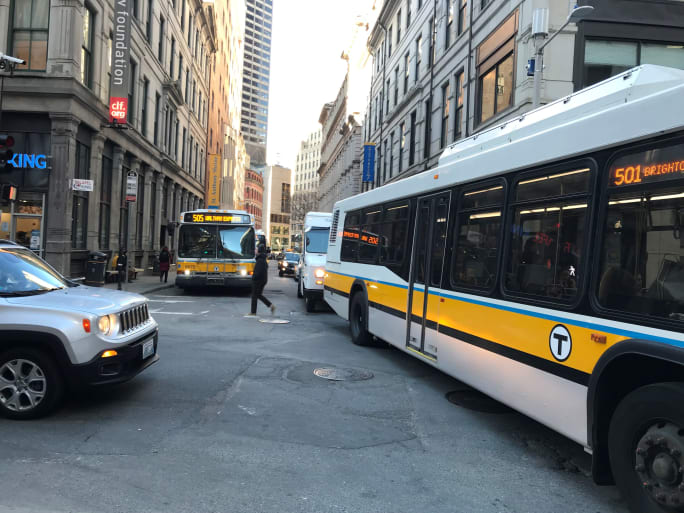
Several grant awards have a statewide impact.
Photo: METRO
Continuing to Fund Transit and More
The Healey-Driscoll Administration has secured more than $9 billion in federal funding grants since taking office.
Federal funding grant awards won by Massachusetts have included more than $1.72 billion to replace the Cape Cod Bridges, $472 million for the MBTA’s North Station Draw One Bridge Replacement Project, $335.4 million to advance the design and construction of the I-90 Allston Multimodal Project, $145 million award towards West-East rail, $249.4 million for the MBTA in discretionary grant funding, and a $116 million grant for the MBTA’s purchase of battery-electric buses.
More Management

METRO Opens Submissions for 2026 Motorcoach Awards
Nominations are now being accepted for METRO Magazine’s Operator of the Year and Innovative Operator of the Year awards.
Read More →
New York MTA Advances Final Contract for Second Avenue Subway Expansion
Contract Four is the largest in the Second Avenue Subway Phase 2 project and includes construction of station infrastructure, tracks, and signals for the subway expansion, MTA officials said. Work on Contract Four will begin in 2027.
Read More →
Transit Agencies Highlight Safety Gains at National Summit
Leaders from 15 major transit systems shared crime-reduction results and safety initiatives while discussing the role of continued federal support.
Read More →

NITA Names New Leadership, Expands Reduced-Fare Program at First Board Meeting
The new regional transit authority appointed its first board chair and interim executive director while extending reduced fares across CTA, Metra, and Pace for eligible riders.
Read More →
Beyond the Checklist: A Structured Approach to Transit Maintenance
Reliability-Centered Maintenance helps transit agencies move beyond routine checklists to focus limited resources on the assets and failures that have the greatest impact on safety, reliability, and service.
Read More →
APTA 2026 Nominating Committee Selects Leadership Slate, Names Chair and Vice Chair Nominees
Leadership changes will help shape the association’s priorities and its representation of the transportation industry during the 2026–2027 term.
Read More →
DART Launches Major Security, Fare Enforcement Initiative
The 90-day demonstration will deploy coordinated security teams at five light rail stations while testing controlled access and gathering data to guide future investments.
Read More →
Advancing Fare Collection Through Technology and Innovation
Learn about delivering 1300 gates at 91 stations while managing fare evasion. Explore the large scale deployment, solution customization and real-world results that affect the region. Prepare for deployment in your region now.
Read More →
Game Day in Motion: Moving Millions During the 2026 World Cup
Between packed transit stations and team motorcoaches, see how agencies and operators across North America tackled the transportation demands of the 2026 FIFA World Cup.
Read More →
Surface Transportation Extension Averts Shutdown, Leaves Transit Funding Gap
The stopgap keeps federal transportation programs moving, but missing advance funding could complicate the transit and rail projects agencies are planning next.
Read More →