



Firetrace provides reliable, cost-effective automatic fire suppression systems
Today, Firetrace systems can be found in transit and military vehicles, wind turbines, fume hoods, electrical cabinets and laboratory applications focusing on the protection of micro-environments, targeting the heart of the fire.
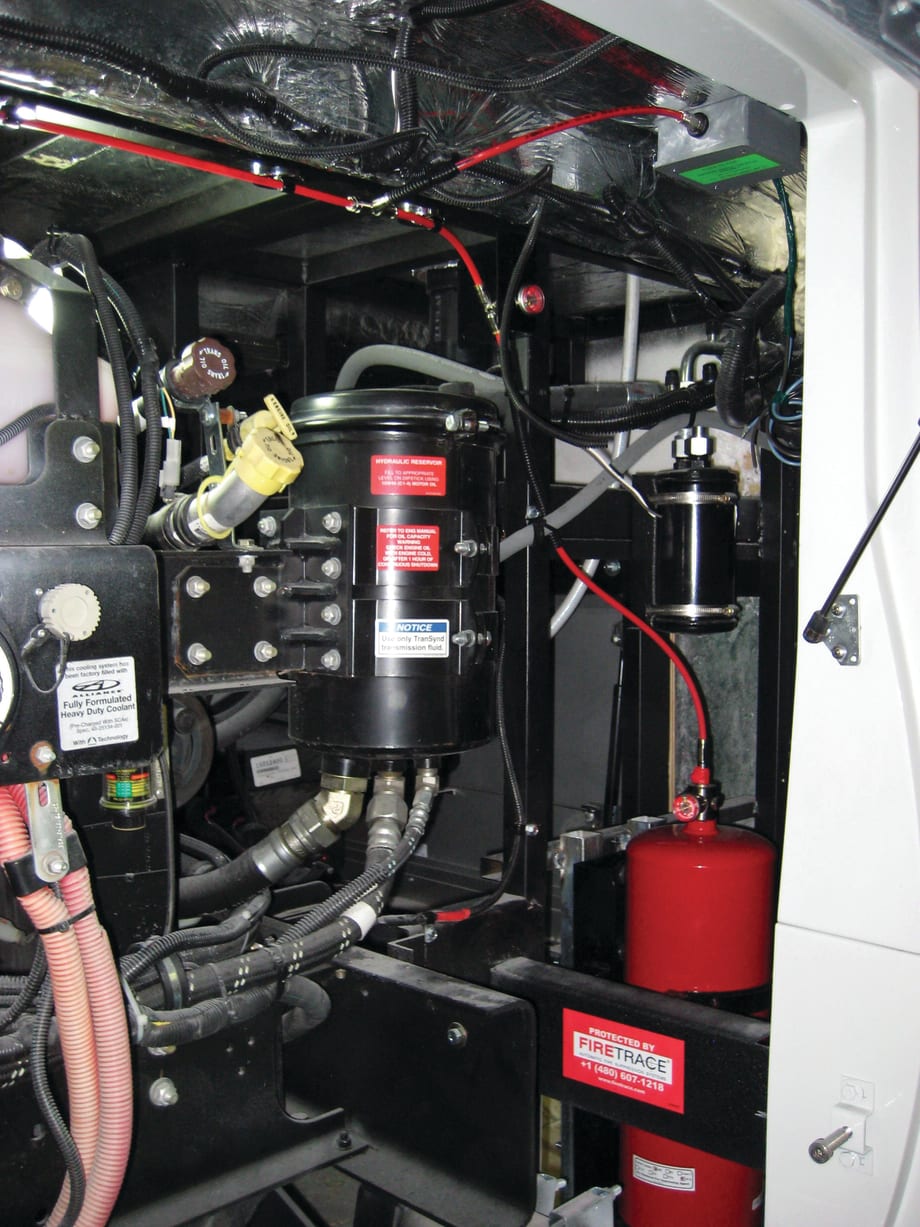
The system’s detection tubing is routed throughout the engine compartment and nearest the highest concern for engine fires, including the turbo and electronics.
The system’s detection tubing is routed throughout the engine compartment and nearest the highest concern for engine fires, including the turbo and electronics.
Firetrace International's automatic fire suppression systems were developed in the 1980s as a means to protect critical enclosures. Today, Firetrace systems can be found in transit and military vehicles, wind turbines, fume hoods, electrical cabinets and laboratory applications focusing on the protection of micro-environments, targeting the heart of the fire.
"Since the 1980s, more than 200,000 Firetrace systems have been installed worldwide," says Firetrace Director of Marketing Scott Starr. That includes more than 10,000 military vehicles currently deployed in Afghanistan and Iraq, protected by the same fire suppression technology available to municipalities worldwide.
Firetrace is headquartered in Scottsdale, Ariz. In 2008, the company opened an additional sales and manufacturing facility near London and distribution offices in Singapore and Australia.
"The need for a reliable and cost effective fire suppression solution is necessary to effectively protect the passengers and assets of municipalities," says Starr.
Bus fire data
As many as 2,600 bus fires occur each year, and significantly more go unreported, according to the National Transportation Safety Board. Of these fires, 60 percent are a result of mechanical failure or heat source failure in the engine compartment, with 24.2 million annually reported in direct property damage because of these incidents, according to the National Fire Protection Association.
"It is essential to protect critical components in vehicles to reduce injury, increase business service and reduce financial loss; Firetrace has a proven track record for all three, receiving reports of two successful fire saves each month," says Starr.
Firetrace offers a unique approach to vehicle fire protection, which utilizes proprietary linear pneumatic heat and flame detection tubing as the method for successful detection in even the harshest of environments.
How it works
The system's detection tubing is routed throughout the engine compartment and nearest the highest concern for engine fires, including the turbo and electronics. In the event of fire or extreme heat, the linear detection tubing will rupture, triggering the specialized valve to immediately release ABC dry chemical powder through strategically placed nozzles in the engine or dash of the vehicle.
The polymer detection tubing is able to withstand extreme temperatures, dust, debris, vibration and routine engine cleaning. Frequent cleaning produces large amounts of steam that can trigger traditional fire suppression solutions.
The performance and reliability of traditional detection solutions, such as thermal sensors, can be seriously impaired by the airflow in the engine compartment. Because heat and flame typically rise from the source of the fire, the airflow may propel the heat away from the location of the thermal sensor, inevitably delaying detection and activation. Airflow can actually help Firetrace provide faster and more reliable detection and suppression in a moving vehicle.
With Firetrace, the linear detection tubing is routed throughout the engine compartment and is positioned both above and behind the potential source of the fire to ensure that the airflow actually helps by directing the heat and flames toward the tubing.
The fire suppression system provides 24/7 protection requiring no continuous power or battery backup for activation, protecting the vehicle even when parked. In addition, there is zero concern for false activation or discharge of the system, according to Starr. Because the linear detection tubing is pressurized, the system acts as passive protection of the vehicle, only activated by fire or extreme heat.
Due to the simplicity of the detection and suppression methods, there are minimal maintenance requirements and no need for costly replacement parts.
The ABC dry chemical suppression agent utilized is effective on every type of fire risk present in an engine compartment. In addition to the vehicle's fuel and the risk of fuel line ruptures, this includes any number of flammable liquids, including hydraulic, brake, automatic transmission and power steering fluids, plus combustible accumulated grease on the engine block, for which frayed or damaged electrical wiring can easily provide the ignition source.
New feature
A recent addition to the Firetrace system includes an indicator module that is mounted on the dash or nearest the operator's view to provide continuous monitoring of the system. The indicator will inform the operator by red light and audible alarm in the event of a fire and, in the event the system requires service, the module will signal with a yellow service light. Manual activation is also an option with one of the newest indicator modules. The switch is mounted direct to the indicator, making it clear that by simply flipping the switch, it will trigger the fire suppression system.
Firetrace systems are easily installed on new or existing large fixed-route buses, motorcoaches and paratransit vehicles. By including Firetrace automatic fire suppression systems in fire prone areas, this will allow operators the necessary time to effectively direct and assist passengers to exit the vehicle in the event of a fire.
More Bus

New York MTA Plans Largest Bus Fleet Upgrade in More Than a Decade
The agency is seeking manufacturers for 650 new CNG buses to replace aging vehicles, improve reliability, and advance its broader fleet modernization strategy.
Read More →
Building a Flexible Path to Transit Electrification
John Hroncich discusses BAE Systems’ modular and scalable approach, lessons learned from decades of real-world operations, and how agencies can identify electrification strategies that fit their fleets.
Read More →
Bus Tech Talk: Keeping Transit Technicians Ahead of the Technology Curve
LA Metro’s Obed Mejia discusses technician training, evolving maintenance technology, fleet replacement, and strategies for getting the most out of today’s transit fleets.
Read More →
Biz Briefs: RIPTA Unveils New Frontrunners, Clevland RTA Adds New Siemens, and More
In METRO's latest installment, we take a look at recent news from Siemens, Prevost, Dodge, and more partnerships making headlines across the transportation sector.
Read More →
People Movement: Holly Arnold Joins Transdev and More
In this edition, we also cover recent appointments and announcements at Pace, CamTran, MCI, and more, showcasing the individuals helping to shape the future of transportation.
Read More →
The High Cost of Transit Buses: Industry Leaders Look to Procurement Reform
Transit leaders and policymakers examine how standardized bus designs, streamlined procurement, and predictable funding could help agencies stretch budgets and deliver better service.
Read More →
The Business Voice Behind Public Transportation
As chair of APTA’s Business Members Board of Governors, Ray Melleady explains how more than 850 business members are partnering with transit agencies to advance funding, innovation, and industry-wide collaboration.
Read More →
From Surviving to Thriving: Building Stronger Transportation Organizations
Bus Business Consultants founder Brian Dickson shares lessons on leadership, organizational health, and creating options for long-term success in a changing transportation industry.
Read More →
Finding the ‘Happy Medium’: Optimizing Maintenance Without Sacrificing Reliability
The key to maintenance optimization isn’t doing less work—it’s doing the right work at the right time on the right assets.
Read More →
LA Metro, City of West Hollywood, and Partners Advance Smarter Bus Lane Enforcement
The award-winning partnership combines AI-powered detection with human oversight to improve bus reliability, accessibility, and enforcement efficiency.
Read More →