



How to Use the Off-Season to 'Tune Up' University Campus Shuttle Service
Each school is unique due to the size of the campuses, student bodies, and their locations within their local communities. But, virtually all of them have two key things in common: the layout of the routes and an “off season.”
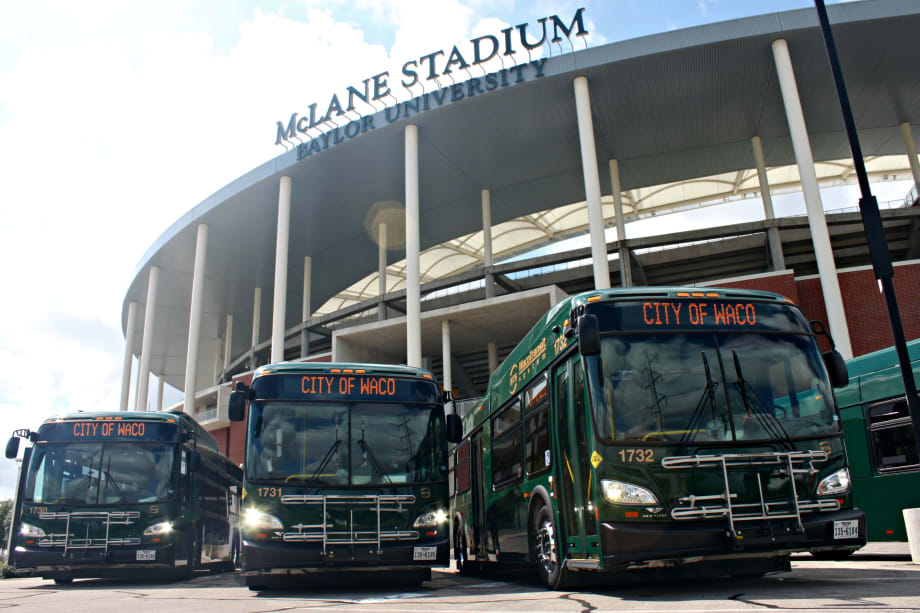
University shuttle operations can use school vacations, like winter or spring breaks, for driver education and training sessions.
University shuttle operations can use school vacations, like winter or spring breaks, for driver education and training sessions.
Summer may be a quiet time on a college campus, but for operators of on- and off-campus bus and shuttle services, summer vacation is no time for relaxing. The proverbial to-do list is a long one that includes addressing issues around staffing vehicle maintenance, route planning, marketing, budgeting, and maybe even international relations.
Each school is unique due to the size of the campuses, student bodies, and their locations within their local communities. But, virtually all of them have two key things in common: the layout of the routes and an “off season.”
Compared to a standard bus service with a dozens of routes that wind their way through an entire city all year long, a university service requires fewer routes and stops and transports riders to one location — the campus. That means when the spring semester ends, operators can scale back the number of vehicles that run each day. That downtime on the streets frees up the time needed to prepare for when the students return in the fall.
Staffing and Maintenance
A top priority should be recruiting and training new operators and managing vacation schedules for your all of your team members.
Consider requiring your drivers to take their personal vacations during the summer. You can also use school vacations, like winter or spring breaks, for driver education and training sessions. That will help you ensure that you keep your drivers rested and happy, while preventing a staffing shortage while school is in session.
But summer is not the time to let the majority of your maintenance team go on vacation. They need to identify and address any current or potential operability issues, test and troubleshoot on-board technologies like the Wi-Fi systems and power outlets, and thoroughly clean and detail each vehicle.
On-Campus, Community & Global Relations
Not all priorities are confined to your garages. Use the summer months to develop and begin executing marketing and community relations campaigns that stretch across print outlets, the web, and your social media channels. Get the word out to students and faculty, who live both on and off campus, as well as members of the community, who attend on-campus events like a football game or concert, about the advantages of using public transportation.
That work should continue after the students return. Attend freshman orientation sessions to meet with students and their parents to explain how the service works and the resulting convenience and safety benefits they will realize.
Expand your marketing and community awareness efforts off-campus as well, particularly if you provide service to students who live in apartments or houses that are not owned and operated by the university. They should help offset the cost to the university of providing the service to students, but those owners and managers will want to know how your service enhances the quality of life for their residents.
An International Community
Also, keep in mind that American colleges and universities attract many students from foreign countries. Work with your university colleagues to determine whether one or more nationalities comprise a statistically significant percentage of the student body and adapt your awareness
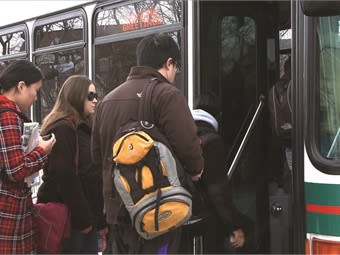
During the summer, expand your marketing and community awareness efforts both on and off-campus, particularly if you provide service to students who live in apartments or houses that are not owned and operated by the university.
programs to cater to those students. In fact, you can take that a step further and implement measures to help make riding the bus an even more attractive and convenient option for foreign students.
For example, Indiana University attracts a number of students from mainland China, whose primary language is Mandarin Chinese. International students are often well-versed in using public transportation, but not in the English language. So Bloomington Transit launched a program to provide drivers and customer service team members with language assistance skills so they can communicate in simple phrases and words with riders who have limited English proficiency.
Bloomington Transit recruited a student group from the University to help develop the curriculum that focuses on basic Mandarin words and phrases in phonetic format, such as “Zow-shung how” (“Good morning”), “Chu-nah” (“Where are you going?”) and “Dow-luh” (“This is your destination”).
The program helps uphold route efficiency because drivers can easily inform all riders when their stops are coming up. Also, it just makes the foreign students feel more comfortable riding on the buses, and they are therefore more likely to do so. Imagine how nice it is for a student still struggling to learn English to hear the driver say “Ni-hao!” (“hello!”)
Go High-Tech
It seems like everyone carries a smartphone now and you must train your drivers to be on the lookout for students with their heads buried in their screens wandering into the street. But you can also use the ubiquity of technology to improve your level of service.
If you have not done so already, use this summer to optimize your website for viewing on mobile devices. The smartphone has become the primary computer for many people, so make it easy for them to read route schedules or your marketing campaign materials on those smaller screens.
Even better, launch a mobile app that provides real-time updates on arrival/departure times, unforeseen delays, or other issues, and ties into your social media platforms like Facebook, Twitter, and Instagram to solicit rider feedback.
Students at Baylor University, in Waco, Texas, can use the transit system’s mobile app to view individual routes and the progress of buses in real-time. They can be sitting in the library or their apartment and plan for the exact minute when they have to leave to catch a bus. This kind of leeway in scheduling their days makes them more likely to take advantage of the transit system.
Blaine Rigler is president of McDonald Transit Associates and VP, Bus Services, for RATP Dev North America.
More Bus

New York MTA Plans Largest Bus Fleet Upgrade in More Than a Decade
The agency is seeking manufacturers for 650 new CNG buses to replace aging vehicles, improve reliability, and advance its broader fleet modernization strategy.
Read More →
Building a Flexible Path to Transit Electrification
John Hroncich discusses BAE Systems’ modular and scalable approach, lessons learned from decades of real-world operations, and how agencies can identify electrification strategies that fit their fleets.
Read More →
Bus Tech Talk: Keeping Transit Technicians Ahead of the Technology Curve
LA Metro’s Obed Mejia discusses technician training, evolving maintenance technology, fleet replacement, and strategies for getting the most out of today’s transit fleets.
Read More →
Biz Briefs: RIPTA Unveils New Frontrunners, Clevland RTA Adds New Siemens, and More
In METRO's latest installment, we take a look at recent news from Siemens, Prevost, Dodge, and more partnerships making headlines across the transportation sector.
Read More →
People Movement: Holly Arnold Joins Transdev and More
In this edition, we also cover recent appointments and announcements at Pace, CamTran, MCI, and more, showcasing the individuals helping to shape the future of transportation.
Read More →
The High Cost of Transit Buses: Industry Leaders Look to Procurement Reform
Transit leaders and policymakers examine how standardized bus designs, streamlined procurement, and predictable funding could help agencies stretch budgets and deliver better service.
Read More →
The Business Voice Behind Public Transportation
As chair of APTA’s Business Members Board of Governors, Ray Melleady explains how more than 850 business members are partnering with transit agencies to advance funding, innovation, and industry-wide collaboration.
Read More →
From Surviving to Thriving: Building Stronger Transportation Organizations
Bus Business Consultants founder Brian Dickson shares lessons on leadership, organizational health, and creating options for long-term success in a changing transportation industry.
Read More →
Finding the ‘Happy Medium’: Optimizing Maintenance Without Sacrificing Reliability
The key to maintenance optimization isn’t doing less work—it’s doing the right work at the right time on the right assets.
Read More →
LA Metro, City of West Hollywood, and Partners Advance Smarter Bus Lane Enforcement
The award-winning partnership combines AI-powered detection with human oversight to improve bus reliability, accessibility, and enforcement efficiency.
Read More →