



Paul Jablonski Navigates Challenges for San Diego's MTS
Faced with high fuel prices and a lack of state funding, the CEO forges ahead by overhauling service and looking for innovative ways to generate revenue.
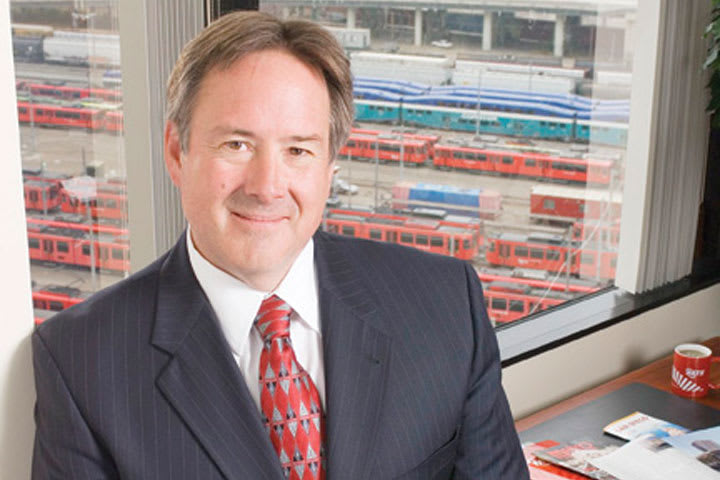
[IMAGE]MET8p42large.jpg[/IMAGE] San Diego Metropolitan Transit System (MTS) CEO Paul Jablonski began his career in the transit industry at an early age by driving a bus for the University of Massachusetts campus in Amherst, where he ultimately moved up to managing the bus system. He then moved on to the Capital District Transportation Authority (CDTA) in Albany, N.Y., where he was an assistant to the executive director of the system. After working on numerous projects, he was given the opportunity to manage one of CDTA’s divisions in Schenectady, N.Y. Jablonski then transferred to the private sector, working for ATE (the predecessor for First Transit), where he was assigned to develop a transportation system in Saudi Arabia per a joint venture with DMJM Harris.
During his nearly four-and-a-half-year stint overseas, his company managed about 60-plus systems in Saudi Arabia. Jablonski was promoted to general manager of the country’s largest system based in the coastal city of Jeddah. This operation consisted of 275 buses and carried an estimated 300,000 people per day. According to Jablonski, the system turned a profit in its final year of operation via ATE.
Back in the States, he continued to work for ATE on various projects, including the company’s first foray into school buses — managing a contract for the Cleveland public school system. In between additional consulting assignments, Jablonski took a break from the industry and took ownership of a New England-based travel agency.
He then headed back to the public side, taking on the assistant general manager position for the Southwest Ohio Regional Transit Authority in Cincinnati. Within a year, he became general manager, where he stayed for 11 years before taking on the job in San Diego as CEO of MTS.
Recently, METRO Executive Editor Janna Starcic spoke with Jablonski about his involvement in the transportation industry and how he is guiding the MTS to its future.
How has the increase in fuel prices affected your operation,
and what are you doing to offset this?
Unfortunately, that problem is compounded for us because the state
of California has huge financial issues. For the past two years, the money we receive from
gas tax sales revenues has been diverted into the state’s general fund. We have
lost in excess of $60 million, which has had a huge impact on our capital plan.
On top of that, with the housing decline, we’ve seen a substantial decline in local sales tax. A good chunk of our operating subsidy comes from a portion of state and local sales tax revenues. For the past year, sales tax revenues have gone from a 5.5 percent increase to a decline of about 2.5 percent. Last year, we were faced with an estimated $14.5 million loss to subsidy revenue in our operation. We had to increase fares on the bus side in January, and we’re increasing fares and changing the fare structure pretty substantially on the rail side in September.
San Diego has had some financial issues too. After 9/11, there was a big decline in tourism and travel, and the military was being deployed. Ridership started to decline, and service wasn’t adjusted fast enough. When I joined MTS at the end of 2003, there was a pretty dramatic budget issue here, with the budget being supported by reserves rather than money that comes in every year.
Instead of just cutting service, we started a two-year initiative called a comprehensive operations analysis (COA). We put our entire system, predominantly the bus side, under a microscope and looked at what was performing and what wasn’t. We also did an analysis of our market to see where people wanted to go and where they didn’t need to. We restructured 95 percent of our service and put resources where ridership was and expected to grow, and removed service where it was low and subsidy was high.
I tell you that story because it positioned us very well for where we are today. With the decline in the sales tax revenues, but more importantly, the increase in gas prices. We were positioned to take advantage of people’s desire to start riding transit in higher numbers. We’ve been seeing a ridership increase since 2005, when we finished that project. Between 2005 and 2007, ridership has increased 12 percent.
With gas prices really ramped up here, we are seeing much larger ridership gains this spring than we are year-to-date. The trolley side year-to-date is growing at about another 7 percent to 8 percent. We still have capacity to absorb, but we are getting closer to reaching capacity. As gas goes [higher], I think we are going to have a more prevalent problem. We do have an overcapacity issue on some of our heaviest lines like the route that goes to the zoo and Balboa Park. We are running articulated buses on those routes now, and they are at capacity.
[PAGEBREAK] Tell me about the status of
your bus fleet?
We are getting 26 new
articulated buses in September from North American Bus
Industries. In August, we are
getting 50 new 40-foot buses from New Flyer
Industries. If we can get some
growth in the sales tax, we’ll be able to operate them more. A big focus for us
has been improving the quality of our fleet.
The 40-foot vehicles we are buying are CNG. We also recently purchased 12 New Flyer buses using ISE Corp. gasoline hybrid technology, which will be used on a new “Super Loop” (a large commercial development north of downtown) service that we are starting up early next spring. This will be a BRT-type shuttle that will hit all of the attractions: the mall, university, hospitals and office parks.
Earlier you mentioned how the capital plan was affected by the
funding deficit, can you be specific?
We are about $300 million short over the next five years. All told,
we have 700 buses. So we need to be replacing somewhere between $15 and $20
million worth of buses every year, roughly 50 buses a year. The buses we are
replacing right now, on the 40-foot side, are 17-year-old diesels. We can
replace 40-foot buses after 12 years, but we’ve had to keep them longer. The
articulated buses that we will receive in October are going to replace 15- and
16-year-old buses that are diesel.
We are on a strict time frame now to replace buses. Unfortunately, with what’s happening with state funding now, if we are spending $20 million a year on buses, we’ve only got $10 million additional to spend on everything else.
We have a 54-mile light rail system that’s $1.5 billion in assets on its own. It’s a very capital intensive type of operation. Fifteen miles of that system, the Blue Line, which opened in 1981, is going to be 28 years old. When the Blue Line was built, it wasn’t all new, so we’ve got almost 30 years of hard use. A good portion of the track is almost 70 years old.
The catenary is almost 30 years old and needs to be replaced. The signal system is old and some are remnants from the old system. All the stations are at-grade, which means they can’t accommodate new low-floor technology, and the shelters need to all be replaced. We’re looking at a $400 million renovation to that 14 or 15 miles of track.
We’re also looking at railcars. Our Siemens U2 cars that are now 28 years old, they’ve been in constant operation since that time. We’re keeping them going, they’re running fine, but over the next five or six years, as they approach 35 years or so, we’re going to have to start replacing them. With the Blue Line, we are looking at $400 million in renovation and $250 million for vehicles; we’ve got this looming need of $600 million.
A positive side to this is the state passed a new bond measure a year ago, prop 1B, that the transit agencies lobbied heavily to add a transit component to. Hopefully, we’ll get $200 million over the next ten years.
In addition, we just passed a balanced budget, which was a difficult process. We had to cut $1.5 million worth of service, and had to eliminate 22 positions, the majority of which were management people. Ten people were laid off. We reorganized our shelter advertising contract, so we could get revenue on that. We’re having a fare increase on the trolley. We are switching from a zone-based fare to a flat fare on the trolley of $2.50.
What are some of the alternative sources of funding you are
looking at?
It was a pretty big decision to
start wrapping some trolleys with ads because the iconic bright red trolleys
are a pretty powerful image here. We are also doing kiosk advertising at some
of our rail stations, as well as banners at some of our stations and transit
centers. Originally, only half of our bus fleet had advertising on it.
Approximately half of our bus fleet is contracted out, which had no
advertising, so we now allow advertising on those buses.
In addition, we are looking at converting some historically non-advertising locations in our system to advertising. Private operations using our transit centers to pick up passengers for casino runs are now being charged an entry fee to use our facility. We are looking at revenue opportunities across the board. We’ve also looked at some of our real estate assets that are under-utilized and have developed short term leases to get them into a revenue generating mode. In the past year, we’ve tried to uncover every stone we could find to maximize revenues.
[PAGEBREAK]
How is your system are going green?
We built, what I believe to be
the nation’s first CNG hybrid bus. We finished that project and released it
around Earth Day. We pulled the engine package out of an older CNG bus and
replaced it with a new CNG engine with a hybrid-electric drive system. This was
a partnership with the
South Coast Air Quality Management District, San Diego County and ISE Corp. It was expensive, but if you look at the vehicle’s emissions profile, it hardly registers. We’re testing it’s fuel economy to see if over the lifetime of that vehicle, how much of a capital cost it will offset.
We are starting to buy hybrid support vehicles so we can test them out. In the past couple of months, we’ve purchased five. In our maintenance shops, we’ve been recycling for a long time. We’re also going to be looking at shelters that use solar instead of electricity.
In addition to funding, what
are some other challenges that your system faces?
A couple of years ago, we started up a management development
department as part of our Human Resources department. Because of the cost of
living in San Diego,
recruiting is very difficult. We realized that we have to do a better job of
training in-house and developing our own people.
On the drivers’ side, we just finished negotiating a five-year agreement with the Amalgamated Transit Union. It took us two years to negotiate that contract; a large part was economic based. The key to the agreement was our ability to hire drivers. Several years ago, when we were negotiating contracts, everybody was doing progressive wage when the market was such that for $10 an hour, you could get a driver in here, train him, and sell him on the long-term benefits of having a pension plan and a $20-per-hour salary at some point in time.
Now, that model has changed. People are trying to feed their families, rent a house or an apartment; they are looking for money. We had a difficult time recruiting drivers. In our new labor agreement, we restructured new hires. We took away some of the benefits, such as vacation time, etc., but we didn’t make a huge impact on pensions. We took that money and instead of paying $11 to hire somebody, we’re paying $14. That’s helped us out tremendously.
We are very committed to training, with six to eight weeks for bus drivers and eight weeks-plus for train operators. Once we get people in the door, they have a tendency to stay. We are competing with everything else out there. We worked with our union partners to make a dent in that. And, I think it was a win-win contract that we had with them.
What are some other challenges that your system faces?
Security of our passengers is always an issue. We’ve had the added
burden since 9/11 of homeland-related security issues. Tijuana is the largest international border
crossing in the world. We operate the trolley system right to its doorstep —
literally 30 feet from the international border. We also operate bus routes
there. We are very involved with homeland security on both the state and
federal levels.
We’ve upgraded our technology dramatically at the border and at train stations, with high resolution cameras, and software that identifies if a person has dwelled in the station too long or if there’s a package that’s been left in one place too long. We always have to be concerned with passenger safety and security, with crime, so that’s a constant challenge.
The internally run bus system, has gone through a metamorphosis over the last four years. We had graffiti and fleet age issues, which we took care of. We had maintenance issues that resulted in breakdowns. Now, we’ve gone from 4,000 miles between road calls to about 18,000 miles to 19,000 miles between road calls. So we’ve made a big change in our fleet and our appearance, which has had a positive impact on our ridership.
Technology was also a big issue for us. Over the past couple of years we introduced maintenance tracking software, vehicle tracking software and materials management software systems on both bus and rail.
We introduced a new fare collection system; and we are going to introduce smart cards this summer on a limited basis. Hopefully, it will be system-wide by the end of the year. Fare collection equipment will be updated on all buses and trolley stations will be equipped with new ticket vending machines that accept smart cards. We’ve also installed a new radio system, AVL technology and a new passenger counting system. We’ve had our hands full delivering technology.
On the rail side, we just started a $14 million initiative to bring centralized train control to the trolley system. For the most part, the line has operated with an old manual system. For the first time ever, we are going to be able to sit in our operations control center and see the entire system on our board, so that we can better manage it. This will assist us with large events such as Chargers and Padres games. For the Chargers games alone, 1 of 3 people arrives by transit. We carry 18,000 to 20,000 by rail and another 2,000 to 3,000 by bus. We have huge movements of [passengers] a number of times a year.
The centralized train control will also help us when problems arise. We had an issue in a heavy rainstorm a couple of years ago where a tree fell down on our catenary wire and we didn’t find out about it until the first train ran out in the morning. With this system, which monitors all of our power generation, we would have known about that at two o’clock in the morning and we could’ve had a jump on that before the peak started. The system will also allow us to bring electronic “next train” information to passengers at our train stations.
What would you say has been your most rewarding experience with
MTS?
I think certainly opening up the Green Line here in the summer of
2005. I purposely made the transition from Cincinnati
to San Diego because I wanted to get to a rail city in my career. When San Diego’s first new light rail system
opened, it was very attractive to me. To be a part of opening a new segment of
that, a segment that was done absolutely right, went into the heart of University of California, San
Diego and tunneled underneath, rather than
on the outskirts.
After three years of operation, one out of every five students now takes transit to the university. Our pass sales have grown by double digits over the last three years. There are about 25,000 undergraduate students and we’re selling over 5,000 semester passes to them. To see the dramatic impact that has had on the university and to see trains come in with 100-plus kids every 15 minutes is pretty gratifying.
More Management

METRO Opens Submissions for 2026 Motorcoach Awards
Nominations are now being accepted for METRO Magazine’s Operator of the Year and Innovative Operator of the Year awards.
Read More →
New York MTA Advances Final Contract for Second Avenue Subway Expansion
Contract Four is the largest in the Second Avenue Subway Phase 2 project and includes construction of station infrastructure, tracks, and signals for the subway expansion, MTA officials said. Work on Contract Four will begin in 2027.
Read More →
Transit Agencies Highlight Safety Gains at National Summit
Leaders from 15 major transit systems shared crime-reduction results and safety initiatives while discussing the role of continued federal support.
Read More →

NITA Names New Leadership, Expands Reduced-Fare Program at First Board Meeting
The new regional transit authority appointed its first board chair and interim executive director while extending reduced fares across CTA, Metra, and Pace for eligible riders.
Read More →
Beyond the Checklist: A Structured Approach to Transit Maintenance
Reliability-Centered Maintenance helps transit agencies move beyond routine checklists to focus limited resources on the assets and failures that have the greatest impact on safety, reliability, and service.
Read More →
APTA 2026 Nominating Committee Selects Leadership Slate, Names Chair and Vice Chair Nominees
Leadership changes will help shape the association’s priorities and its representation of the transportation industry during the 2026–2027 term.
Read More →
DART Launches Major Security, Fare Enforcement Initiative
The 90-day demonstration will deploy coordinated security teams at five light rail stations while testing controlled access and gathering data to guide future investments.
Read More →
Advancing Fare Collection Through Technology and Innovation
Learn about delivering 1300 gates at 91 stations while managing fare evasion. Explore the large scale deployment, solution customization and real-world results that affect the region. Prepare for deployment in your region now.
Read More →
Game Day in Motion: Moving Millions During the 2026 World Cup
Between packed transit stations and team motorcoaches, see how agencies and operators across North America tackled the transportation demands of the 2026 FIFA World Cup.
Read More →
Surface Transportation Extension Averts Shutdown, Leaves Transit Funding Gap
The stopgap keeps federal transportation programs moving, but missing advance funding could complicate the transit and rail projects agencies are planning next.
Read More →