



Q&A with UMA President/CEO Victor Parra
Before presiding over his last UMA Expo in February, METRO Executive Editor Janna Starcic spoke with Parra about the changes and challenges he’s seen in the industry, where he’s headed now, and what the industry needs to do next.
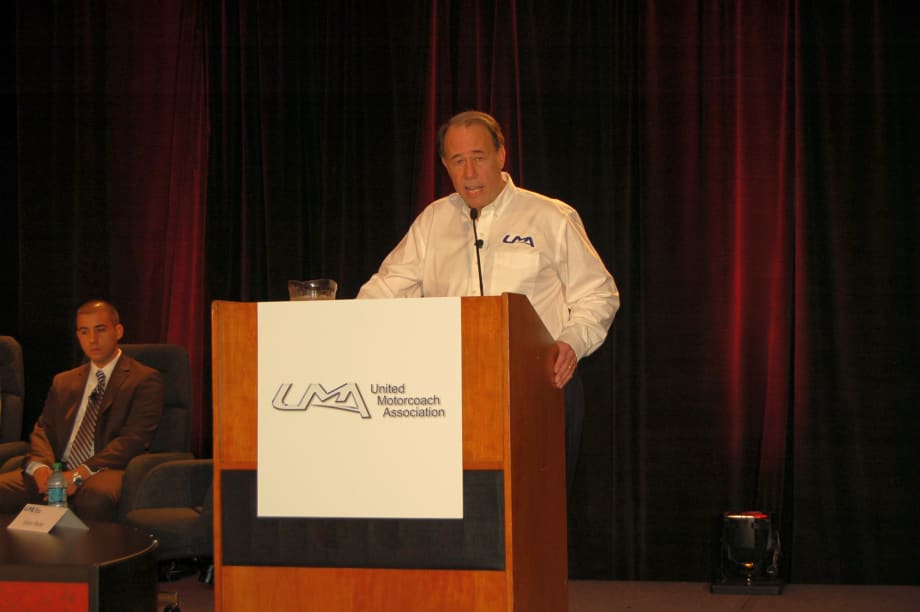
Parra would like to see legislators focus on private-sector resources when developing policy going forward.
Parra would like to see legislators focus on private-sector resources when developing policy going forward.
In late November 2016, long-time United Motorcoach Association (UMA) President/CEO Victor Parra announced that he would retire, effective March 31, 2017. He was originally appointed president/CEO in 1998 and was the second person to hold the job since the inception of the UMA. During his tenure, Parra helped grow and stabilize membership through the creation of Bus & Motorcoach News and the development of BusRates.Com and the Bus & Motorcoach Academy. Before presiding over his last UMA Expo in February, METRO Executive Editor Janna Starcic spoke with Parra about the changes and challenges he’s seen in the industry, where he’s headed now, and what the industry needs to do next.
What were some key challenges during your tenure?
When I came on, probably the first [challenge] was when the U.S. DOT came out with rules for the Americans with Disabilities Act. The proposed rule, as it related to our industry, had a requirement, if you were a charter operator, 10% of your equipment had to be lift-equipped. We challenged that, and, as a result, we were given an exemption for charter operators. The outcome was the 48-hour rule, which stated that if you received a request, you have 48 hours to find a lift-equipped coach to fulfill that request, rather than being required to purchase a coach.
That was probably one of the first victories, in the sense that the U.S. DOT redefined our business as being demand-responsive. That was very significant because it really helped people understand what the charter business is and how it differed from the line-run business. That was also a key differentiator for FMCSA to really look at our industry, and it was a first step in helping the regulators understand that there was a difference between the trucking industry and the bus industry. It really was a major challenge.
Also, it’s hard to underestimate the impact of 9/11 and what it meant. I remember getting a call right after 9/11 from a woman who had a small bus company in Pennsylvania. She had a charter company, and her whole business was built around school trips to Washington, D.C., and shopping trips to New York. You can imagine what happened to her business — it just evaporated. And she was in tears. We talked for a long time, and obviously, there was nothing I could do to help her, but it made me realize we’ve got to focus on diversification. [That conversation] told me that, going forward, educationally, we really have to help these companies diversify their revenue base, and teach them marketing.
How is the UMA starting a dialogue with the new Administration?
Our lobbyist has already had some preliminary discussions with the transition team — we want to get in the door. It’s going to take up a lot of time educating new agency heads on who we are, what we do, and our importance to meeting the transportation challenges of this country. We are also going to have a lot of new members of Congress. A lot of rookies will be coming on board, and this is the time to reach out and help them understand who we are and what we’re all about. Education will be important going forward as we look at our legislative strategy.
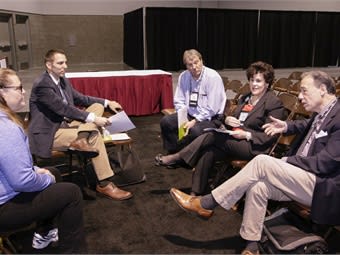
One of the most important qualities for an association CEO is having strong listening skills, Parra explains. Hearing what members “say” in surveys and research is also key.
How has your lobbying background helped you in your role at the UMA?
I’ve been a lobbyist since the 70s, so I understand the interaction between the regulatory and legislative processes. The mission of our organization is to help our industry be successful and give members the competitive edge. Understanding the process and what you need to do to help advance issues is very important.
My understanding of how to build coalitions and work within them has been valuable, especially in the early days. Back then, UMA’s presence [on Capitol Hill] was minimal at best. We didn’t have a lot to work with, so it was important to look at ways of better leveraging other organizations that had a stronger presence on Capitol Hill that did have an understanding of how Congress works and how to effect change. That’s really what we did over time until we could stand on our own. We really took an important step and beefed up our lobbying efforts. We work closely with the American Bus Association, obviously, on issues where we have a common interest.
I think members of Congress now turn to us when they are looking at legislation that may affect our industry and ask for our input.
What does the industry need to do to be successful?
Continue with diversification [of their business]. Our industry has a bright future, it’s just a question of how we get there. I would love for our legislators to really look at our industry and realize that we’ve got to utilize our private-sector resources as we are developing policy going forward and not just thinking of transits as being the only solution. [We need to] focus on public-private partnerships, not just as “us and them,” but “together,” looking at what needs to be done to reduce fuel consumption and congestion to make our cities more inhabitable.
We really have to build a strong partnership between industry and government. We have to work together. They need to understand our industry better, come up with solutions that make the most sense, and enhance the safety of the traveling public and not necessarily create a regulatory and enforcement burden that doesn’t result in safer transportation for our passengers.
What challenges do you foresee with regard to impending regulations?
Compliance reviews have just become so onerous. They used to be called inspectors, now they’re called investigators. That tells you how the culture has changed as it relates to compliance reviews. It seems like they are only looking for what’s wrong. As an agency that’s committed to safety, the [FMCSA] should tell you what you should do to operate safer.
Secondly, the Lease & Interchange Rule has to change, and the FMCSA needs to look at the data that safety fitness determinations are based on. Congress has already said the data is flawed, so they are doing a study. To still consider this an active regulatory initiative, while the data on which this determination is based on is flawed, is crazy.
Finally, we have a lot of unfunded mandates, like adding seatbelts and reducing emissions to meet the new EPA regulations. If you are going to impose this, at least give us funding to help make these changes. Also, you’ve got all of these agencies working independently of each other. Sometimes their interests run contrary to each other. Hopefully, the president will look at some of these issues and create some coordination across the various agencies.
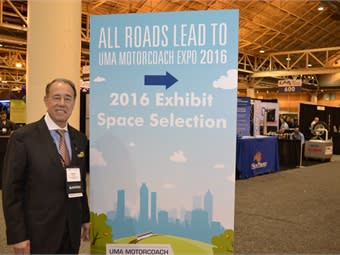
Parra says that seeing the impact 9/11 had on the industry led the UMA to emphasize educating operators on marketing and helping them diversify their revenue base.
What changes would you like to see in terms of technology?
I’d love to see complete interoperability among all the technologies that we are seeing coming on buses. Let’s just talk about electronic logging devices (ELDs) for a moment. ELDs should have the ability to be GPS-enabled, and should be able to not just maintain driver’s logs, but also produce IFTA reports and IRP reports and provide information that can help a company deal with those reports.
Whether it’s ELDs or stability control, all this technology needs to be interoperable and have a common set of standards, so [the technology] can work together and interface with each other. This would make life much easier for the driver, owner, dispatcher, and everybody else involved.
What key traits does your successor need?
Strong listening skills. I spent a lot of time listening; I still do. It’s probably one of the most important qualities for an association CEO; for any CEO. Our members are our customers; they are the people we are trying to influence to make them successful. [We need to] listen to their needs. Not just talking with them face-to-face or on the phone, but listening to what they have to say in surveys and research. Reading between the lines and understanding exactly what they are communicating to us.
Secondly, understanding that you are dealing with entrepreneurs and family run businesses, and hopefully, as I did, develop an appreciation for what that means. It really is special. Their commitment to this organization, and what they do on a day-to-day basis, is extraordinary.
This is a very personal industry, and it’s about relationships. You see companies shift equipment from A to B simply because they trust that salesman. It is a relationship-driven industry. Know that right away when you sit in this seat. While it’s important to develop goals, objectives, strategies, and budgets, it’s equally important to recognize that some of these people have mortgaged their house to buy that first bus and have gone into debt. Know the sacrifices that they make to get into this business. Focus on their needs and listen to what they have to say — you’ll learn so much.
What’s your advice for new operators?
[This business] takes more capital than you realize. When we see attrition in the industry, very often it’s because companies are undercapitalized.
I think the upside is it’s a very exciting industry, there’s room for growth in most markets. Recognize that as a new operator, you’re in good company. Appreciate that company. Have an understanding that having relationships [with other members] will be important.
What are your plans once you retire?
I don’t see myself completely retiring, in terms of just not doing anything. I’m too much of a Type A. I love building; I love building organizations. This has been a great ride. It’s been a labor of love, in terms of helping to build this organization to where it is today. It’s got more building to go, so hopefully whoever is going to take my spot is going to recognize that and continue to build on what we’ve accomplished at this point.
I don’t envision myself just hitting the golf course. I’m not a very good golfer, but I do enjoy it. I like to keep busy. I’m always thinking of ways that we could better serve our members and what we can do to help individuals build their own companies. I don’t think my brain is going to turn off and don’t intend to allow it to turn off, but I am going to relax and do some traveling. I’ve never taken more than 11 days off at any one time, so I may even splurge and take two full weeks.
More Motorcoach

METRO Opens Submissions for 2026 Motorcoach Awards
Nominations are now being accepted for METRO Magazine’s Operator of the Year and Innovative Operator of the Year awards.
Read More →
Biz Briefs: Alstom Lands Canadian Contract, LYT to Supply California TSP, and More
In METRO's latest installment, we take a look at recent news from Complete Coach Works, Beep, FlixBus, and more partnerships making headlines across the transportation sector.
Read More →
Biz Briefs: RIPTA Unveils New Frontrunners, Clevland RTA Adds New Siemens, and More
In METRO's latest installment, we take a look at recent news from Siemens, Prevost, Dodge, and more partnerships making headlines across the transportation sector.
Read More →
People Movement: Holly Arnold Joins Transdev and More
In this edition, we also cover recent appointments and announcements at Pace, CamTran, MCI, and more, showcasing the individuals helping to shape the future of transportation.
Read More →
ABA Report: Motorcoach Travel Generates $161.6B Economic Impact
The 2025 analysis finds motorcoach travel supported nearly 900,000 jobs and generated $28 billion in federal, state, and local taxes.
Read More →
CharterUP’s Armir Harris on Technology, AI, and the Future of Group Mobility
In a recent episode of METROspectives, CharterUP Founder/CEO Armir Harris discussed the company’s evolution from an online charter bus marketplace into a technology platform supporting public- and private-sector mobility and much more.
Read More →
People Movement: ABC Names John Walsh as Chief Commercial Officer
In this edition, METRO also covers recent appointments and announcements at the DART, STV, and more, showcasing the individuals helping to shape the future of transportation.
Read More →
From Surviving to Thriving: Building Stronger Transportation Organizations
Bus Business Consultants founder Brian Dickson shares lessons on leadership, organizational health, and creating options for long-term success in a changing transportation industry.
Read More →
Biz Briefs: Luminator Marks Milestone and More
From manufacturers and suppliers to transit agencies and motorcoach operators, these updates offer a snapshot of the projects, partnerships and business moves driving the industry forward.
Read More →
ABAF Study Reveals Growing Insurance Crisis for Motorcoach Operators
Preliminary findings show 98% of operators faced premium increases over the past five years, while shrinking insurer participation is putting added pressure on businesses and customers.
Read More →