



Shuttle Services Make Key Connections for DFW Airport
The world's third busiest airport, Dallas/Fort Worth International operates five different shuttle services to accommodate a wide variety of parking and transit options for airport visitors and employees.
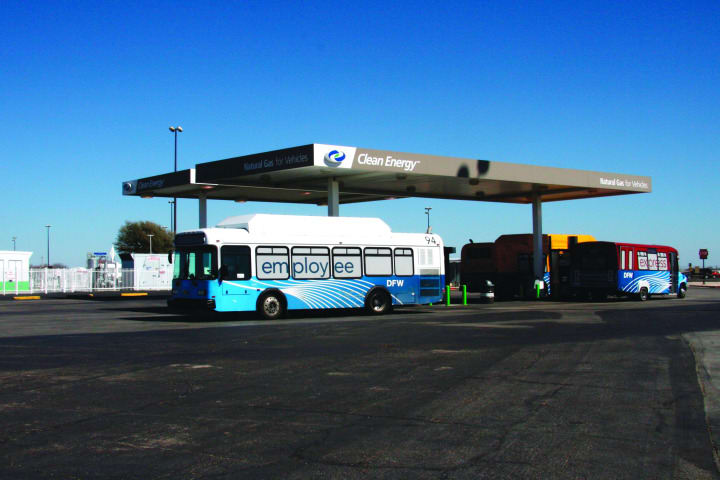
To serve its high volume of traffic, the airport operates five different shuttle services for customers and employees.
[IMAGE]shuttle.jpg[/IMAGE]Dallas/Fort Worth International Airport (DFW) is the world's third busiest airport, officials say, with nearly 1,750 flights per day and 57 million passengers a year.
To serve its high volume of traffic, the airport operates five different shuttle services for customers and employees. There is a need to transport people not just from terminal to terminal (Terminal Link vans), but also to and from remote parking lots, the consolidated rental car center and — with the airport's Express service — from private vehicles to curbside at the terminals. Employees also have their own shuttle service, which transports them from the employee parking lot to the central terminal area.
Wide variety of services
The Express and Terminal Link services use Ford F-450 vans that are converted by a local provider to run on compressed natural gas (CNG).
The consolidated rental car center was opened in March 2001. "We required all the rental car companies to pitch in to the current single rental car shuttle service," says Tomás Rivera, assistant vice president of transportation management. Previously, all 10 rental car companies had individual shuttles running airport routes to two rental car centers, one at the north end of the airport and the other at the south end.
Gillig diesel buses currently comprise the rental car shuttle fleet, from model years 2004 and 2005. "We're in the process of replacing those with ElDorado National access buses that we've received about 12 of on the property, but we have not yet put them into service," Rivera says.
The employee transit shuttle has been in existence since 2005, when the airport's Skylink train system replaced an automated people mover.
The employee and remote parking shuttle fleets are made up of 2004 and 2005 CNG-powered ElDorado National buses. "We just received a shipment of 12 2009 models," Rivera says.
The parking shuttles are managed by Dara Hayden, assistant vice president of parking, point of service. Remote parking, the most economical parking option at the airport, has been available with shuttle service since 1989, she says. The Express service, which picks up and drops off passengers at their vehicles in the airport's 7,000 garage parking spaces, has been available for about 10 years.
"All of the vehicles are owned by DFW Airport," Rivera says. "We purchase the vehicles ourselves at government fleet sales through the metropolitan planning organizations (MPOs), such as the North Texas Central Council of Governments or the Houston-Galveston Area Council. We also obtain the rolling stock tax free, so it's a substantial savings."
The remote parking vehicles are maintained by DFW staff, while vehicles for the four other shuttle services are operated and maintained by contractors.
'The green airport story'
About 95 percent of all the airport's vehicles run on CNG, including non-revenue vehicles.
The emphasis on alternative fuel use first emerged in the late 1990s, Rivera says, when the Dallas/Fort Worth metropolitan statistical area was designated as a non-attainment area for nitrogen oxide (NOx). "The result of that was a state implementation plan, which required the airport to reduce mobile and point-source emissions," Rivera says.
DFW began working with Clean Energy Fuels Corp., and currently has contracts with the fuel provider to operate and supply the private and public access CNG fueling stations that support the fleets. The rental car shuttle fleet is beginning the conversion process to CNG vehicles, due to be completed within four years.
Consolidation of the rental car shuttle fleet contributed to the airport's goal to reduce emissions and also helped reduce the amount of vehicular traffic on the carousel roadways and congestion on the curbside, Rivera says.
The airport has become a champion of alternative fuels, sharing "the green airport story," as Rivera describes it, with colleagues at trade shows and professional organization meetings.
[PAGEBREAK]Operational concerns
Despite holding the reins of a high number of different shuttle services at a large establishment, Hayden says there are few glaring challenges.
"From my perspective, we have done such a wonderful job of identifying many efficiencies, we are very active in organizations geared toward this type of transportation and we learn best practices. We really have very few challenges," she says.
The factors that are always top-of-mind, however, include the safety of airport visitors on the roadways in their private vehicles as well as that of the shuttles and their operators, particularly during highly congested periods or instances of severe weather.
In addition, Rivera says that attracting qualified automotive technicians is one of his main focuses, "especially as we have a generational turnover in the industry," he says. "Previously, automotive mechanics, especially in transit buses, were heavy diesel-type mechanics. Now, these new engines come with a whole host of electronics and software-driven components. Trying to get the personnel and keep up with the training requirements can be a challenge."
Additional equipment
DFW's shuttle buses are equipped with IVTAS (Integrated Video Terminal Announcement System), a GPS-driven device that automatically announces terminals and gates as the vehicle approaches.
The rental car shuttle fleet also offers a next-bus feature for passengers waiting curbside. GPS technology locates each vehicle, average speed is calculated based on tachometer readings over the past few minutes and an estimate of time until arrival is posted on digital signs at passenger loading zones.
"There's a growing interest in the industry for these sorts of amenities for passengers, especially as the land side — concessions and the non-aviation side — become more important in the commercial aspect of the airport," Rivera says. "These sorts of passenger amenities are coming to the front as far as attracting passengers or retaining passengers on a given airport. Also, the geographic size of DFW Airport makes it such that an application of that type is probably more valuable here than at a smaller airport."
Many of the shuttle vehicles are also equipped with video-based fleet monitoring and risk management systems.
Hayden emphasizes that purchasing decisions on fleet equipment are made with efficiency in mind. "Anything that would give us greater efficiencies and help us to affect our bottom line I think we'd take a look at," she says.
"We're open to the possibility of any technological development and how that might apply to DFW Airport," Rivera says, adding that DFW will be testing a non-revenue electric vehicle beginning in August.
Future improvements
The airport is preparing to undergo a project to renovate four of the five terminals. "Part of that effort will be taking a look at curbside allocation," Hayden says. "We're studying which products will remain on the upper levels, which will remain on the lower levels, and should there be an adjustment in those products and where they are along the curb? It'll be different than it is today."
The impact on shuttle service will be minimal, Hayden explains, with the only change being the addition of parking spaces in some lots to accommodate garages that are taken offline for remodeling. "We'll need to add capacity at the parking lots to absorb those displaced passengers, but the [shuttle] route will stay the same," she says.
In conjunction with the Terminal Development Program (TDP), the airport is implementing a Business Continuity Program to minimize disruptions and inconveniences for passengers. "Its purpose is to make sure we identify what those impacts of the program will be to our current operations and enable us to get out in front of those impacts by devising work-arounds that are both economical and convenient to the passengers," Rivera says. "Some of our competitors, the off-airport parking operators, would like to have people think that this is going to be chaos and disruption out here and so that passenger's better off using off-airport services. That will not be the case because of the Business Continuity Program. We expect to have very minimal, if any, impact on our ground transportation passengers as a result of the TDP."
More Motorcoach

METRO Opens Submissions for 2026 Motorcoach Awards
Nominations are now being accepted for METRO Magazine’s Operator of the Year and Innovative Operator of the Year awards.
Read More →
Biz Briefs: Alstom Lands Canadian Contract, LYT to Supply California TSP, and More
In METRO's latest installment, we take a look at recent news from Complete Coach Works, Beep, FlixBus, and more partnerships making headlines across the transportation sector.
Read More →
Biz Briefs: RIPTA Unveils New Frontrunners, Clevland RTA Adds New Siemens, and More
In METRO's latest installment, we take a look at recent news from Siemens, Prevost, Dodge, and more partnerships making headlines across the transportation sector.
Read More →
People Movement: Holly Arnold Joins Transdev and More
In this edition, we also cover recent appointments and announcements at Pace, CamTran, MCI, and more, showcasing the individuals helping to shape the future of transportation.
Read More →
ABA Report: Motorcoach Travel Generates $161.6B Economic Impact
The 2025 analysis finds motorcoach travel supported nearly 900,000 jobs and generated $28 billion in federal, state, and local taxes.
Read More →
CharterUP’s Armir Harris on Technology, AI, and the Future of Group Mobility
In a recent episode of METROspectives, CharterUP Founder/CEO Armir Harris discussed the company’s evolution from an online charter bus marketplace into a technology platform supporting public- and private-sector mobility and much more.
Read More →
People Movement: ABC Names John Walsh as Chief Commercial Officer
In this edition, METRO also covers recent appointments and announcements at the DART, STV, and more, showcasing the individuals helping to shape the future of transportation.
Read More →
From Surviving to Thriving: Building Stronger Transportation Organizations
Bus Business Consultants founder Brian Dickson shares lessons on leadership, organizational health, and creating options for long-term success in a changing transportation industry.
Read More →
Biz Briefs: Luminator Marks Milestone and More
From manufacturers and suppliers to transit agencies and motorcoach operators, these updates offer a snapshot of the projects, partnerships and business moves driving the industry forward.
Read More →
ABAF Study Reveals Growing Insurance Crisis for Motorcoach Operators
Preliminary findings show 98% of operators faced premium increases over the past five years, while shrinking insurer participation is putting added pressure on businesses and customers.
Read More →