



Valley Metro Strives for Balanced Ad Policy
Less than a year after the system’s debut, talks of an ad policy emerged after vendors showed interest in displaying full wrap or panel advertisements on the new light rail vehicles.
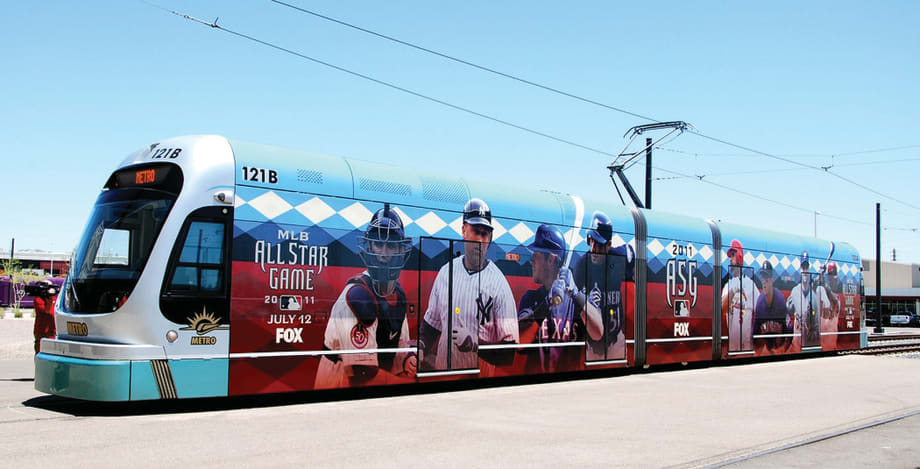
Metro Light Rail (Metro), serving the greater Phoenix area, is one of the busiest transit systems of its kind in the country. Open only since December of 2008, the operation is a newer addition to Valley Metro and raised a series of important questions regarding the relationship between company branding and outside advertisement.
Less than a year after the system’s debut, talks of an ad policy emerged after vendors showed interest in displaying full wrap or panel advertisements on the new light rail vehicles.
“Some board members expressed serious concern over the issue, fearing large outside ads and graphics would compromise Metro Light Rail’s brand since it was so new,” says Hilary Foose, director, communication and marketing, for Valley Metro. “At the time, they were really trying to ensure its place in our community as a well-known and established mode of transportation.”
Regardless, it’s difficult to ignore the critical revenue generated from ads. Therefore, Metro compromised, according to Foose, tiptoeing into the arena of advertisements.
The agency enacted a policy, with limitations allowing only a certain number of vehicles to be fully wrapped with commercial advertising at one time. It was a balance without disturbing Metro’s image and brand. Valley Metro reserved some cars for community graphics as well.
“They made sure advertising can have its part, but only a certain part,” says Foose. “It’s indicative of the fact that we could use the opportunity to generate additional revenue that would then go toward supporting the operation that serves constituents in this community.” [PAGEBREAK]
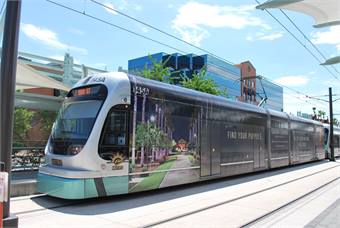
Currently, there are 50 light rail vehicles in the entire fleet — 10 of which can have full train wraps while another four are reserved for community wraps. There’s no limitation on the number of center section train wraps.
Metro displays ads on vehicle interiors and offers ceiling ads as well, which Foose says might be catching wind.
“It has been a very, very successful advertising program,” says Foose. “Our original estimates were maybe a few hundred thousand dollars per year, and now, we’re upward of $600,000 that comes directly to our agency.”
Valley Metro’s community train wrap program is for community-centric advertising or messaging and events of regional significance.
“We look for really significant events that bring an infusion of dollars to the whole region by way of tourism, hotel rooms and more,” says Foose.
The operation’s first wraps were for the 2009 NBA All-Star game in Phoenix. They were created through a partnership between the transit agency, the Phoenix Suns and the NBA as a way to do local promotion.
Valley Metro also partners with Local First, an organization that advocates local businesses. Together, they put together train wraps to get the word out about Arizonian businesses, venues, entertainment and buying local foods.
Alcohol advertising is also new on the horizon for Valley Metro. The policy now allows for these ads on light rail vehicles and stations, due to their large source of revenue. The board of directors was initially concerned about a potentially negative community reaction. But being that Phoenix is such an urban environment, says Foose, most residents were immune to this form of advertisement.
Valley Metro uses CBS Outdoor to sell, coordinate and install ad projects on their behalf. The transit agency approves all advertisements, based on their own ad policy criteria, and gets roughly 60% of the gross of sales.
More Rail
Amtrak, CN Reach Agreements to Strengthen Passenger Rail Service, Safety
The agreement resolves a more than decade-long proceeding before the Surface Transportation Board concerning the terms and conditions for Amtrak services, such as the City of New Orleans, Illini/Saluki, and Wolverine.
Read More →
New York MTA Advances Final Contract for Second Avenue Subway Expansion
Contract Four is the largest in the Second Avenue Subway Phase 2 project and includes construction of station infrastructure, tracks, and signals for the subway expansion, MTA officials said. Work on Contract Four will begin in 2027.
Read More →
San Diego MTS Breaks Monthly Trolley Ridership Record
Agency officials said July’s ridership indicates MTS’s continued recovery from the pandemic.
Read More →
Report Examines NJ TRANSIT Reliability, Funding Challenges
The Garden State Initiative analysis examines the roles of Amtrak infrastructure, fleet management, and agency operations while recommending a more performance-based approach to improving reliability.
Read More →
Stadler, CapMetro Sign Long-Term Rail Fleet Support Agreement
Beginning in 2027, Stadler will provide on-site technical expertise, spare parts support, training, and obsolescence management to help extend the reliability and longevity of CapMetro’s GTW fleet.
Read More →
Biz Briefs: Alstom Lands Canadian Contract, LYT to Supply California TSP, and More
In METRO's latest installment, we take a look at recent news from Complete Coach Works, Beep, FlixBus, and more partnerships making headlines across the transportation sector.
Read More →
CATS Gold Line Marks 5 Years of Service, 2.8M Passenger Trips
With a six-mile expansion planned, the Charlotte streetcar is positioned to connect more neighborhoods and major transit hubs across the region.
Read More →
Why Simulating Pedestrian Movement Has Become Essential for Modern Rail Stations
Pedestrian microsimulation is helping rail planners identify bottlenecks, test station designs, and prepare complex transit hubs for growing passenger volumes.
Read More →
Amtrak Begins Major Construction at New York’s Sunnyside Yard
The new maintenance facility will support Amtrak’s Airo trainsets while improving maintenance efficiency and turnaround times in New York.
Read More →
Chicago Leaders Unveil Plans for O’Hare Airport Express Train
The privately developed project would offer a 15-minute trip between downtown and O’Hare’s Terminal 2, with trains operating every 15 minutes on a dedicated track. The service would use battery-electric trains and three existing freight rail rights-of-way.
Read More →