



RELATED: Uber to test flying vehicle network in Dallas, Fort Worth
Charging tech key to bringing urban air mobility to the masses
Accessible, point-to-point transportation will expand to the skies as vehicle charging goes vertical.
by Paul Stith
September 16, 2019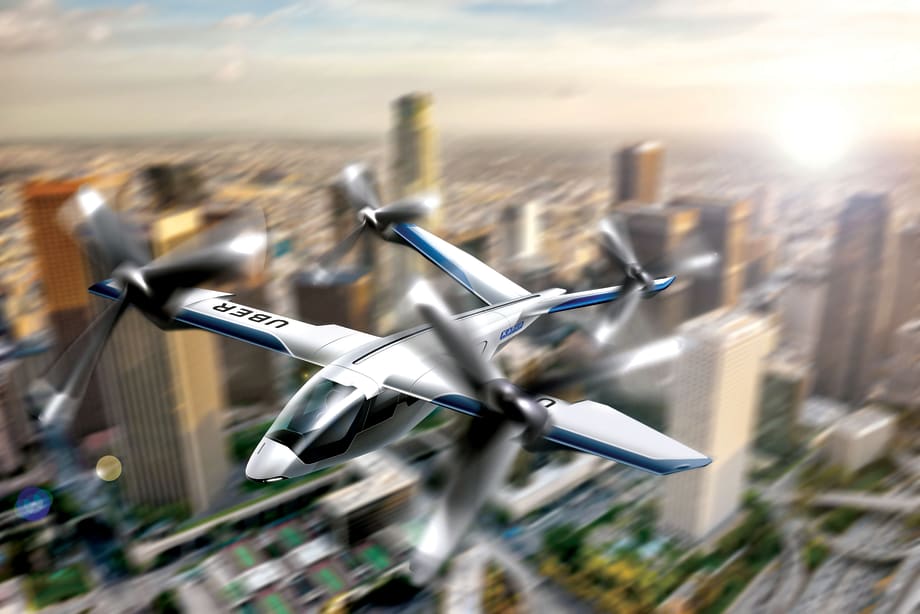
Uber anticipates that eVTOL flights could achieve costs on par with Uber Black services before dropping to Uber X pricing levels.
Karem/Uber Elevate
6 min to read
Uber anticipates that eVTOL flights could achieve costs on par with Uber Black services before dropping to Uber X pricing levels.
Karem/Uber Elevate
The electrification of our streets is fully engaged. But is it time to start looking up?
Now that motorists are embracing EVs for the morning commute and both enterprises and transit operators are actively exploring battery-powered vehicles to replace fossil-fuel fleets, the natural next step is to gaze upward to city skies to explore the opportunities of electric flight. Boarding an aerial vehicle to soar above urban congestion while reducing emissions has shifted from Jetsons-style fantasy toward a 2020s reality. While flying cars aren’t in your neighborhood yet, the transportation sector’s transformation to electric power is accelerating rapidly.
Efficiency meets excitement
The groundbreaking performance of Tesla Motors’ EV models changed our understanding of what electric propulsion can do for transportation. Far from supporting practical hybrid cars, Tesla used electric drivetrains to create vehicles customers wanted to drive and experience. The introduction of these high-performing EVs have changed how we view transportation, and today, the sky is the next frontier.
In the past few years, leading aerospace companies and startups alike have broken new ground in the design of electric vertical take-off and landing vehicles (eVTOLs), which offer significantly greater efficiency and flexibility than traditional point-to-point options, such as helicopters. To date, almost every major technological hurdle required to make this vision a reality has been overcome — and perhaps most importantly, it is on track to be achieved at a competitive price-point.
Anybody have an extension cord?
It wasn’t all that long ago that the power grid wasn’t ready for refrigerators or air conditioners. But just as power-hungry appliances forced energy service providers to react quickly to adapt the grid to accommodate new demand, history shows that further evolution is upon us. Facing aging infrastructure, growing electrification, an evolving of transportation, and the integration of renewable energy, utilities are challenged to build the future grid to support new demands.
For electric utilities, many of which faced years of flat or declining load growth, EVs and even autonomous vehicles (AVs) are viewed as key to their futures. But before the EV/AV revolution can fully pave the way for eVTOLs to become reality, the industry must put in place the electric infrastructure that can handle the highly distributed, yet often concentrated volume of EV charging — on the ground — that would help facilitate an efficient Urban Air Mobility (UAM) transportation system take off.
Recently, Black & Veatch, working with the National Institute of Aerospace (NIA) on behalf of the National Aeronautics and Space Administration (NASA), completed its Urban Air Mobility Electrical Infrastructure Study. Given rising interest in the potential of eVTOLs to alter the transportation landscape, the team examined three major metropolitan areas (Los Angeles, Houston and Baltimore/Washington, D.C.) as future urban air mobility markets with a focus on local utility energy supply and infrastructure for both storing and charging these groundbreaking aircraft.
The study compared current EV charging needs, particularly across transit and fleet vehicles, and found that urban air mobility would leverage power infrastructure similar in function and scale to that required by transit and heavy-duty EVs, which are just are about to hit their hockey stick moment. Distribution grid enhancements would be required to support significant points of concentrated demand from eVTOLs, which the study assumed would require high-powered, high-capacity 600kW chargers, versus a typical passenger vehicle DC fast charging, which typically range from 50kW-350kW.

Leading aerospace companies and startups have broken new ground in the design of electric vertical take-off and landing vehicles (eVTOLs), which offer significantly greater efficiency and flexibility in urban areas than traditional point-to-point options, such as helicopters.
Black & Veatch
Urban Air Mobility as a Service
Under most planning scenarios, production of eVTOLs isn’t viewed in terms of hundreds of vehicles hitting the market on an annual basis, but rather a curve that would rise from dozens of initial vehicles to thousands, leveraging automotive scale production techniques. Some early eVTOL visionaries see the volume of these vehicles and the corresponding frequency of flight creating a financially viable business model and anticipate a profitability timeline measured in years rather than decades.
To this point, eVTOLs may offer new opportunities when it comes to Transportation-as-a-Service (TaaS). Uber, an eVTOL industry leader, anticipates that eVTOL flights could achieve costs on par with Uber Black services before dropping to Uber X pricing levels. Although early eVTOL flights would require a licensed pilot, the eventual introduction of fully autonomous versions would drive price points even lower, with estimates in the range of 40 to 50 cents per mile of flight, putting eVTOLs on par with many major metropolitan taxi rates today and more attractive than car ownership over time.
With opportunities to develop eVTOLs at a scale more akin to automobiles than helicopters, excitement is building around the potential for electric aircraft to help promote mobility, reduce surface congestion, and support an emerging transportation future and regional planning. But barriers exist, and right now, one of the largest barriers is the battery.
eVTOL designers see lithium-ion as the technology that will move them forward to a functional, market-ready aircraft. Today’s lithium-ion batteries can manage the duty cycles that are required to give life to these new vehicles. Further battery advancements including reductions in battery weight and continued improvements in stability coupled with highly redundant systems will be needed to extend range, establish market confidence and are requisite for regulatory approvals.
Like many major shifts, regulation will play a large part in directing eVTOLs as they come to fruition. In June, Uber convened the 2019 Uber Elevate Summit, an annual event that brings together builders, investors, policymakers and government officials under the umbrella of turning the vision of urban aerial ride-sharing into reality. While some companies are forging their own path, many believe a speedier path to regulatory approval and deployment of eVTOLs lies in the ability to create designs within agreed-upon parameters.
The development of a regulatory construct and vehicles that can operate within it is certainly something that can be done. But in the spirit of collaboration and open dialogue, all major players — from builders, investors and city agencies to energy service providers and policymakers — will need to work together to facilitate the regulatory regime that oversees the power and energy delivery and encourage its development.
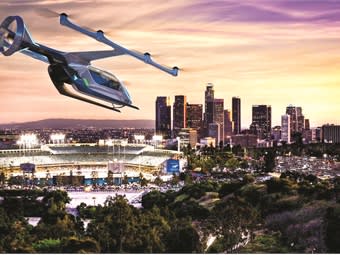
While some companies are forging their own path, many believe a speedier path to regulatory approval and deployment
of eVTOLs lies in the ability to create designs within agreed-upon parameters.
Karem/Uber Elevate
The future of eVTOLs
If you look at other modes of transportation that are being electrified — buses, trains, trucks, etc. — a case can be made that many programs are underfunded, resulting in slow deployments even as air quality continues to deteriorate. eVTOLs can be a boon to the future of these efforts. Many cities around the world are adopting mandates to electrify and reduce greenhouse gas emissions, but funding remains an issue. But, just as automakers have created identities and fans based on limited production models, eVTOLs offer a flashy concept, which could create a halo effect that would help support the capital investment that is needed to fund the charging infrastructure necessary to propel electric ground fleets.
As eVTOLs continue to edge their way into the mainstream conscious, excitement will continue to build over the promise of aerial transportation to reduce urban congestion and decrease emissions. The future looks bright, backed by the Electrical Infrastructure Study for UAM Aircraft report, which concluded that the distributed energy resources and grid enhancements necessary to support eVTOL programs are well within the range of reality — both from a technological and cost perspective — especially when planned and executed in concert with other infrastructure programs. Cool factor aside, the excitement can be leveraged to attract capital that will advance all forms of electrified transportation and take flight.
Paul Stith is the Director of Strategy & Innovation for Black & Veatch’s Transformative Technologies business www.bv.com.
Subscribe to Our Newsletter
More New Mobility

From Hardware to Digital Partner: Luminator Charts Its Next Chapter
CEO Magnus Friberg discusses Luminator’s shift toward becoming a digital partner, the growing importance of software and interoperability, and how AI can help agencies improve operations and passenger experience.
Read More →
Biz Briefs: Alstom Lands Canadian Contract, LYT to Supply California TSP, and More
In METRO's latest installment, we take a look at recent news from Complete Coach Works, Beep, FlixBus, and more partnerships making headlines across the transportation sector.
Read More →
CharterUP’s Armir Harris on Technology, AI, and the Future of Group Mobility
In a recent episode of METROspectives, CharterUP Founder/CEO Armir Harris discussed the company’s evolution from an online charter bus marketplace into a technology platform supporting public- and private-sector mobility and much more.
Read More →
Jacksonville’s NAVI Project Charts a New Course for Autonomous Public Transportation
Through its NAVI program, JTA is showing how autonomous vehicles, intelligent infrastructure, and coordinated operations can work together to deliver everyday public transportation.
Read More →
Biz Briefs: Luminator Marks Milestone and More
From manufacturers and suppliers to transit agencies and motorcoach operators, these updates offer a snapshot of the projects, partnerships and business moves driving the industry forward.
Read More →
New Tricks for Old Bureaucracies: Joshua Schank on Making Transit Innovation Stick
Former LA Metro Chief Innovation Officer Joshua Schank discusses why good ideas aren't enough, how transit agencies can overcome resistance to change, and why today's challenges demand more innovation.
Read More →
How DART's GoPass Is Redefining Regional Mobility
Serving 14 transit agencies, GoPass simplifies multimodal travel by allowing riders to plan, pay for, and manage an entire trip through one app.
Read More →
Biz Briefs: OCTA Taps Clean Energy for Hydrogen Station, Stadler to Supply Via Rail Vehicles, and More
From manufacturers and suppliers to transit agencies and motorcoach operators, these updates offer a snapshot of the projects, partnerships and business moves driving the industry forward.
Read More →CharterUP Expands Into New Mobility and Autonomous Transportation
Vice President of New Mobility Stephen Joos discusses how CharterUP is leveraging its nationwide transportation network, technology platform, and autonomous vehicle partnerships to expand into workforce mobility, campus shuttles, and transit solutions.
Read More →
METRO Magazine Announces 2026 Innovative Solutions Awards Winners
Projects Recognized for Advancing Mobility Through Technology, Accessibility, Workforce Innovation, and Operational Excellence
Read More →