




RELATED: Transportation technologies receive $600K from U. of Mich.
American spending on transportation drops by 11.3% since 1989
While transportation costs accounted for the second-largest household budget category behind housing expenses in both 1989 and 2016, transportation expenditures relative to housing costs declined from 61.6% in 1989 to 47.9% last year.
October 23, 2017

Photo: University of Michigan
2 min to read

Photo: University of Michigan
Although the average cost of a new vehicle today is well over $30,000 and the price of gasoline has more than doubled in the past 30 years, Americans spend less on transportation today than they did back when the first George Bush was president.
In 1989, American households averaged 18.9% of all expenditures on transportation (vehicle purchases, gasoline, other related expenses). But last year, transportation expenses had fallen to 15.8% of all personal expenditures, say researchers at the University of Michigan.
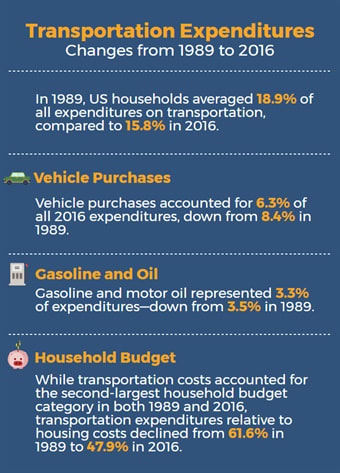
Photo: University of Michigan
Using data from the Bureau of Labor Statistics' Consumer Expenditures Survey, Michael Sivak and Brandon Schoettle of the U-M Transportation Research Institute examined transportation expenditures for 1989 and 2016 and for three groups of consumers (all income levels and the lowest and highest quintiles of income).
They found that the absolute expenditures for transportation, adjusted for inflation, dropped by 11.3% — from $5,268 in 1989 to $4,675 in 2016.
Specifically, vehicle purchases accounted for 6.3% of all expenditures last year, while gasoline and motor oil represented an additional 3.3% — down from 8.4% and 3.5%, respectively, in 1989.
While transportation costs accounted for the second-largest household budget category behind housing expenses in both 1989 and 2016, transportation expenditures relative to housing costs declined from 61.6% in 1989 to 47.9% last year.
Perhaps not surprisingly, the researchers found that total transportation expenditures in 2016 for the lowest quintile of income were proportionally higher than for the highest quintile (15% vs. 14.4%).
In addition, transportation expenditures for households in the lowest quintile of income were lower than food costs for both 1989 and 2016. In contrast, those in the highest quintile of income spent more on transportation than food in both years.
More Bus

New York MTA Plans Largest Bus Fleet Upgrade in More Than a Decade
The agency is seeking manufacturers for 650 new CNG buses to replace aging vehicles, improve reliability, and advance its broader fleet modernization strategy.
Read More →
Building a Flexible Path to Transit Electrification
John Hroncich discusses BAE Systems’ modular and scalable approach, lessons learned from decades of real-world operations, and how agencies can identify electrification strategies that fit their fleets.
Read More →
Bus Tech Talk: Keeping Transit Technicians Ahead of the Technology Curve
LA Metro’s Obed Mejia discusses technician training, evolving maintenance technology, fleet replacement, and strategies for getting the most out of today’s transit fleets.
Read More →
Biz Briefs: RIPTA Unveils New Frontrunners, Clevland RTA Adds New Siemens, and More
In METRO's latest installment, we take a look at recent news from Siemens, Prevost, Dodge, and more partnerships making headlines across the transportation sector.
Read More →
People Movement: Holly Arnold Joins Transdev and More
In this edition, we also cover recent appointments and announcements at Pace, CamTran, MCI, and more, showcasing the individuals helping to shape the future of transportation.
Read More →
The High Cost of Transit Buses: Industry Leaders Look to Procurement Reform
Transit leaders and policymakers examine how standardized bus designs, streamlined procurement, and predictable funding could help agencies stretch budgets and deliver better service.
Read More →
The Business Voice Behind Public Transportation
As chair of APTA’s Business Members Board of Governors, Ray Melleady explains how more than 850 business members are partnering with transit agencies to advance funding, innovation, and industry-wide collaboration.
Read More →
From Surviving to Thriving: Building Stronger Transportation Organizations
Bus Business Consultants founder Brian Dickson shares lessons on leadership, organizational health, and creating options for long-term success in a changing transportation industry.
Read More →
Finding the ‘Happy Medium’: Optimizing Maintenance Without Sacrificing Reliability
The key to maintenance optimization isn’t doing less work—it’s doing the right work at the right time on the right assets.
Read More →
LA Metro, City of West Hollywood, and Partners Advance Smarter Bus Lane Enforcement
The award-winning partnership combines AI-powered detection with human oversight to improve bus reliability, accessibility, and enforcement efficiency.
Read More →