




RELATED: CapMetro marks accessibility milestone with achievements
Capital Metro's 30th touts service, development accomplishments
Linda Watson’s fifth year at the agency was also recognized and her outstanding contributions were commended by her peers. To date, Watson’s accomplishments include launching MetroRapid, Austin’s first BRT service, on time and under budget, with ridership already meeting or exceeding expectations.
August 10, 2015
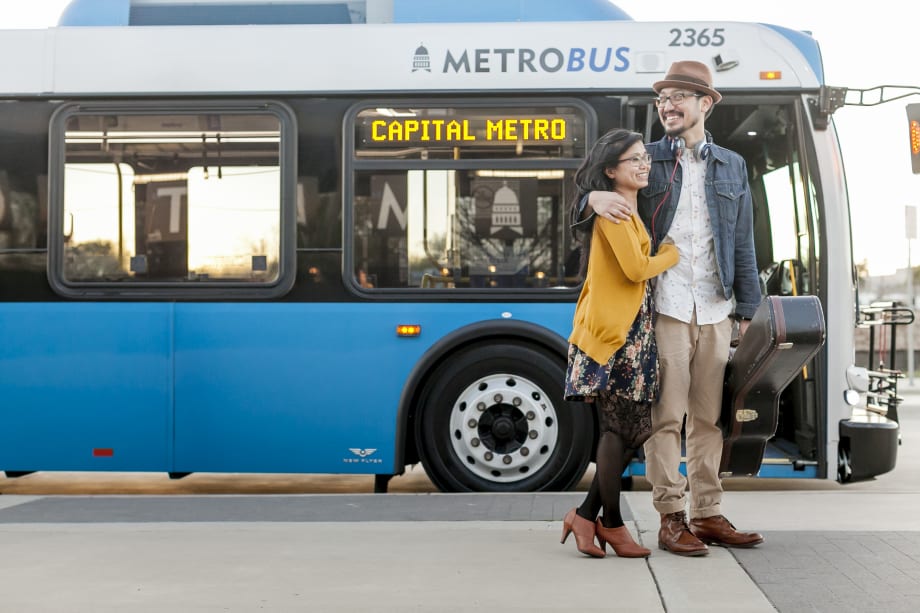
Photo: Capital Metro/Brio Photography
3 min to read

Photo: Capital Metro/Brio Photography
Austin’s transportation agency, Capital Metro, commemorated its 30th anniversary at the organization’s July 27th board meeting with a gathering that included state and local officials recognizing key milestones.
President/CEO Linda S. Watson spoke about the many strides Capital Metro has made since its launch on July 1, 1985. “We have a lot to do to continue to evolve to meet the needs of our fast-growing community," Watson said. "That’s why this whole celebration is called ‘30 Forward’….because it’s about looking ahead to another 30 great years of service.”
Several special guests paid tribute Capital Metro’s impressive history, including Austin Mayor Steve Adler; former Mayor Lee Leffingwell; Rep. Eddie Rodriguez, Texas House of Representatives; and several members of Austin’s City Council. These state and city officials read proclamations recognizing the agency’s important milestones, including providing more than 837 million bus and train rides to people in Central Texas over the last 30 years.
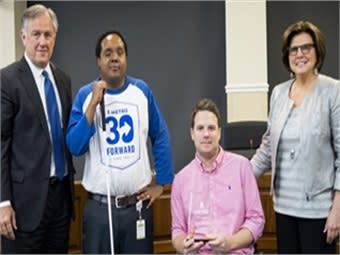
(l-r): Wade Cooper (Capital Metro Board of Directors Chairman), Martin Kareithi (Capital Metro Accessible Transportation Specialist), Boone Blocker (Access Advisory Committee Chair) and Linda Watson (Capital Metro President/CEO)
The agency has provided over 1 million rides to seniors, members of the disabled community, and low-income transit dependent riders to help them stay mobile, active and connected through its Basic Transposition Needs Fund, established in 2012.
In recent years, Capital Metro has used technological advances to enhance the rider experience. In 2014, the agency launched one of the first mobile transit apps in the country to provide a new high-tech level of convenience allowing customers to buy passes and plan trips. This year, real-time information was introduced across the entire Capital Metro fleet, bringing new predictability and reliability to riders. Recently, the agency established a high-frequency bus network that offers 15-minute departure on five popular routes, allowing people to wait less at stops and have more options.

Photo: Capital Metro/Brio Photography
A compelling series of videotaped interviews with Capital Metro’s long-term employees reflecting on their employment with the agency was shown. In addition, 49 employees, who’ve worked at Capital Metro for the entire 30-year duration, were thanked by Watson who said, “It’s a real pleasure to be a part of such a hardworking and dedicated team of people. Thank you for your dedication to Capital Metro and Central Texas.”

Former Austin Mayor Lee Leffingwell congratulates Capital Metro President/CEO Linda Watson.
Two other significant recognitions were announced during the afternoon. Those in attendance noted the 25th anniversary of the Americans with Disabilities Act. In 1992, Capital Metro became the first transit agency in Texas – and one of the first in the nation – to have a 100% ADA-accessible bus fleet. The agency also currently provides over 50,000 trips a month through its MetroAccess service, connecting people unable to use our regular services with trips to medical appointments, the grocery store and other vital places.

Photo: Capital Metro/Brio Photography
Linda Watson’s fifth year at Capital Metro was also recognized and her outstanding contributions were commended by her peers. To date, Watson’s accomplishments include launching MetroRapid, Austin’s first BRT service, on time and under budget, with ridership already meeting or exceeding expectations. Under her leadership, a $50 million grant from the Texas Department of Transportation has been secured for upcoming enhancements to MetroRail, to meet ridership which has more than quadrupled since the service launched in 2010.
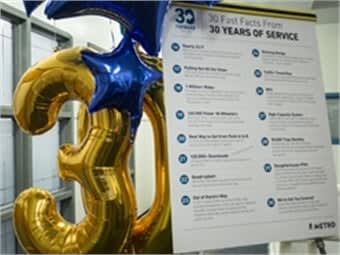
Festive decor greeted guests, many wearing t-shirts bearing the “30 Forward” theme, as they assembled in the board room.
Watson has also encourages the development of transit-friendly communities resulting, so far, in $153 million in private development generated around rail stations with more than $1 billion in additional planned transit oriented development. And while working with the City of Austin and surrounding communities, she has led efforts on area transportation system studies as part of Project Connect, including the development of a locally-preferred alternative plan to connect surrounding communities to Austin’s core.
More Management

METRO Opens Submissions for 2026 Motorcoach Awards
Nominations are now being accepted for METRO Magazine’s Operator of the Year and Innovative Operator of the Year awards.
Read More →
New York MTA Advances Final Contract for Second Avenue Subway Expansion
Contract Four is the largest in the Second Avenue Subway Phase 2 project and includes construction of station infrastructure, tracks, and signals for the subway expansion, MTA officials said. Work on Contract Four will begin in 2027.
Read More →
Transit Agencies Highlight Safety Gains at National Summit
Leaders from 15 major transit systems shared crime-reduction results and safety initiatives while discussing the role of continued federal support.
Read More →

NITA Names New Leadership, Expands Reduced-Fare Program at First Board Meeting
The new regional transit authority appointed its first board chair and interim executive director while extending reduced fares across CTA, Metra, and Pace for eligible riders.
Read More →
Beyond the Checklist: A Structured Approach to Transit Maintenance
Reliability-Centered Maintenance helps transit agencies move beyond routine checklists to focus limited resources on the assets and failures that have the greatest impact on safety, reliability, and service.
Read More →
APTA 2026 Nominating Committee Selects Leadership Slate, Names Chair and Vice Chair Nominees
Leadership changes will help shape the association’s priorities and its representation of the transportation industry during the 2026–2027 term.
Read More →
DART Launches Major Security, Fare Enforcement Initiative
The 90-day demonstration will deploy coordinated security teams at five light rail stations while testing controlled access and gathering data to guide future investments.
Read More →
Sponsored•September 9, 2026
Advancing Fare Collection Through Technology and Innovation
Learn about delivering 1300 gates at 91 stations while managing fare evasion. Explore the large scale deployment, solution customization and real-world results that affect the region. Prepare for deployment in your region now.
Read More →
Game Day in Motion: Moving Millions During the 2026 World Cup
Between packed transit stations and team motorcoaches, see how agencies and operators across North America tackled the transportation demands of the 2026 FIFA World Cup.
Read More →
Surface Transportation Extension Averts Shutdown, Leaves Transit Funding Gap
The stopgap keeps federal transportation programs moving, but missing advance funding could complicate the transit and rail projects agencies are planning next.
Read More →