



Community Transit set to launch BRT service
Staff will be at each Swift station throughout the first few days of service to answer questions. Getting riders used to paying fares at the station, not onboard the bus, is expected to be the biggest challenge.

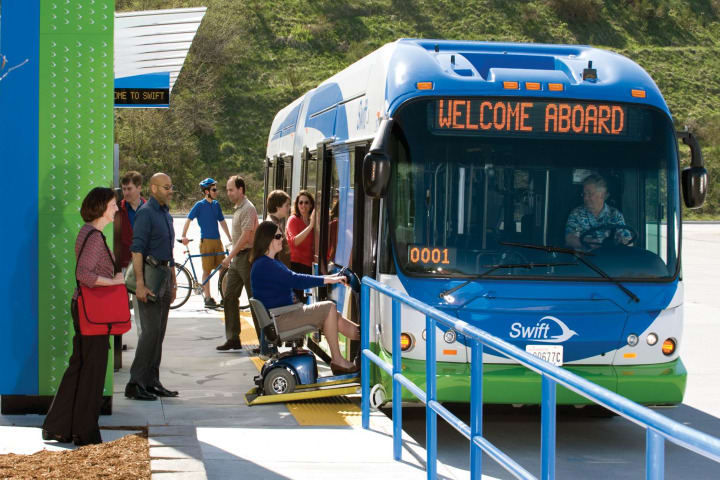
[IMAGE]Swift-station-people-full.jpg[/IMAGE]On Sunday, Nov. 29, Snohomish County, Wash.-based Community Transit will host a public celebration to launch Swift into service. The party will be held from 2 p.m. to 4 p.m. at the Crossroads Swift Station at Highway 99 and 196th Street in Lynnwood. The first Swift buses will begin service after the event, with free rides until midnight.
Swift will begin its regular weekday service at 5 a.m. Monday, Nov. 30.
“Transit service will be a little more exciting and a lot quicker with Swift,” said Community Transit CEO Joyce Eleanor. “From the distinctive hybrid Swift buses to the easily identifiable stations to the idea of off board fare collection, Swift brings a new experience to the state.”
About 100 transit fans will take the official inaugural rides on Swift buses from the Aurora Village Transit Center to the Swift launch celebration on Sunday.
The family event will include carnival games, face painting, balloon animals, a photo booth, live music and Community Transit’s super hero, Oxy Gene. Two Swift buses will be on hand for people to tour.
Swift will operate on a 17-mile corridor in Snohomish County between Everett Station and the Aurora Village Transit Center in Shoreline, primarily along Highway 99. Buses will run every 10 minutes weekdays and every 20 minutes at night and on weekends. Swift service runs until midnight seven nights a week.
Swift will stop at just 12 stations in each direction and riders will pay their fare at the stations, using ticket vending machines or ORCA smart cards. Onboard bike racks, transit signal priority to extend a green light and transit access lanes in south Snohomish County are additional features to keep Swift buses moving.
Community Transit staff will be at each Swift station throughout the first few days of service to answer questions. Getting riders used to paying fares at the station, not onboard the bus, is expected to be the biggest challenge.
“Riders must remember to pay their fare as soon as they get to the Swift station because the bus will not be stopped for long,” said Eleanor. “This is very different from the current way people ride buses, but it is essential to keep this service swift. If people use an ORCA card, it will be even easier.”
Earlier this year Community Transit adopted a fare enforcement policy that allows for citations up to $124 for people caught riding buses without paying their fare. On Swift, riders will randomly be asked to show their proof of fare payment.
More Bus

New York MTA Plans Largest Bus Fleet Upgrade in More Than a Decade
The agency is seeking manufacturers for 650 new CNG buses to replace aging vehicles, improve reliability, and advance its broader fleet modernization strategy.
Read More →
Building a Flexible Path to Transit Electrification
John Hroncich discusses BAE Systems’ modular and scalable approach, lessons learned from decades of real-world operations, and how agencies can identify electrification strategies that fit their fleets.
Read More →
Bus Tech Talk: Keeping Transit Technicians Ahead of the Technology Curve
LA Metro’s Obed Mejia discusses technician training, evolving maintenance technology, fleet replacement, and strategies for getting the most out of today’s transit fleets.
Read More →
Biz Briefs: RIPTA Unveils New Frontrunners, Clevland RTA Adds New Siemens, and More
In METRO's latest installment, we take a look at recent news from Siemens, Prevost, Dodge, and more partnerships making headlines across the transportation sector.
Read More →
People Movement: Holly Arnold Joins Transdev and More
In this edition, we also cover recent appointments and announcements at Pace, CamTran, MCI, and more, showcasing the individuals helping to shape the future of transportation.
Read More →
The High Cost of Transit Buses: Industry Leaders Look to Procurement Reform
Transit leaders and policymakers examine how standardized bus designs, streamlined procurement, and predictable funding could help agencies stretch budgets and deliver better service.
Read More →
The Business Voice Behind Public Transportation
As chair of APTA’s Business Members Board of Governors, Ray Melleady explains how more than 850 business members are partnering with transit agencies to advance funding, innovation, and industry-wide collaboration.
Read More →
From Surviving to Thriving: Building Stronger Transportation Organizations
Bus Business Consultants founder Brian Dickson shares lessons on leadership, organizational health, and creating options for long-term success in a changing transportation industry.
Read More →
Finding the ‘Happy Medium’: Optimizing Maintenance Without Sacrificing Reliability
The key to maintenance optimization isn’t doing less work—it’s doing the right work at the right time on the right assets.
Read More →
LA Metro, City of West Hollywood, and Partners Advance Smarter Bus Lane Enforcement
The award-winning partnership combines AI-powered detection with human oversight to improve bus reliability, accessibility, and enforcement efficiency.
Read More →