



Related: EMBARK's Ferbrache, Rush Join METROspectives Podcast
EMBARK Reveals Name and Branding for Upcoming Bus Rapid Transit System
The board received the final brand package for the brand that includes a logo and other conceptual elements for the vehicle and platform.
by Staff
November 5, 2021
EMBARK and Comm solicited input throughout the months-long process that involved EMBARK staff, city and industry leaders as well as a community workgroup of business owners, community leaders, and residents.
Photo: EMBARK
2 min to read
The Central Oklahoma Transportation and Parking Authority Board of Trustees announced it recently approved “RAPID” as the name for EMBARK’s Bus Rapid Transit (BRT) system that is expected to begin service in late 2023, according to the company's press release.
The board received the final brand package for RAPID that includes a logo and other conceptual elements for the vehicle and platform.
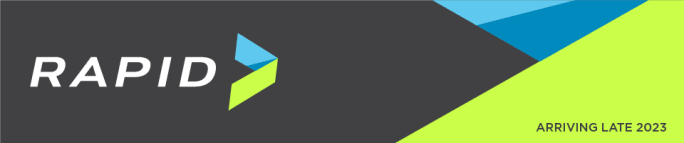
Photo: EMBARK
“EMBARK’s vision is to deliver world-class transportation to our region. RAPID helps us move closer to that vision by creating connections where people can move more freely,” said Jason Ferbrache, EMBARK administrator. “Stakeholders shared that the brand should be inviting, progressive, and sleek – that’s what we delivered.”
The brand strategy was created by Koch Comm, a local PR, digital, and creative firm in Oklahoma City, with input from stakeholders. EMBARK and Comm solicited input throughout the months-long process that involved EMBARK staff, city and industry leaders as well as a community workgroup of business owners, community leaders, and residents.
“From our research and focus group conversations, it became exceedingly clear how committed the community is to supporting robust transit options that improve the accessibility to our neighborhoods, businesses and public spaces,” said Kym Koch-Thompson, principal of Koch Comm. “We are honored to have a role in the branding of a project with such magnitude and influence on the future of our city.”
RAPID Northwest will be the system’s first line, connecting downtown OKC to the northwest side of Oklahoma City. It originates downtown and travels 9-1/2 miles each way through Classen Boulevard and Northwest Expressway.
It is estimated that over 20% of the region’s jobs and around 40,000 residents live within 1/2 mile of the first line.
“The RAPID offers our district a way to embrace connectivity between our community with other neighborhoods,” said Thuan Nguyen, chair of the Oklahoma City Asian District Cultural Association and member of the BRT community workgroup. “It is an honor and great example of public and private organizations working together toward a shared goal that benefits current and future visitors, residents, and members of our community.”
The project is funded through local and federal sources. More than half of the project is funded by a $14.3 million B.U.I.L.D. grant for construction from the U.S. Department of Transportation in 2018.
RAPID will be comprised of nine Compressed Natural Gas (CNG) vehicles with upgraded seating and amenities providing 12-15 minute service. The raised-platform stops will facilitate level ADA accessible boarding, real-time customer information, waste receptacles, ticketing kiosk, security lighting, bike racks, and branded pylon.
More Bus

New York MTA Plans Largest Bus Fleet Upgrade in More Than a Decade
The agency is seeking manufacturers for 650 new CNG buses to replace aging vehicles, improve reliability, and advance its broader fleet modernization strategy.
Read More →
Building a Flexible Path to Transit Electrification
John Hroncich discusses BAE Systems’ modular and scalable approach, lessons learned from decades of real-world operations, and how agencies can identify electrification strategies that fit their fleets.
Read More →
Bus Tech Talk: Keeping Transit Technicians Ahead of the Technology Curve
LA Metro’s Obed Mejia discusses technician training, evolving maintenance technology, fleet replacement, and strategies for getting the most out of today’s transit fleets.
Read More →
Biz Briefs: RIPTA Unveils New Frontrunners, Clevland RTA Adds New Siemens, and More
In METRO's latest installment, we take a look at recent news from Siemens, Prevost, Dodge, and more partnerships making headlines across the transportation sector.
Read More →
People Movement: Holly Arnold Joins Transdev and More
In this edition, we also cover recent appointments and announcements at Pace, CamTran, MCI, and more, showcasing the individuals helping to shape the future of transportation.
Read More →
The High Cost of Transit Buses: Industry Leaders Look to Procurement Reform
Transit leaders and policymakers examine how standardized bus designs, streamlined procurement, and predictable funding could help agencies stretch budgets and deliver better service.
Read More →
The Business Voice Behind Public Transportation
As chair of APTA’s Business Members Board of Governors, Ray Melleady explains how more than 850 business members are partnering with transit agencies to advance funding, innovation, and industry-wide collaboration.
Read More →
From Surviving to Thriving: Building Stronger Transportation Organizations
Bus Business Consultants founder Brian Dickson shares lessons on leadership, organizational health, and creating options for long-term success in a changing transportation industry.
Read More →
Finding the ‘Happy Medium’: Optimizing Maintenance Without Sacrificing Reliability
The key to maintenance optimization isn’t doing less work—it’s doing the right work at the right time on the right assets.
Read More →
LA Metro, City of West Hollywood, and Partners Advance Smarter Bus Lane Enforcement
The award-winning partnership combines AI-powered detection with human oversight to improve bus reliability, accessibility, and enforcement efficiency.
Read More →