



Feds propose new rules to protect bus passengers in rollover crashes
Performance requirements would ensure a sufficient level of survival space and reduce the risk of ejection in rollover crashes.

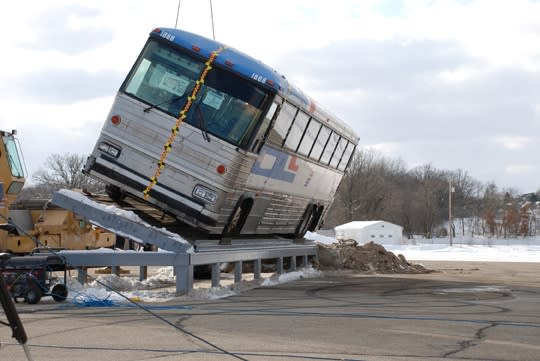
Motorcoach rollover testing image courtesy NHTSA.
Motorcoach rollover testing image courtesy NHTSA.
The U.S. National Highway Traffic Safety Administration (NHTSA) proposed new rules to protect passengers in large bus crashes by requiring structural improvements to the vehicle's design.
According to The Detroit News, the rules won’t require school buses or urban transit buses to get the upgrades or seek significant retrofitting of existing buses.
RELATED:NHTSA to require seat belts on motorcoaches
"The consequences for passengers in rollover crashes are severe," said U.S. Transportation Secretary Anthony Foxx. "I want passengers to know that when this Department sees opportunities to make their travel safer so that they can more confidently visit their families or get to work, we are going to do just that and we believe this proposal is a step in that direction."
The proposed standard would establish performance requirements that each new motorcoach and large bus must meet when subjected to a dynamic test in which the bus is tipped over from a raised platform onto a hard level surface. The proposed standard would:
Require space around occupant seating positions to be maintained to afford occupants a survivable space in a crash;
Require the seats, overhead luggage racks, and window glazing to remain attached to their mountings during and after the test; and
Require emergency exits to remain closed during the rollover test and operable after the test.
Both the proposed test procedure and performance requirements are closely modeled after the European regulations for large buses. In a separate rulemaking action to improve safety even further, the Department is planning on finalizing requirements later this year for stability control technologies in these vehicles, which would help prevent rollovers from occurring.
"The traveling public deserves safer service and peace of mind when they board a motorcoach or large bus," said NHTSA Acting Administrator David Friedman. "Stronger large bus structures, combined with seat belt use will help keep passengers secured and protected in the event of a crash."
"In addition to taking critical steps to improve the structural design of buses," said FMCSA Administrator Anne Ferro, "We are committed to further increasing motorcoach safety through stricter oversight, in-depth investigations into high-risk companies, and by ensuring that drivers are properly licensed and medically fit for the job."
NHTSA's Notice of Proposed Rulemaking can be viewed in the Federal Register and members of the public will have the opportunity to comment on the proposal for 60 days. NHTSA is proposing a compliance date of three years after publication of a final rule. Read the NPRM.
For additional safety information regarding motorcoach travel or to download FMCSA's free SaferBus mobile app, visit the Look Before You Book website. As always, FMCSA urges travelers to report any unsafe bus company, vehicle or driver by calling its toll free hotline 1-888-DOT-SAFT (1-888-368-7238) or online: http://nccdb.fmcsa.dot.gov.
More Bus

New York MTA Plans Largest Bus Fleet Upgrade in More Than a Decade
The agency is seeking manufacturers for 650 new CNG buses to replace aging vehicles, improve reliability, and advance its broader fleet modernization strategy.
Read More →
Building a Flexible Path to Transit Electrification
John Hroncich discusses BAE Systems’ modular and scalable approach, lessons learned from decades of real-world operations, and how agencies can identify electrification strategies that fit their fleets.
Read More →
Bus Tech Talk: Keeping Transit Technicians Ahead of the Technology Curve
LA Metro’s Obed Mejia discusses technician training, evolving maintenance technology, fleet replacement, and strategies for getting the most out of today’s transit fleets.
Read More →
Biz Briefs: RIPTA Unveils New Frontrunners, Clevland RTA Adds New Siemens, and More
In METRO's latest installment, we take a look at recent news from Siemens, Prevost, Dodge, and more partnerships making headlines across the transportation sector.
Read More →
People Movement: Holly Arnold Joins Transdev and More
In this edition, we also cover recent appointments and announcements at Pace, CamTran, MCI, and more, showcasing the individuals helping to shape the future of transportation.
Read More →
The High Cost of Transit Buses: Industry Leaders Look to Procurement Reform
Transit leaders and policymakers examine how standardized bus designs, streamlined procurement, and predictable funding could help agencies stretch budgets and deliver better service.
Read More →
The Business Voice Behind Public Transportation
As chair of APTA’s Business Members Board of Governors, Ray Melleady explains how more than 850 business members are partnering with transit agencies to advance funding, innovation, and industry-wide collaboration.
Read More →
From Surviving to Thriving: Building Stronger Transportation Organizations
Bus Business Consultants founder Brian Dickson shares lessons on leadership, organizational health, and creating options for long-term success in a changing transportation industry.
Read More →
Finding the ‘Happy Medium’: Optimizing Maintenance Without Sacrificing Reliability
The key to maintenance optimization isn’t doing less work—it’s doing the right work at the right time on the right assets.
Read More →
LA Metro, City of West Hollywood, and Partners Advance Smarter Bus Lane Enforcement
The award-winning partnership combines AI-powered detection with human oversight to improve bus reliability, accessibility, and enforcement efficiency.
Read More →