



FRA approves blueprint to connect Boston, New Haven to Montreal via rail
The Initiative proposes to restore service between Boston and New Haven, Conn., through Springfield, Mass. and Hartford, Conn., and add new service between Boston and Montreal.

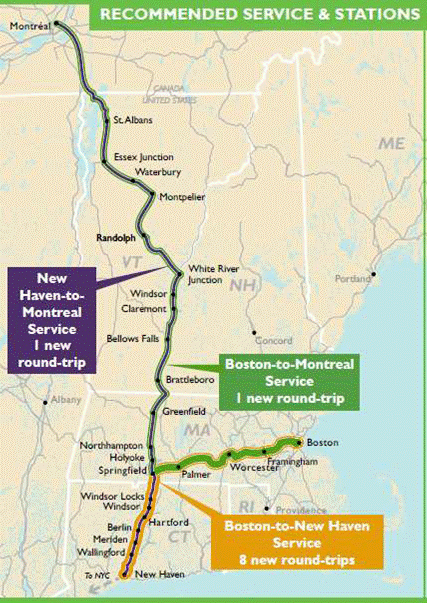
The Federal Railroad Administration (FRA) announced a Finding of No Significant Impact on the Northern New England Intercity Rail Initiative (Initiative), clearing the way for states and the federal government to invest in future passenger rail service in New England.
The Initiative proposes to restore service between Boston and New Haven, Conn., through Springfield, Mass. and Hartford, Conn., and add new service between Boston and Montreal.
“Existing passenger rail service through New England is limited and already at capacity for a region that is growing,” said U.S. Transportation Secretary Anthony Foxx. “With an approved blueprint in hand, New England can now move forward to connect people to key job centers and allow students to easily travel to and from New England’s numerous colleges.”
FRA awarded $942,775 to the Massachusetts Department of Transportation (MassDOT) and the Vermont Agency of Transportation (VTrans) through FRA’s Next Generation High-Speed Rail Program to study potential service options and complete the Tier 1 Environmental Assessment, in accordance with the National Environmental Policy Act.
FRA found that no significant environmental impacts would result from adding more frequent and higher speed intercity passenger rail service, in large part due to the use of existing operating rail lines within existing rights-of-way. The proposed infrastructure improvements also would be located within existing right-of-way along areas that were in the past double or triple tracked.
MassDOT and VTrans will coordinate the Initiative with other projects, including NEC FUTURE, FRA’s ongoing comprehensive planning effort to define, evaluate, and prioritize future investments in the Northeast Corridor (NEC). Together, this Initiative and NEC FUTURE would provide greater connectivity to central Connecticut, Massachusetts, northern New England and Montreal.
More Rail
Amtrak, CN Reach Agreements to Strengthen Passenger Rail Service, Safety
The agreement resolves a more than decade-long proceeding before the Surface Transportation Board concerning the terms and conditions for Amtrak services, such as the City of New Orleans, Illini/Saluki, and Wolverine.
Read More →
New York MTA Advances Final Contract for Second Avenue Subway Expansion
Contract Four is the largest in the Second Avenue Subway Phase 2 project and includes construction of station infrastructure, tracks, and signals for the subway expansion, MTA officials said. Work on Contract Four will begin in 2027.
Read More →
San Diego MTS Breaks Monthly Trolley Ridership Record
Agency officials said July’s ridership indicates MTS’s continued recovery from the pandemic.
Read More →
Report Examines NJ TRANSIT Reliability, Funding Challenges
The Garden State Initiative analysis examines the roles of Amtrak infrastructure, fleet management, and agency operations while recommending a more performance-based approach to improving reliability.
Read More →
Stadler, CapMetro Sign Long-Term Rail Fleet Support Agreement
Beginning in 2027, Stadler will provide on-site technical expertise, spare parts support, training, and obsolescence management to help extend the reliability and longevity of CapMetro’s GTW fleet.
Read More →
Biz Briefs: Alstom Lands Canadian Contract, LYT to Supply California TSP, and More
In METRO's latest installment, we take a look at recent news from Complete Coach Works, Beep, FlixBus, and more partnerships making headlines across the transportation sector.
Read More →
CATS Gold Line Marks 5 Years of Service, 2.8M Passenger Trips
With a six-mile expansion planned, the Charlotte streetcar is positioned to connect more neighborhoods and major transit hubs across the region.
Read More →
Why Simulating Pedestrian Movement Has Become Essential for Modern Rail Stations
Pedestrian microsimulation is helping rail planners identify bottlenecks, test station designs, and prepare complex transit hubs for growing passenger volumes.
Read More →
Amtrak Begins Major Construction at New York’s Sunnyside Yard
The new maintenance facility will support Amtrak’s Airo trainsets while improving maintenance efficiency and turnaround times in New York.
Read More →
Chicago Leaders Unveil Plans for O’Hare Airport Express Train
The privately developed project would offer a 15-minute trip between downtown and O’Hare’s Terminal 2, with trains operating every 15 minutes on a dedicated track. The service would use battery-electric trains and three existing freight rail rights-of-way.
Read More →