




RELATED: How Metro is inspiring, training tomorrow's workforce
L.A. Metro Red Line subway celebrates 25 years of service
The popularity of the subway system sparked a renaissance of rail planning and construction in L.A. County that now spans 105 miles of Metro Rail, with four new projects currently under construction.
January 30, 2018
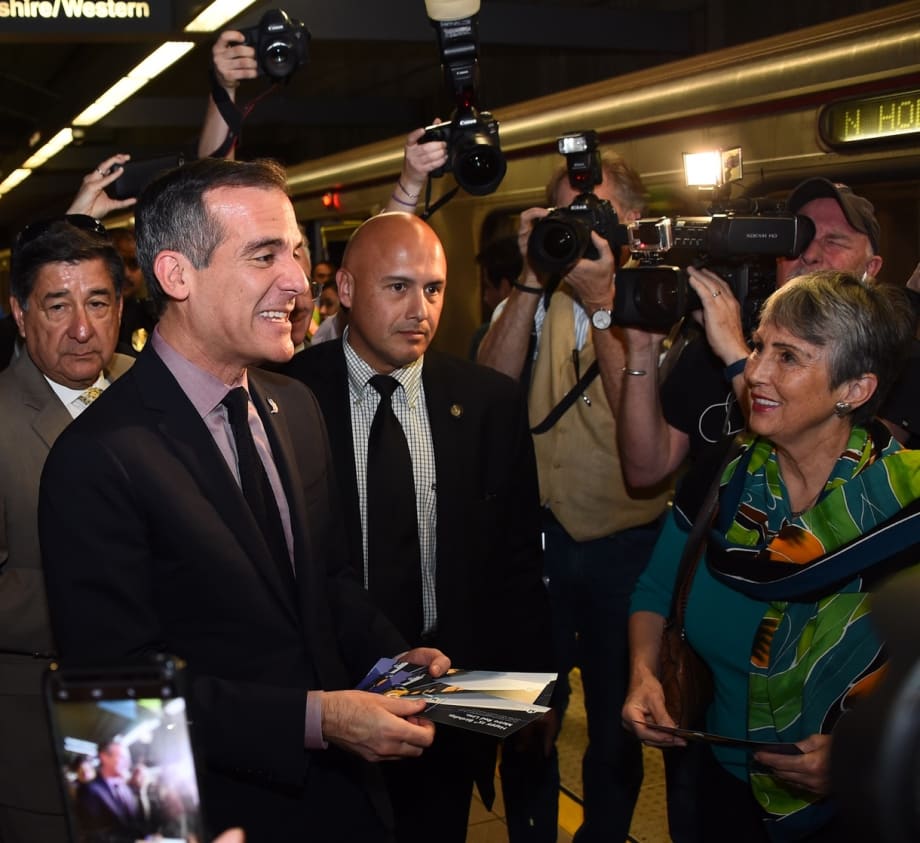
Los Angeles Mayor and Metro Board Chair Eric Garcetti Rides the Metro Red Line subway handing out complimentary 25th Birthday TAP cards to riders.
3 min to read
Los Angeles Mayor and Metro Board Chair Eric Garcetti Rides the Metro Red Line subway handing out complimentary 25th Birthday TAP cards to riders.
Elected officials and community stakeholders joined Los Angeles Mayor and Los Angeles County Metropolitan Transportation Authority’s (Metro) Board Chair Eric Garcetti to celebrate the Metro Red Line’s 25th birthday. The popularity of the subway system sparked a renaissance of rail planning and construction in L.A. County that now spans 105 miles of Metro Rail, with four new projects currently under construction.
“Twenty-five years ago, the Red Line transformed how we connect our communities — and today, it is the backbone of our Metro network and a blueprint for our transportation future,” said Los Angeles Mayor and Metro Board Chair Eric Garcetti. “I’m proud to celebrate the progress we’ve made, and excited to continue this historic journey in the years to come.”
Over the last 25 years, the Red Line has carried an estimated 817 million passengers while traveling approximately 3.6 billion miles. The Red Line currently has more than 140,000 boardings on an average weekday.
Planning for the Metro Red Line began in earnest in 1975, when Metro’s predecessor agency, the Southern California Rapid Transit District (RTD), established a Rapid Transit Advisory Committee to evaluate a series of transportation corridors in Los Angeles County.
These corridors were within the densely-populated “regional core,” an area of 55 square miles that included the Central Business District, the Mid-Wilshire, and Miracle Mile areas along Wilshire Boulevard, Hollywood, and Universal City and North Hollywood in the San Fernando Valley.
Groundbreaking for the Metro Red Line occurred in September 1986, near the future home of the Civic Center Station. The first 4.4-mile segment opened in 1993 and included five stations between Union Station and MacArthur Park, as well as a rail maintenance yard and shop.
In July 1996, the line was extended from MacArthur Park to Wilshire/Western. In December 1999, the next segment opened from Wilshire/Vermont to Hollywood/Vine. The final three stations opened in June 2000, pushing the subway to Hollywood/Highland, Universal City and North Hollywood in the San Fernando Valley. In 2006, the Wilshire “spur” portion of the Red Line from Union Station to Wilshire/Western was renamed the Purple Line.
Over the last quarter century, 10 joint developments with a value of more than $1.3 billion have been built along the Red and Purple Lines, including mixed-use buildings with residences and retail, schools, and hotels. These include developments at stations, including Hollywood/Highland, Hollywood/Vine, Hollywood/Western, Wilshire/Vermont, and Westlake/MacArthur Park. In total, 379 of the residential units developed are affordable. Joint development projects at the North Hollywood Red Line Station and the Vermont/Santa Monica Station are currently in progress.
Expanding the subway is also underway with the Purple Line to be extended to the VA Hospital in Westwood in three phases. The first segment from Wilshire/Western to Wilshire/La Cienega is under construction and a groundbreaking date for the next segment to downtown Beverly Hills and Century will be soon announced. Metro is forecasting the entire project to the VA Hospital will be complete by 2026, two years prior to the 2028 Summer Olympics and Paralympics that are to be held in the L.A. region.
“As we celebrate the Red Line’s 25th birthday we also look toward expanding not only our subway system but transportation in general across the entire region for many decades to come,” said Metro CEO Phillip A. Washington.
Growth of the Metro Rail system continues with four additional lines now under construction. In addition to the subway, these include the Regional Connector Transit Project, the Crenshaw/LAX Line, and the Gold Line Extension from Azusa to Claremont.
As part of the celebration, Mayor Garcetti and other elected officials and dignitaries rode the Red Line from the Civic Center Station to Union Station and handed out complimentary 25th Birthday Metro Red Line TAP Cards and lapel pins.
More Rail

New York MTA Advances Final Contract for Second Avenue Subway Expansion
Contract Four is the largest in the Second Avenue Subway Phase 2 project and includes construction of station infrastructure, tracks, and signals for the subway expansion, MTA officials said. Work on Contract Four will begin in 2027.
Read More →
San Diego MTS Breaks Monthly Trolley Ridership Record
Agency officials said July’s ridership indicates MTS’s continued recovery from the pandemic.
Read More →
Report Examines NJ TRANSIT Reliability, Funding Challenges
The Garden State Initiative analysis examines the roles of Amtrak infrastructure, fleet management, and agency operations while recommending a more performance-based approach to improving reliability.
Read More →
Stadler, CapMetro Sign Long-Term Rail Fleet Support Agreement
Beginning in 2027, Stadler will provide on-site technical expertise, spare parts support, training, and obsolescence management to help extend the reliability and longevity of CapMetro’s GTW fleet.
Read More →
Biz Briefs: Alstom Lands Canadian Contract, LYT to Supply California TSP, and More
In METRO's latest installment, we take a look at recent news from Complete Coach Works, Beep, FlixBus, and more partnerships making headlines across the transportation sector.
Read More →
CATS Gold Line Marks 5 Years of Service, 2.8M Passenger Trips
With a six-mile expansion planned, the Charlotte streetcar is positioned to connect more neighborhoods and major transit hubs across the region.
Read More →
Why Simulating Pedestrian Movement Has Become Essential for Modern Rail Stations
Pedestrian microsimulation is helping rail planners identify bottlenecks, test station designs, and prepare complex transit hubs for growing passenger volumes.
Read More →
Amtrak Begins Major Construction at New York’s Sunnyside Yard
The new maintenance facility will support Amtrak’s Airo trainsets while improving maintenance efficiency and turnaround times in New York.
Read More →
Chicago Leaders Unveil Plans for O’Hare Airport Express Train
The privately developed project would offer a 15-minute trip between downtown and O’Hare’s Terminal 2, with trains operating every 15 minutes on a dedicated track. The service would use battery-electric trains and three existing freight rail rights-of-way.
Read More →
OCTA Maps Out 30-Year Strategy to Protect Coastal Rail Corridor
The draft feasibility report identifies strategies to protect the coastal rail line for decades as the agency continues near-term stabilization and sand placement efforts.
Read More →