




RELATED: [Video] MBTA's Operations and Control Center - Behind the Scenes
MBTA GM DePaola to retire, citing cancer fight
His accomplishments as GM include improving service for MBTA riders, designing and implementing an $83 million Winter Resiliency program and ensuring that the renovation of Government Center Station was completed on time and on budget.
May 24, 2016

Photo: MBTA
4 min to read
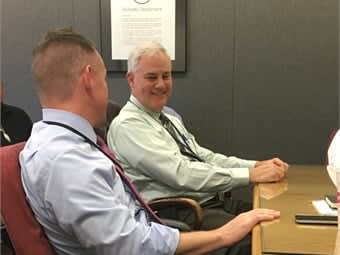
Photo: MBTA
Frank DePaola, P.E., who has served as GM of the Massachusetts Bay Transportation Authority (MBTA) since February 2015, announced to staff Monday that he plans to retire after his current appointment expires on June 30.
Secretary of Transportation Stephanie Pollack thanked DePaola in a letter to MBTA employees and announced that MBTA Chief Administrator Brian Shortsleeve would step into the role of Acting General Manager effective July 1, with MBTA Chief Operating Officer Jeffrey Gonneville assuming additional responsibilities at that time.
Secretary Pollack said, "I have already begun consultations with the members of the Fiscal and Management Control Board on how best to ensure that during the coming transition the MBTA continues to serve its customers safely and reliably, builds on the progress that has been made on financial stability and increases its investment in maintenance and capital assets."
"It has been an honor to serve as General Manager during this critical period and to work with so many dedicated colleagues and employees who have helped the MBTA improve service, become more resilient and fix the T's aging assets," DePaola said. Referring to his battle with cancer, DePaola called the job of General Manager "rewarding and relentless." He added, "My decision to retire is a difficult one but I cannot continue to spend the countless hours that the job demands while continuing needed treatment and focusing on my health."
Governor Charlie Baker praised DePaola for his service, "Frank has been the kind of General Manager that the MBTA needs, someone whose management style has helped the MBTA to increase the public's confidence in the transit system's performance while also leading the T workforce during a period of change. On behalf of the Baker-Polito Administration, I want to express my appreciation to Frank for his work ethic and dedication."
Secretary Pollack added, "Frank has always stepped up when his management and engineering skills were needed." She noted that DePaola had been working at the MBTA as Assistant GM for Design and Construction in March 2011, when he was named MassDOT's Highway Administrator after a light fixture fell from the ceiling in one of the Central Artery tunnels. DePaola went on to serve as Acting Secretary of Transportation beginning in November 2014 and, after Pollack was named Secretary in January 2015, DePaola was named the first Chief Operating Officer of the Massachusetts Department of Transportation.
"Almost exactly four years after Frank left the MBTA to help MassDOT's highway programs regain their footing, he agreed to return to the MBTA to help the organization recover from the devastating winter of 2015, re-focus on customer service and operating performance and develop and implement a winter resiliency program," Pollack noted. She recalled that, "When I walked into his office to ask if he'd take on the challenge, Frank told me he'd already begun planning for both the recovery effort and for repairs to tracks, power and signals that would need to begin almost immediately in order to be completed before the next winter."
Since assuming the leadership role of the MBTA in February 2015, DePaola has shared responsibility with Chief Administrator Shortsleeve, overseeing the MBTA departments responsible for operations, safety, systemwide accessibility and capital program delivery. His accomplishments as General Manager include improving service for MBTA riders, designing and implementing an $83 million Winter Resiliency program and ensuring that the renovation of Government Center Station was completed on time and on budget. DePaola also supervised the Interim Project Management Team that re-designed the Green Line Extension Project after massive cost overruns led the MassDOT Board and MBTA Fiscal and Management Control Board to call for comprehensive changes in the project.
DePaola is a licensed, registered Professional Engineer in Massachusetts and Rhode Island, and holds a Master of Science Degree in Civil Engineering from Northeastern University and a Bachelor of Science Degree from the University of Massachusetts-Dartmouth.
Secretary Pollack, who under the MBTA reform legislation enacted last year is responsible for hiring the MBTA's General Manager, pledged to "work closely with FMCB and MassDOT Board members and MBTA leaders to develop a transition plan that will ensure continued progress in the near-term while laying the groundwork for the stable, long-term leadership and governance that will help the MBTA to once again become one of the safest, most reliable and customer-focused and best maintained transit agencies in the United States." As part of that transition, as of July 1 Chief Administrator Shortsleeve will become Acting General Manager and Chief Operating Officer Gonneville will take on additional responsibilities including oversight of the MBTA's safety, environmental and system wide accessibility departments.
More Management

METRO Opens Submissions for 2026 Motorcoach Awards
Nominations are now being accepted for METRO Magazine’s Operator of the Year and Innovative Operator of the Year awards.
Read More →
New York MTA Advances Final Contract for Second Avenue Subway Expansion
Contract Four is the largest in the Second Avenue Subway Phase 2 project and includes construction of station infrastructure, tracks, and signals for the subway expansion, MTA officials said. Work on Contract Four will begin in 2027.
Read More →
Transit Agencies Highlight Safety Gains at National Summit
Leaders from 15 major transit systems shared crime-reduction results and safety initiatives while discussing the role of continued federal support.
Read More →

NITA Names New Leadership, Expands Reduced-Fare Program at First Board Meeting
The new regional transit authority appointed its first board chair and interim executive director while extending reduced fares across CTA, Metra, and Pace for eligible riders.
Read More →
Beyond the Checklist: A Structured Approach to Transit Maintenance
Reliability-Centered Maintenance helps transit agencies move beyond routine checklists to focus limited resources on the assets and failures that have the greatest impact on safety, reliability, and service.
Read More →
APTA 2026 Nominating Committee Selects Leadership Slate, Names Chair and Vice Chair Nominees
Leadership changes will help shape the association’s priorities and its representation of the transportation industry during the 2026–2027 term.
Read More →
DART Launches Major Security, Fare Enforcement Initiative
The 90-day demonstration will deploy coordinated security teams at five light rail stations while testing controlled access and gathering data to guide future investments.
Read More →
Sponsored•September 9, 2026
Advancing Fare Collection Through Technology and Innovation
Learn about delivering 1300 gates at 91 stations while managing fare evasion. Explore the large scale deployment, solution customization and real-world results that affect the region. Prepare for deployment in your region now.
Read More →
Game Day in Motion: Moving Millions During the 2026 World Cup
Between packed transit stations and team motorcoaches, see how agencies and operators across North America tackled the transportation demands of the 2026 FIFA World Cup.
Read More →
Surface Transportation Extension Averts Shutdown, Leaves Transit Funding Gap
The stopgap keeps federal transportation programs moving, but missing advance funding could complicate the transit and rail projects agencies are planning next.
Read More →