




RELATED: Hyperloop begins construction process on passenger transport system
MIT students win first round of SpaceX Hyperloop contest
Beating out a field of more than 100 other teams from around the world, the group of MIT graduate students won the best overall design award for a vehicle, or pod, that will ride inside the Hyperloop, a system of tubes connecting major cities.
February 1, 2016
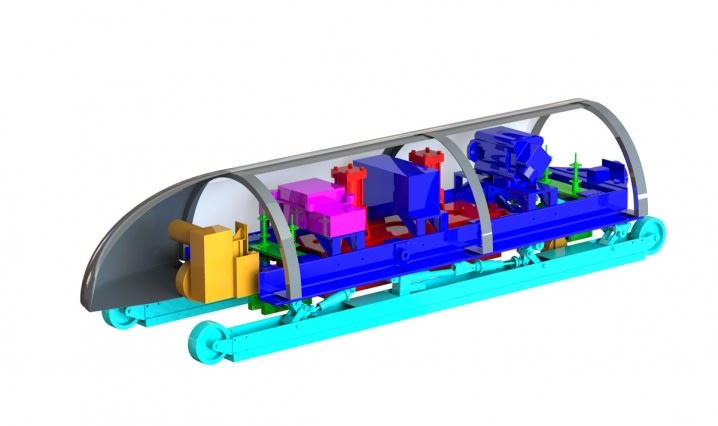
A rendering of MIT's Hyperloop pod design. Image courtesy of MIT Hyperloop Team.
3 min to read
A rendering of MIT's Hyperloop pod design. Image courtesy of MIT Hyperloop Team.
By Leda Zimmerman | School of Engineering, Massachusetts Institute of Technology
A team from MIT (Massachusetts Institute of Technology) took top honors Saturday at a competition at Texas A&M University to design the Hyperloop, a high-speed transportation concept dreamed up by Tesla Motors and SpaceX CEO Elon Musk.
Beating out a field of more than 100 other teams from around the world, the group of MIT graduate students won the best overall design award for a vehicle, or pod, that will ride inside the Hyperloop, a system of tubes connecting major cities — or what Musk calls “a fifth mode of transportation.” They will now move on to build a small-scale prototype of their design and test it this summer on a track being built next to the SpaceX headquarters in Hawthorne, Calif.
“MIT has been involved in so many technological breakthroughs in the past century,” says team captain Philippe Kirschen, a master’s student in aeronautics and astronautics. “It just makes sense we would help advance what might be the future of transportation.”
In 2013, Musk declared war on conventional inter-city travel. Last summer, he threw down the gauntlet, announcing a year-long competition to design vehicles for his Hyperloop scheme, a transit system ideally suited for major city pairs separated by 900 miles or less (think San Francisco and Los Angeles). In Hyperloop, people and freight are propelled in pods through tubes maintained at a near-vacuum. In the absence of air or surface friction, the pods travel at close to the speed of sound (around 750 miles per hour), using low-energy propulsion systems.
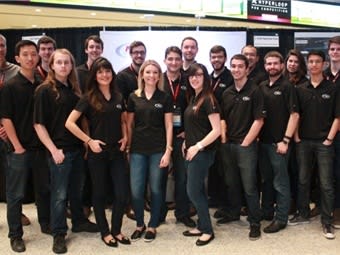
MIT Hyperloop Team: Doug Hart, Shawn Zhang, Colm O’Rourke, Greg Izatt, Greg Monahan , Nargis Sakhbova, Philippe Kirschen, Georgiana Vancea, Chris Merian, Peter Chamberlain, Sabrina Ball, Charlie Wheeler, Derek Paxson, Chuan Zhang, John Mayo, Rachel Dias Carlson, Lakshya Jain, Max Opgenoord. Additional team members not pictured: Yiou He, Philip Caplan, Olaide Olambiwonnu, Nick Baladis, Aleksandr Rakitin, and Josh Chen.
Photo courtesy of Nargis Sakhibova.
Since the fall, Kirschen and approximately two dozen fellow graduate students from a variety of engineering disciplines have been racing to create a design and sub-scale, prototype pod for the competition. Pods must accommodate a mechanical pusher that will serve as a propulsion system, and may levitate inside a near-vacuum tube that encloses the track. The capsules must also be equipped with sensors that can broadcast real-time telemetry data during the mile-long run.
With strengths in aeronautics, mechanical engineering, and electrical engineering and computer science, the MIT Hyperloop Team focused on speed, braking, stability, and levitation. For the latter problem, they developed a model for electrodynamic suspension that relies on powerful magnets placed over a conducting plate, which in this case is the aluminum track SpaceX is building. The magnets generate lift. “The beauty of the system we designed,” says Kirschen, “is that it’s completely passive, an elegant property that will make our pod very scalable.”
This innovation, a departure from Musk’s original notion of pods levitating on a cushion of air, required a major research thrust. “None of us knew anything about magnets, and there has definitely been a steep learning curve for us,” Kirschen says.
The team is gathering support from all over MIT. Douglas P. Hart of Mechanical Engineering, is facilitating team members working on the project for credit as part of his Engineering System Development course. During MIT's Independent Activities Period in January, the team finalized its pod design for the competition at Texas A&M. Their final capsule came in roughly 2.5 meters long, about one meter wide; it weighs 250 kilograms, and has the aerodynamic feel, says Kirschen, of a bobsled.
With the first stage of the competition behind them, the action now shifts to fabrication on a larger scale. The team will move from simulations to aluminum and carbon fiber, trying out braking systems, and, with great caution, testing dangerously strong magnets. Final assembly must be complete by mid-May. “Ideally, it will reach a speed in excess of 100 meters per second,” Kirschen says. There will be no passengers on board for the 20-second inaugural run.
This story was originally published by MIT News
More Bus

New York MTA Plans Largest Bus Fleet Upgrade in More Than a Decade
The agency is seeking manufacturers for 650 new CNG buses to replace aging vehicles, improve reliability, and advance its broader fleet modernization strategy.
Read More →
Building a Flexible Path to Transit Electrification
John Hroncich discusses BAE Systems’ modular and scalable approach, lessons learned from decades of real-world operations, and how agencies can identify electrification strategies that fit their fleets.
Read More →
Bus Tech Talk: Keeping Transit Technicians Ahead of the Technology Curve
LA Metro’s Obed Mejia discusses technician training, evolving maintenance technology, fleet replacement, and strategies for getting the most out of today’s transit fleets.
Read More →
Biz Briefs: RIPTA Unveils New Frontrunners, Clevland RTA Adds New Siemens, and More
In METRO's latest installment, we take a look at recent news from Siemens, Prevost, Dodge, and more partnerships making headlines across the transportation sector.
Read More →
People Movement: Holly Arnold Joins Transdev and More
In this edition, we also cover recent appointments and announcements at Pace, CamTran, MCI, and more, showcasing the individuals helping to shape the future of transportation.
Read More →
The High Cost of Transit Buses: Industry Leaders Look to Procurement Reform
Transit leaders and policymakers examine how standardized bus designs, streamlined procurement, and predictable funding could help agencies stretch budgets and deliver better service.
Read More →
The Business Voice Behind Public Transportation
As chair of APTA’s Business Members Board of Governors, Ray Melleady explains how more than 850 business members are partnering with transit agencies to advance funding, innovation, and industry-wide collaboration.
Read More →
From Surviving to Thriving: Building Stronger Transportation Organizations
Bus Business Consultants founder Brian Dickson shares lessons on leadership, organizational health, and creating options for long-term success in a changing transportation industry.
Read More →
Finding the ‘Happy Medium’: Optimizing Maintenance Without Sacrificing Reliability
The key to maintenance optimization isn’t doing less work—it’s doing the right work at the right time on the right assets.
Read More →
LA Metro, City of West Hollywood, and Partners Advance Smarter Bus Lane Enforcement
The award-winning partnership combines AI-powered detection with human oversight to improve bus reliability, accessibility, and enforcement efficiency.
Read More →