



N.Y. MTA reopens station damaged on 9/11
The collapse of the Twin Towers caused significant damage to the Cortlandt Street R station as well as the Cortlandt Street station on the 1 line, which remains out of service. The $20 million project to reopen the southbound platform was funded by the Port Authority and the MTA.

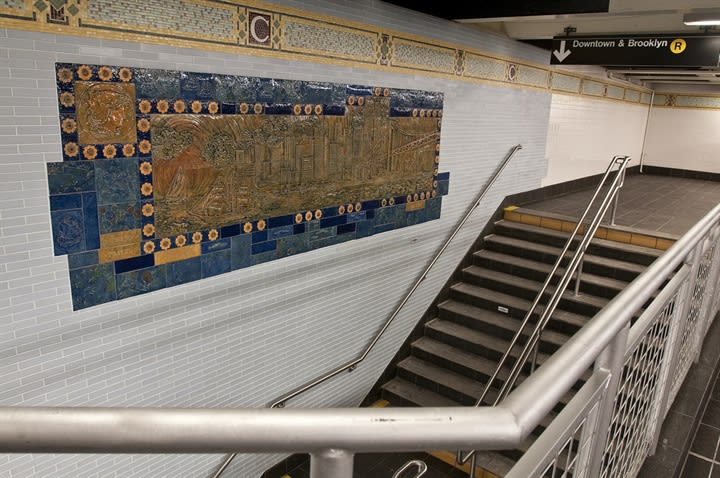
Photo of the station interior featuring murals by artist Margie Hughto by MTAPhotos via Flickr.
[IMAGE]N-Y-MTA-Cortlandt-station-opening-MTAPhotos-via-Flickr--2.jpg[/IMAGE]New York's Metropolitan Transportation Authority (MTA) reopened the downtown side of the Cortlandt Street R subway station, which was damaged by the collapse of the Twin Towers on 9/11. The opening coincides with the tenth anniversary of the terrorist attack.
The northbound side of the Cortlandt Street station reopened in November 2009. Now, customers will be able to access the southbound platform through two underground passageways: through the newly constructed Cortlandt Street underpass (where the station's wall murals have been reinstalled) or the entrance from One Liberty Plaza.
The collapse of the Twin Towers on 9/11 caused significant damage to the Cortlandt Street R station as well as the Cortlandt Street station on the 1 line, which remains out of service. The R Line station remained closed for one year while damage from the collapse was repaired. The station then operated from Sept. 15, 2002 until August 20, 2005, when it was closed again for the excavation and construction of the Dey Street Passageway. This pedestrian concourse will serve as a vital link between the Cortlandt Street station and the Fulton Street Transit Center currently under construction by MTA Capital Construction.
[IMAGE]N-Y-MTA-Cortlandt-station-interior-2.jpg[/IMAGE]
The $20 million project to reopen the southbound Cortlandt Street platform was funded by the Port Authority and the MTA. The station’s artwork, "Trade, Treasure and Travel," by artist Margie Hughto and commissioned in 1997, was undamaged in the 9/11 attacks and remained in storage until the station rehabilitation was complete. The murals are comprised of twelve thematically related hand-made bas-relief ceramic tile panels relating to finance and decorated with real and mythical creatures connected to the sea trade.
The station is served by the R during the daytime hours and the N during late nights. Cortlandt Street originally opened on Jan. 5, 1918 as part of the BMT Broadway Line.
“We made a commitment to have this platform open before the tenth anniversary of 9/11 and today we are here to fulfill that commitment,” said Walder. “I’m so proud that the MTA is able to participate in another vital milestone in the revitalization of Lower Manhattan. Our employees were first responders on that tragic day; we worked tirelessly to bring the subway back just months after the attack and every day since we have been rebuilding and helping the city come back stronger than ever.”
MTA Capital Construction is responsible for rebuilding the station. Its president, Michael Horodniceanu, stated, “This is a significant customer benefit that we’ve been able to re-open ahead of schedule as we continue to make progress building the Fulton Street Transit Center.”
More Rail

New York MTA Advances Final Contract for Second Avenue Subway Expansion
Contract Four is the largest in the Second Avenue Subway Phase 2 project and includes construction of station infrastructure, tracks, and signals for the subway expansion, MTA officials said. Work on Contract Four will begin in 2027.
Read More →
San Diego MTS Breaks Monthly Trolley Ridership Record
Agency officials said July’s ridership indicates MTS’s continued recovery from the pandemic.
Read More →
Report Examines NJ TRANSIT Reliability, Funding Challenges
The Garden State Initiative analysis examines the roles of Amtrak infrastructure, fleet management, and agency operations while recommending a more performance-based approach to improving reliability.
Read More →
Stadler, CapMetro Sign Long-Term Rail Fleet Support Agreement
Beginning in 2027, Stadler will provide on-site technical expertise, spare parts support, training, and obsolescence management to help extend the reliability and longevity of CapMetro’s GTW fleet.
Read More →
Biz Briefs: Alstom Lands Canadian Contract, LYT to Supply California TSP, and More
In METRO's latest installment, we take a look at recent news from Complete Coach Works, Beep, FlixBus, and more partnerships making headlines across the transportation sector.
Read More →
CATS Gold Line Marks 5 Years of Service, 2.8M Passenger Trips
With a six-mile expansion planned, the Charlotte streetcar is positioned to connect more neighborhoods and major transit hubs across the region.
Read More →
Why Simulating Pedestrian Movement Has Become Essential for Modern Rail Stations
Pedestrian microsimulation is helping rail planners identify bottlenecks, test station designs, and prepare complex transit hubs for growing passenger volumes.
Read More →
Amtrak Begins Major Construction at New York’s Sunnyside Yard
The new maintenance facility will support Amtrak’s Airo trainsets while improving maintenance efficiency and turnaround times in New York.
Read More →
Chicago Leaders Unveil Plans for O’Hare Airport Express Train
The privately developed project would offer a 15-minute trip between downtown and O’Hare’s Terminal 2, with trains operating every 15 minutes on a dedicated track. The service would use battery-electric trains and three existing freight rail rights-of-way.
Read More →
OCTA Maps Out 30-Year Strategy to Protect Coastal Rail Corridor
The draft feasibility report identifies strategies to protect the coastal rail line for decades as the agency continues near-term stabilization and sand placement efforts.
Read More →