



Ohio's COTA, FTA sign $37M grant for BRT project
CMAX will help relieve passenger crowding and spur economic development along Cleveland Avenue, one of the city’s busiest travel corridors.

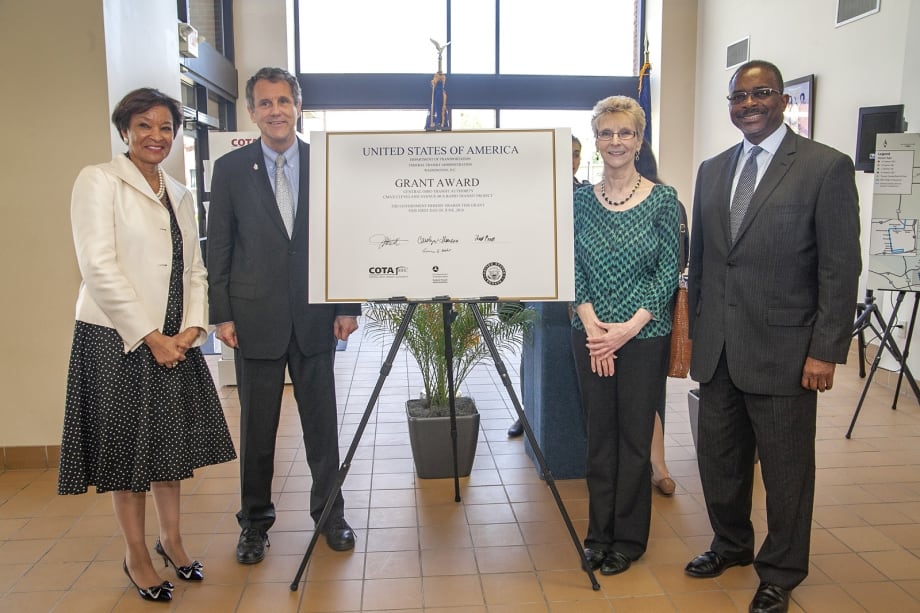
(L to R): FTA Acting Administrator Carolyn Flowers; U.S. Sen. Sherrod Brown; Greater Linden Development Corp. Executive Director Donna Hicho; and COTA President/CEO W. Curtis Stitt.
(L to R): FTA Acting Administrator Carolyn Flowers; U.S. Sen. Sherrod Brown; Greater Linden Development Corp. Executive Director Donna Hicho; and COTA President/CEO W. Curtis Stitt.
The Federal Transit Administration (FTA) announced the award of $37.5 million in federal grant funds to the Central Ohio Transit Authority (COTA) for a new Bus Rapid Transit (BRT) service in Columbus.
The new BRT Line, called CMAX, will help relieve passenger crowding and spur economic development along Cleveland Avenue, one of the city’s busiest travel corridors. FTA Acting Administrator Carolyn Flowers participated in a ceremony to award the funds with Senator Sherrod Brown and local officials.
“Transit plays a critical role in connecting Americans to economic opportunity – that’s true in Ohio and around the country,” said U.S. Transportation Secretary Anthony Foxx. “COTA’s new BRT line will strengthen and revitalize the communities it serves along Cleveland Avenue, connect residents of Columbus to education and jobs, and improve quality of life in the region.”
The 15.6-mile BRT service will provide a much-needed option in a corridor with high transit use. Ridership on COTA’s existing local bus route on Cleveland Avenue is among the highest in the system and rapidly growing; standing loads are common. CMAX will help reduce passenger crowding and improve travel speeds and schedule reliability along the corridor.
In addition, the line will connect riders to major destinations such as downtown Columbus, Columbus State Community College, shopping centers and hospitals.
“The Cleveland Avenue BRT will make a huge difference for thousands of commuters in the Cleveland Avenue corridor who are enduring standing-room only buses stuck in traffic,” said FTA Acting Administrator Carolyn Flowers. “When the BRT line opens, commuters will have a fast and convenient way to get to school, work, medical appointments and other destinations.”
The FTA is contributing 77% of the $48.65 million total cost of the Cleveland Avenue BRT project. The federal grant funds are from the Small Starts funding category of FTA’s Capital Investment Grant (CIG) program. The CIG program is the federal government’s primary grant program for funding major transit projects. The remaining project costs are being paid for by a sales tax that is collected in the COTA service area and dedicated to funding expanded transit services.
The project will operate between downtown Columbus and the Ohio Health Medical Center in the neighboring city of Westerville. BRT service is planned to operate in existing peak-period bus-only lanes for one mile in downtown Columbus and in mixed traffic for the rest of the route.
The project also includes 32 bus stops, construction of two park-and-ride lots, the purchase of 15 compressed natural gas buses, transit signal priority and next-bus arrival information for passenger platforms. The BRT line is scheduled to open in January 2018.
More Bus

New York MTA Plans Largest Bus Fleet Upgrade in More Than a Decade
The agency is seeking manufacturers for 650 new CNG buses to replace aging vehicles, improve reliability, and advance its broader fleet modernization strategy.
Read More →
Building a Flexible Path to Transit Electrification
John Hroncich discusses BAE Systems’ modular and scalable approach, lessons learned from decades of real-world operations, and how agencies can identify electrification strategies that fit their fleets.
Read More →
Bus Tech Talk: Keeping Transit Technicians Ahead of the Technology Curve
LA Metro’s Obed Mejia discusses technician training, evolving maintenance technology, fleet replacement, and strategies for getting the most out of today’s transit fleets.
Read More →
Biz Briefs: RIPTA Unveils New Frontrunners, Clevland RTA Adds New Siemens, and More
In METRO's latest installment, we take a look at recent news from Siemens, Prevost, Dodge, and more partnerships making headlines across the transportation sector.
Read More →
People Movement: Holly Arnold Joins Transdev and More
In this edition, we also cover recent appointments and announcements at Pace, CamTran, MCI, and more, showcasing the individuals helping to shape the future of transportation.
Read More →
The High Cost of Transit Buses: Industry Leaders Look to Procurement Reform
Transit leaders and policymakers examine how standardized bus designs, streamlined procurement, and predictable funding could help agencies stretch budgets and deliver better service.
Read More →
The Business Voice Behind Public Transportation
As chair of APTA’s Business Members Board of Governors, Ray Melleady explains how more than 850 business members are partnering with transit agencies to advance funding, innovation, and industry-wide collaboration.
Read More →
From Surviving to Thriving: Building Stronger Transportation Organizations
Bus Business Consultants founder Brian Dickson shares lessons on leadership, organizational health, and creating options for long-term success in a changing transportation industry.
Read More →
Finding the ‘Happy Medium’: Optimizing Maintenance Without Sacrificing Reliability
The key to maintenance optimization isn’t doing less work—it’s doing the right work at the right time on the right assets.
Read More →
LA Metro, City of West Hollywood, and Partners Advance Smarter Bus Lane Enforcement
The award-winning partnership combines AI-powered detection with human oversight to improve bus reliability, accessibility, and enforcement efficiency.
Read More →