




RELATED: Penn State hires first alternative transportation coordinator
Penn State expanding campus shuttle service
With the addition of the new Campus Shuttle route, Transportation Services will replace its Paratransit Shuttle service, which provided transportation for pre-approved students, faculty, and staff with mobility impairments.
August 7, 2017
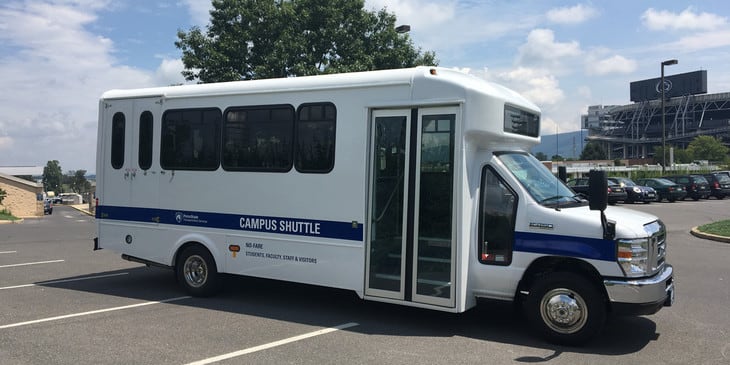
University officials hope the new Campus Shuttle service will encourage more people to “park once” and take advantage of the shuttle to navigate campus.
Penn St.
2 min to read
University officials hope the new Campus Shuttle service will encourage more people to “park once” and take advantage of the shuttle to navigate campus.
Penn St.
Starting Aug. 21, Penn State will launch a new campus shuttle service that will make getting around University Park campus easier and more convenient. The new, no-fare service — Campus Shuttle via Pollock Road — will include 16 stops and provide more flexible transport for faculty, staff, students, and visitors.
The existing Campus Shuttle route and schedule, which will remain unchanged, will be renamed the Campus Shuttle via College Avenue beginning this fall.
University officials hope the new Campus Shuttle service will encourage more people to “park once” and take advantage of the shuttle to navigate campus.
“The new Campus Shuttle via Pollock Road will help us reach an important goal — increasing the number of people who get around campus using transit and other modes of alternative transportation,” said Rob DeMayo, director of Transportation Services. “With our new service, combined with the existing Campus Shuttle and CATA’s LOOP and LINK, we will offer six dedicated no-fare campus transit options that provide convenient transportation to nearly every corner of the University Park campus.”
With the addition of the new Campus Shuttle route, Transportation Services will replace its Paratransit Shuttle service, which provided transportation for pre-approved students, faculty, and staff with mobility impairments. Transportation Services engaged with Student Disability Resources and the Affirmative Action office to ensure that the change wouldn’t diminish service to students, faculty, and staff with mobility impairments. “The new route will provide access to a wider expanse of campus than previously offered by the Paratransit Shuttle,” DeMayo said.
“The new Campus Shuttle represents a more inclusive transportation solution for individuals with mobility impairments and others in the Penn State community,” said Keith Jervis, director of Student Disability Resources.
“No longer will an individual need to identify and be labeled as a person with a disability to have access to this transportation option,” he said. “This universally designed solution will benefit many while providing more timely access to classes and offices.”
Like the existing Campus Shuttle vehicles, the new Campus Shuttle will be wheelchair-accessible, and beginning this fall, all shuttles will offer priority seating for those with mobility impairments. Students, faculty, and staff with mobility impairments who require point-to-point transit service are still encouraged to use the CATARIDE program.
Transportation Services recently partnered with TransLoc to equip each Campus Shuttle vehicle with automatic vehicle location (AVL) technology that allows customers to see each shuttle in real-time and receive arrival predictions through the TransLoc Rider mobile app and at psu.transloc.com. Real-time information for the new Campus Shuttle via Pollock Road will be available through the mobile app and website.
More Bus

New York MTA Plans Largest Bus Fleet Upgrade in More Than a Decade
The agency is seeking manufacturers for 650 new CNG buses to replace aging vehicles, improve reliability, and advance its broader fleet modernization strategy.
Read More →
Building a Flexible Path to Transit Electrification
John Hroncich discusses BAE Systems’ modular and scalable approach, lessons learned from decades of real-world operations, and how agencies can identify electrification strategies that fit their fleets.
Read More →
Bus Tech Talk: Keeping Transit Technicians Ahead of the Technology Curve
LA Metro’s Obed Mejia discusses technician training, evolving maintenance technology, fleet replacement, and strategies for getting the most out of today’s transit fleets.
Read More →
Biz Briefs: RIPTA Unveils New Frontrunners, Clevland RTA Adds New Siemens, and More
In METRO's latest installment, we take a look at recent news from Siemens, Prevost, Dodge, and more partnerships making headlines across the transportation sector.
Read More →
People Movement: Holly Arnold Joins Transdev and More
In this edition, we also cover recent appointments and announcements at Pace, CamTran, MCI, and more, showcasing the individuals helping to shape the future of transportation.
Read More →
The High Cost of Transit Buses: Industry Leaders Look to Procurement Reform
Transit leaders and policymakers examine how standardized bus designs, streamlined procurement, and predictable funding could help agencies stretch budgets and deliver better service.
Read More →
The Business Voice Behind Public Transportation
As chair of APTA’s Business Members Board of Governors, Ray Melleady explains how more than 850 business members are partnering with transit agencies to advance funding, innovation, and industry-wide collaboration.
Read More →
From Surviving to Thriving: Building Stronger Transportation Organizations
Bus Business Consultants founder Brian Dickson shares lessons on leadership, organizational health, and creating options for long-term success in a changing transportation industry.
Read More →
Finding the ‘Happy Medium’: Optimizing Maintenance Without Sacrificing Reliability
The key to maintenance optimization isn’t doing less work—it’s doing the right work at the right time on the right assets.
Read More →
LA Metro, City of West Hollywood, and Partners Advance Smarter Bus Lane Enforcement
The award-winning partnership combines AI-powered detection with human oversight to improve bus reliability, accessibility, and enforcement efficiency.
Read More →