



Report: Rising gas prices may make public transit more attractive to Hoosiers
A 10% increase in gas prices over several years will increase bus ridership by 3.4% while a sudden 10% spike in gas prices is associated with a 1.15% increase in bus ridership in Indiana.


Photo courtesy Ball State Unidersity.
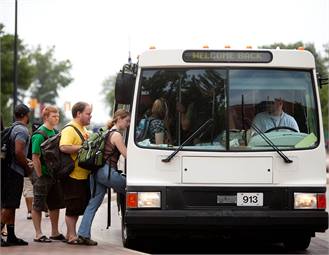
Photo courtesy Ball State Unidersity.
MUNCIE, Ind. — Rising gas prices over the coming decade may make public transportation significantly more attractive to Hoosiers, say three new reports from Ball State University.
In fact, ridership could more than double by 2035, meaning the customer base would expand well beyond the current “typical” users who are low-income residents who are most dependent on Indiana’s current 66 fixed-route public transportation systems.
Ball State’s Center for Business and Economic Research (CBER) found that almost 70% fixed-route bus riders are dependent on buses because they do not have access to a vehicle.
CBER also discovered that a 10% increase in gas prices over several years will increase bus ridership by 3.4% while a sudden 10% spike in gas prices is associated with a 1.15% increase in bus ridership in Indiana.
“Under conservative assumptions, we expect ridership to more than double by 2035,” said Michael Hicks, CBER director and economics professor. “In fact, we anticipate ridership to increase as public transportation becomes more acceptable among more affluent urban and suburban residents — something that state officials have been promoting for several years.”
“Public Transportation in Indiana: An Analysis of Ridership Surveys,” “The Effect of Gasoline Prices on Public Bus Ridership in Indiana” and “Fixed Route and Demand-Response Systems: Funding Methods, Benefits and Costs in Indiana” were produced by CBER for the Indiana Transportation Association. The studies may be found at http://cms.bsu.edu/academics/centersandinstitutes/bbr/currentstudiesandpublications.
The studies examine options for public transit, methods of funding and the impact of fixed-route bus transit in Indiana. In addition to Hicks, the research team included Dagney Faulk, CBER research director; and Kevin Kroll, a Ball State graduate assistant specializing in geographic information and CBER regional analysis.
Research indicated that the typical fixed-route bus rider in Indiana is a 19- to 34-year-old woman making less than $15,000 a year. She is likely to not own a car and to use the bus about five times per week for either school or work.
“For workers who do not have access to a private vehicle, lack of bus access or cuts to existing transit is likely to have an impact on their ability to get to work and maintain employment,” Hicks said. “Workers with at least one vehicle in the household are less likely to be affected by transit cuts.”
Research also found:
• Among survey respondents, 49% of riders had an annual household income below $15,000 while 9.6% of respondents’ households have an annual income exceeding $50,000.
• A third of transit riders use the bus system more than five days per week.
• Sixty percent of transit users described the primary purpose of their trip as getting to work or school.
• Indiana’s public transit systems provided about 35.2 million passenger trips and logged about 46.6 million vehicle miles.
• Survey responses indicate high levels of satisfaction with public transit among users.
“Our benefit-cost estimates also suggest that for each dollar of expenditure on public transit more than $3 of benefit are realized,” Hicks said. “We recommend a broader set of tax instruments approved through a local referenda process to fund transit.”
Ball State’s research clearly indicates that public transportation is valuable to Indiana’s economy, said Kent McDaniel, executive director of the Indiana Transportation Association.
“These reports clearly illustrate that the benefits of public, fixed-route transit systems outweigh the costs for both taxpayers as a whole and those who ride the transit system,” he said.
More Bus

New York MTA Plans Largest Bus Fleet Upgrade in More Than a Decade
The agency is seeking manufacturers for 650 new CNG buses to replace aging vehicles, improve reliability, and advance its broader fleet modernization strategy.
Read More →
Building a Flexible Path to Transit Electrification
John Hroncich discusses BAE Systems’ modular and scalable approach, lessons learned from decades of real-world operations, and how agencies can identify electrification strategies that fit their fleets.
Read More →
Bus Tech Talk: Keeping Transit Technicians Ahead of the Technology Curve
LA Metro’s Obed Mejia discusses technician training, evolving maintenance technology, fleet replacement, and strategies for getting the most out of today’s transit fleets.
Read More →
Biz Briefs: RIPTA Unveils New Frontrunners, Clevland RTA Adds New Siemens, and More
In METRO's latest installment, we take a look at recent news from Siemens, Prevost, Dodge, and more partnerships making headlines across the transportation sector.
Read More →
People Movement: Holly Arnold Joins Transdev and More
In this edition, we also cover recent appointments and announcements at Pace, CamTran, MCI, and more, showcasing the individuals helping to shape the future of transportation.
Read More →
The High Cost of Transit Buses: Industry Leaders Look to Procurement Reform
Transit leaders and policymakers examine how standardized bus designs, streamlined procurement, and predictable funding could help agencies stretch budgets and deliver better service.
Read More →
The Business Voice Behind Public Transportation
As chair of APTA’s Business Members Board of Governors, Ray Melleady explains how more than 850 business members are partnering with transit agencies to advance funding, innovation, and industry-wide collaboration.
Read More →
From Surviving to Thriving: Building Stronger Transportation Organizations
Bus Business Consultants founder Brian Dickson shares lessons on leadership, organizational health, and creating options for long-term success in a changing transportation industry.
Read More →
Finding the ‘Happy Medium’: Optimizing Maintenance Without Sacrificing Reliability
The key to maintenance optimization isn’t doing less work—it’s doing the right work at the right time on the right assets.
Read More →
LA Metro, City of West Hollywood, and Partners Advance Smarter Bus Lane Enforcement
The award-winning partnership combines AI-powered detection with human oversight to improve bus reliability, accessibility, and enforcement efficiency.
Read More →