



S.F. Muni celebrates 100 years
Also launched special section of its website to share photographic archive images, historic information and a calendar of events at which the SFMTA centennial will be featured.

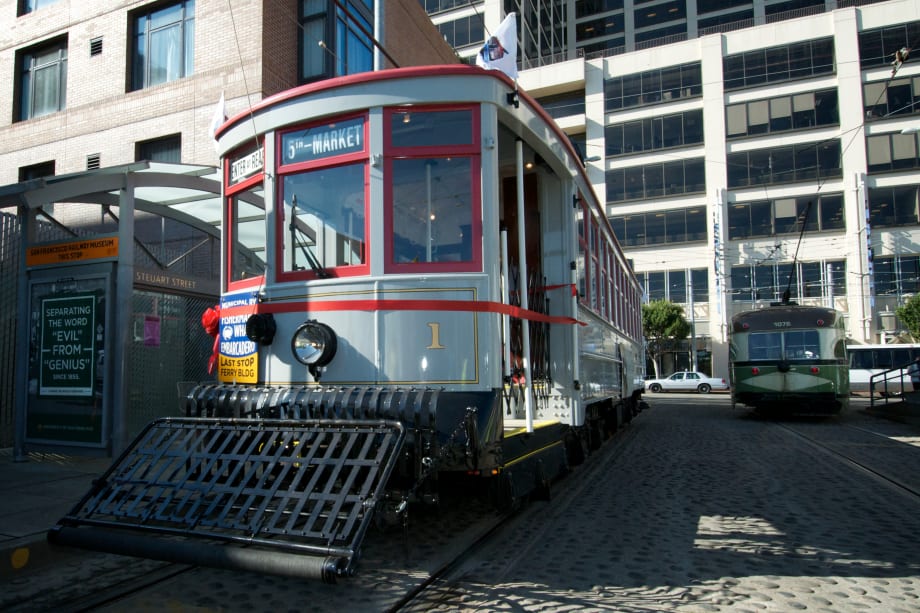
Photos courtesy SFMTA.
Photos courtesy SFMTA.
State and local officials gathered Thursday to launch the 100th anniversary celebration of the San Francisco Municipal Railway (Muni), founded on December 28, 1912.
As the first publicly-owned transit system in a major U.S. city, Muni was inaugurated by Mayor James Rolph Jr. at Geary and Kearny streets with Car No. 1. That streetcar has been restored and will now join Muni’s historic streetcar fleet which runs on the F Market and Wharves Line. The citywide celebration through December will include San Francisco’s transit history and the city’s current integrated surface transportation network that encompasses pedestrians, bicyclists, transit, parking, traffic and taxis.
“Even one hundred years ago, San Francisco was the ‘Innovation Capital of the World’, when the city used mining technology and applied it to transit, a true innovation at the time that resulted in our modern Muni system that we still have today,” said Mayor Edwin M. Lee. “Just as our San Francisco innovators did a century ago, we are meeting the challenge of providing a world class transportation system for our residents with dedication and innovation.”
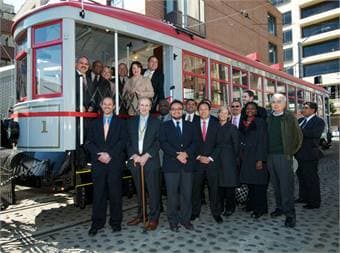
State and local officials, including San Francisco Edwin M. Lee and U.S. Senator Dianne Feinstein (pictured inside the streetcar) gathered to launch the 100th anniversary celebration of the San Francisco Municipal Railway (Muni), founded on December 28, 1912.
The SFMTA also launched a special section of its website at sfmta.com/100 to share photographic archive images, historic information and a calendar of events at which the SFMTA centennial will be featured. All community events will feature information about Muni’s world-renown transit history, including photography exhibits from Muni’s history archive of nearly 30,000 images dating back to the 19th century.
The photographic archive is also featured on sfmta.com/100 with links to the “Treasures from the Muni Archive” celebrating Muni’s first 100 years, which is installed on Muni transit shelters along Market Street, at the MSR Museum and on Historypin.com, a project of the London-based non-profit We Are What We Do. With the help of Historypin, the SFMTA can share a tour of site-specific images. Shelter displays have a QR code that allows viewers to access a summary of the exhibit and a link to the free Historypin.com app. The SFMTA’s "Archive" page on Historypin.com is also available on interactive monitors at the MSR Museum.
During the celebration Mayor Lee and U.S. Senator Dianne Feinstein unveiled the centennial logo, designed by the SFMTA’s award-winning graphic designer. The centennial logo depicts both Muni’s Car No. 1 as well as the original O’Shaughnessy Muni logo.
As the first major, publicly-owned transit agency in the U.S., Muni has grown to provide transit service to more than 200 million customers per year in one of the densest, most compact cities in the nation. Coverage per capita is among the highest in the U.S. with 63 bus routes, six light rail lines, the historic F Line and three cable car lines. Of the 700,000 daily boardings on Muni, more than 80% are city residents.
San Francisco has long been in the vanguard of alternative fuels and recycling while aggressively promoting sustainable modes — transit, bicycling and walking. It has routinely enacted policies to reduce greenhouse gas emissions and furthering the city’s Climate Action Plan. The SFMTA’s initiatives focus on the environment to create a sustainable quality of life for current and future generations of residents and visitors.
The SFMTA Centennial website sfmta.com/100 will continue to have updated event information throughout the year.
More Rail

New York MTA Advances Final Contract for Second Avenue Subway Expansion
Contract Four is the largest in the Second Avenue Subway Phase 2 project and includes construction of station infrastructure, tracks, and signals for the subway expansion, MTA officials said. Work on Contract Four will begin in 2027.
Read More →
San Diego MTS Breaks Monthly Trolley Ridership Record
Agency officials said July’s ridership indicates MTS’s continued recovery from the pandemic.
Read More →
Report Examines NJ TRANSIT Reliability, Funding Challenges
The Garden State Initiative analysis examines the roles of Amtrak infrastructure, fleet management, and agency operations while recommending a more performance-based approach to improving reliability.
Read More →
Stadler, CapMetro Sign Long-Term Rail Fleet Support Agreement
Beginning in 2027, Stadler will provide on-site technical expertise, spare parts support, training, and obsolescence management to help extend the reliability and longevity of CapMetro’s GTW fleet.
Read More →
Biz Briefs: Alstom Lands Canadian Contract, LYT to Supply California TSP, and More
In METRO's latest installment, we take a look at recent news from Complete Coach Works, Beep, FlixBus, and more partnerships making headlines across the transportation sector.
Read More →
CATS Gold Line Marks 5 Years of Service, 2.8M Passenger Trips
With a six-mile expansion planned, the Charlotte streetcar is positioned to connect more neighborhoods and major transit hubs across the region.
Read More →
Why Simulating Pedestrian Movement Has Become Essential for Modern Rail Stations
Pedestrian microsimulation is helping rail planners identify bottlenecks, test station designs, and prepare complex transit hubs for growing passenger volumes.
Read More →
Amtrak Begins Major Construction at New York’s Sunnyside Yard
The new maintenance facility will support Amtrak’s Airo trainsets while improving maintenance efficiency and turnaround times in New York.
Read More →
Chicago Leaders Unveil Plans for O’Hare Airport Express Train
The privately developed project would offer a 15-minute trip between downtown and O’Hare’s Terminal 2, with trains operating every 15 minutes on a dedicated track. The service would use battery-electric trains and three existing freight rail rights-of-way.
Read More →
OCTA Maps Out 30-Year Strategy to Protect Coastal Rail Corridor
The draft feasibility report identifies strategies to protect the coastal rail line for decades as the agency continues near-term stabilization and sand placement efforts.
Read More →