




RELATED: KCATA offers all-access transit pass to 3 colleges, universities
U. of Kentucky's transit pass program surpasses 1 million rides
The BluPass program — funded by Parking and Transportation Services — was implemented to decrease single-occupancy vehicle use, give students and employees more choices in transportation options and to ultimately reduce campus parking demand.
November 14, 2016

Photo: University of Kentucky
2 min to read
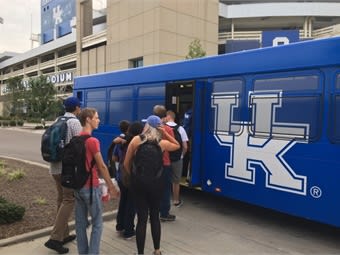
Photo: University of Kentucky
On July 1, 2015, the University of Kentucky and Lextran began a partnership that would allow UK students, faculty and staff to ride any Lextran bus route free of charge simply by showing their valid Wildcard ID. The partnership — dubbed BluPass — has grown tremendously in its first 15 months of service, recently surpassing 1 million rides.
The program — funded by Parking and Transportation Services (PTS) — was implemented in an effort to decrease single-occupancy vehicle use, give students and employees more choices in transportation options and to ultimately reduce campus parking demand.
"One of the major goals of the Transportation Master Plan was to mitigate parking demand through the use of alternative transportation and transportation demand management," said Lance Broeking, director of Parking and Transportation Services. "We're trying to provide university employees and students with opportunities to shift their mode of transportation using a variety of alternative transportation options from bicycling to walking to campus. Mass transit is just another one of the tools in the toolbox."
Lextran travels throughout 24 different city routes extending throughout and beyond the UK campus into the Lexington community. The program includes all Lextran routes, both on and off campus, allowing UK students, faculty and staff to travel to, from, and around campus while also accessing the city.
"BluPass has saved me a lot of money and time. I don't have to pay for parking. Timewise, it's just much easier to hop on, get to where you need to be instead of spending half an hour walking to class," said Ryan Hoover, sophomore special education major.
BluPass has proven to have a number of benefits for its users. Students and employees who were already riding Lextran prior to the introduction of BluPass experienced an immediate cost savings with a fare-free commute. Students and employees who switched to mass transit after the introduction of BluPass also saw reduced vehicle operating and parking costs, along with a lowered carbon footprint.
Chemistry senior lecturer Kim Woodrum says by using BluPass she has saved time and money and is grateful for the opportunity to ride the bus to work using BluPass to work.
"I really appreciate UK making this available," Woodrum said.
More Bus

New York MTA Plans Largest Bus Fleet Upgrade in More Than a Decade
The agency is seeking manufacturers for 650 new CNG buses to replace aging vehicles, improve reliability, and advance its broader fleet modernization strategy.
Read More →
Building a Flexible Path to Transit Electrification
John Hroncich discusses BAE Systems’ modular and scalable approach, lessons learned from decades of real-world operations, and how agencies can identify electrification strategies that fit their fleets.
Read More →
Bus Tech Talk: Keeping Transit Technicians Ahead of the Technology Curve
LA Metro’s Obed Mejia discusses technician training, evolving maintenance technology, fleet replacement, and strategies for getting the most out of today’s transit fleets.
Read More →
Biz Briefs: RIPTA Unveils New Frontrunners, Clevland RTA Adds New Siemens, and More
In METRO's latest installment, we take a look at recent news from Siemens, Prevost, Dodge, and more partnerships making headlines across the transportation sector.
Read More →
People Movement: Holly Arnold Joins Transdev and More
In this edition, we also cover recent appointments and announcements at Pace, CamTran, MCI, and more, showcasing the individuals helping to shape the future of transportation.
Read More →
The High Cost of Transit Buses: Industry Leaders Look to Procurement Reform
Transit leaders and policymakers examine how standardized bus designs, streamlined procurement, and predictable funding could help agencies stretch budgets and deliver better service.
Read More →
The Business Voice Behind Public Transportation
As chair of APTA’s Business Members Board of Governors, Ray Melleady explains how more than 850 business members are partnering with transit agencies to advance funding, innovation, and industry-wide collaboration.
Read More →
From Surviving to Thriving: Building Stronger Transportation Organizations
Bus Business Consultants founder Brian Dickson shares lessons on leadership, organizational health, and creating options for long-term success in a changing transportation industry.
Read More →
Finding the ‘Happy Medium’: Optimizing Maintenance Without Sacrificing Reliability
The key to maintenance optimization isn’t doing less work—it’s doing the right work at the right time on the right assets.
Read More →
LA Metro, City of West Hollywood, and Partners Advance Smarter Bus Lane Enforcement
The award-winning partnership combines AI-powered detection with human oversight to improve bus reliability, accessibility, and enforcement efficiency.
Read More →