



U. Wis.-Green Bay signs U-Pass agreement
New contract does away with the former agreement, under which a $35,000 annual lump-sum payment — underwritten by student fees and a portion of University parking fees — was paid to Metro in exchange for unlimited bus rides for students, faculty and staff.

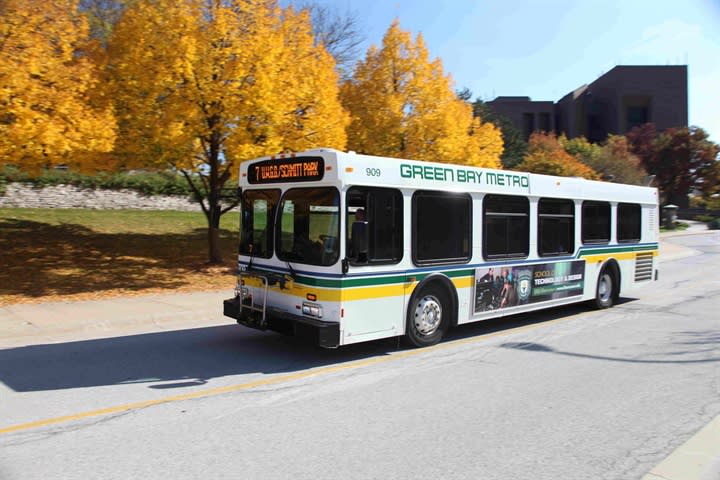
The agreement is part of an ongoing effort to encourage bus ridership among students, faculty and staff, emphasizing the convenience and cost and environmental benefits of taking the bus. Photo credit: Eric Miller, UW-Green Bay Communications
[IMAGE]Green-Bay-Metro-bus-2-2.jpg[/IMAGE]The University of Wisconsin-Green Bay and Green Bay Metro recently signed a revised busing agreement that will continue their partnership while more directly tying the cost of service to the number of rides taken.
The new U-Pass contract does away with the former agreement, under which a $35,000 annual lump-sum payment — underwritten by student fees and a portion of University parking fees — was paid to Metro in exchange for unlimited bus rides for students, faculty and staff.
Under the new arrangement, the chargeback becomes 25 cents per ride, billed quarterly, which still will allow University ID-holders to ride at no additional charge — and also offer a more precise way for UW-Green Bay to pay for the service, said Tom Wittig, GM for Green Bay Metro. The change, approved at the July meeting of the Green Bay Transit Commission, is a key element of what Wittig says is an ongoing and important relationship between the campus and transit.
“It’s very important because public transportation is a vital ingredient for college students,” Wittig said. “It gives them the independence to travel throughout the Green Bay area, whether they have a car or not.”
The agreement is part of an ongoing effort to encourage bus ridership among students, faculty and staff, emphasizing the convenience and cost and environmental benefits of taking the bus. Since its inception in 2008, U-Pass has continued thanks to a cooperative effort of University officials, the UWGB Student Government Association and Green Bay Metro.
“The U-Pass agreement certainly benefits the environment through taking some single-occupancy vehicles off the road, with an additional benefit of saving money by not gassing up the car as frequently,” said Laurie Case, sustainability and strategic planning coordinator at UWGB. “We’ll continue to depend on Metro as a cornerstone in our ability to reduce greenhouse gas emissions from the campus community.”
The new U-Pass agreement is one of several changes recently unveiled by Metro, which has started adding no-cost Saturday rides for all bus patrons amid plans for a west-side route restructuring intended to make transportation easier and more efficient.
In addition, UWGB will hold discussions with Metro to consider a direct Saturday route for high-volume student locations, such as grocery stores, said Riley Evan Peterson, UW-Green Bay Student Government Association president. The SGA and UWGB Public Safety’s parking operations will continue to split the cost for the U-Pass agreement, which could be about half of what it was under the former funding system.
In addition, Metro hopes to have a presence at various campus events during the school year, Wittig said, encouraging students to explore the transit system. The University Union also will play a role, marketing the effort to students as part of an overall focus on sustainability.
“Practicing sustainable efforts will come easy to students with the help of the Green Bay Metro agreement,” said Kelly Kramp, manager of programs, promotions and marketing for the Union. “The University Union looks forward to helping educate the students on their U-Pass.”
More Bus

New York MTA Plans Largest Bus Fleet Upgrade in More Than a Decade
The agency is seeking manufacturers for 650 new CNG buses to replace aging vehicles, improve reliability, and advance its broader fleet modernization strategy.
Read More →
Building a Flexible Path to Transit Electrification
John Hroncich discusses BAE Systems’ modular and scalable approach, lessons learned from decades of real-world operations, and how agencies can identify electrification strategies that fit their fleets.
Read More →
Bus Tech Talk: Keeping Transit Technicians Ahead of the Technology Curve
LA Metro’s Obed Mejia discusses technician training, evolving maintenance technology, fleet replacement, and strategies for getting the most out of today’s transit fleets.
Read More →
Biz Briefs: RIPTA Unveils New Frontrunners, Clevland RTA Adds New Siemens, and More
In METRO's latest installment, we take a look at recent news from Siemens, Prevost, Dodge, and more partnerships making headlines across the transportation sector.
Read More →
People Movement: Holly Arnold Joins Transdev and More
In this edition, we also cover recent appointments and announcements at Pace, CamTran, MCI, and more, showcasing the individuals helping to shape the future of transportation.
Read More →
The High Cost of Transit Buses: Industry Leaders Look to Procurement Reform
Transit leaders and policymakers examine how standardized bus designs, streamlined procurement, and predictable funding could help agencies stretch budgets and deliver better service.
Read More →
The Business Voice Behind Public Transportation
As chair of APTA’s Business Members Board of Governors, Ray Melleady explains how more than 850 business members are partnering with transit agencies to advance funding, innovation, and industry-wide collaboration.
Read More →
From Surviving to Thriving: Building Stronger Transportation Organizations
Bus Business Consultants founder Brian Dickson shares lessons on leadership, organizational health, and creating options for long-term success in a changing transportation industry.
Read More →
Finding the ‘Happy Medium’: Optimizing Maintenance Without Sacrificing Reliability
The key to maintenance optimization isn’t doing less work—it’s doing the right work at the right time on the right assets.
Read More →
LA Metro, City of West Hollywood, and Partners Advance Smarter Bus Lane Enforcement
The award-winning partnership combines AI-powered detection with human oversight to improve bus reliability, accessibility, and enforcement efficiency.
Read More →