



VTA's apprenticeship program is ideal labor/management partnership
Provides mentors, apprenticeships, college credit, career advancement, for incoming and current VTA Operations employees.

Santa Clara Valley Transportation Authority's labor/management partnership provides mentors, apprenticeships, college credit, and in many cases, career advancement, for incoming and current VTA Operations employees.
Valley Transportation Authority
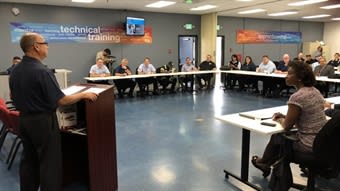
Santa Clara Valley Transportation Authority's labor/management partnership provides mentors, apprenticeships, college
, and in many cases, career advancement, for incoming and current VTA Operations employees.
Valley Transportation Authority
Strengthening the voice transit workers have at their agencies is a top priority for International President of the Amalgamated Transit Union (ATU) John Costa. When he heard that the Santa Clara Valley Transportation Authority (VTA) and ATU Local 265 had a successful formula for that concept, he decided to make the three-thousand-mile trip from Washington, D.C. to San Jose to learn the secret to the success.
What Costa may not have expected to find was the strong relationship between management and labor created through the Joint Workforce Investment program (JWI.)
“I’m glad to see the pride here in how you work together,” Costa told a gathering of the VTA/ATU program participants who came together to provide Costa with a full view of how the program functions. “This is good stuff, working together.”
The JWI program is a labor/management partnership that provides mentors, apprenticeships, college credit, and in many cases, career advancement, for incoming and current VTA Operations employees, including bus and light rail operators, mechanics, and light rail overhead line and track workers. It’s become a national model for improving the working conditions of transit workers, and it was the brainchild of now-retired bus operator and ATU member Tom Fink.
“When I came to ATU with this proposal, (15 years ago) I was riding on my reputation as a driver and a member of the ATU (Local 265) Executive Board,” said Fink, who drove a VTA bus for 25 years. “And I said we were in a predicament with what it takes to train and mentor operators on the street.”
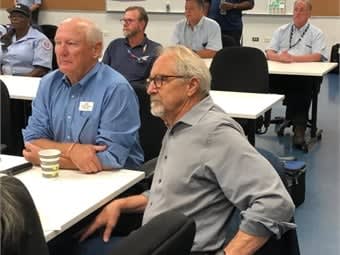
The Joint Workforce Investment program become a national model for improving the working conditions of transit workers, and it was the brainchild of now-retired bus operator and ATU member Tom Fink (right).
Valley Transportation Authority
Fink described the kind of stress front line transit workers, like bus operators, experience navigating a multi-ton bus safely through traffic while dealing with some riders who can at times be less than respectful, or even outright abusive. Such conditions can, and do, drive operators away from these jobs, and Fink wanted to figure out a way to keep that from happening. He knew the union couldn’t do it alone, and management, by themselves, hadn’t been able to find the secret to success either. But coming together to tackle the issues soon made all the difference.
“The common ground,” said Fink, “was that we were both concerned about serving the public.”
ATU brought in a third party facilitator, Deb Moy, of California Transit Works!, a consortium focused on transit workforce development, to draw the two sides together to create the program. Moy started doing “focus groups” among workers to see what issues needed to be addressed in order for them to maintain healthy, successful careers. She nurtured management to address those concerns and both sides agreed to commit to honest, open communication to improve the working environment.
What started out pairing up new operators with more experienced “mentors” whom they could confide in and learn from, grew into a first-in-the-nation, full-fledged, state-certified apprenticeship program for multiple VTA transit professions. Mission College now offers up to 18 college credits to program participants, and the California Labor Federation and the U.S. Department of Labor are sources of financial support. What makes this program work is equal leadership on both sides, said Moy. “You’re here for a common purpose and that theme is carried through the program,” she said.
Lisa Vickery, now a Transportation Superintendent in charge of VTA’s Chaboya Bus Yard, helped get the program off the ground on the management side as a newly minted supervisor. “Being able to build trust and speak honestly, our compromise is that we can look at a problem from two completely different perspectives, but come up with a solution,” Vickery said.
VTA GM/CEO Nuria Fernandez started at VTA after the program was already in full swing, but she pledged that her support of it will continue. “We are here because we’re serving others,” Fernandez told the gathering, “and that’s one of the reasons our apprenticeship program is so important. Through this program, we can help each other be better.”
ATU International President John Costa was impressed enough that he wants to help integrate the concept into the ATU International training program, and encourage other ATU locals to bring it to their transit agencies.
“We’re going to try to encourage other locals to do the same because it’s benefitted the workers’ voice,” said Costa. “We’ve seen the success here and we want to push that to other agencies.”
More Management

METRO Opens Submissions for 2026 Motorcoach Awards
Nominations are now being accepted for METRO Magazine’s Operator of the Year and Innovative Operator of the Year awards.
Read More →
New York MTA Advances Final Contract for Second Avenue Subway Expansion
Contract Four is the largest in the Second Avenue Subway Phase 2 project and includes construction of station infrastructure, tracks, and signals for the subway expansion, MTA officials said. Work on Contract Four will begin in 2027.
Read More →
Transit Agencies Highlight Safety Gains at National Summit
Leaders from 15 major transit systems shared crime-reduction results and safety initiatives while discussing the role of continued federal support.
Read More →

NITA Names New Leadership, Expands Reduced-Fare Program at First Board Meeting
The new regional transit authority appointed its first board chair and interim executive director while extending reduced fares across CTA, Metra, and Pace for eligible riders.
Read More →
Beyond the Checklist: A Structured Approach to Transit Maintenance
Reliability-Centered Maintenance helps transit agencies move beyond routine checklists to focus limited resources on the assets and failures that have the greatest impact on safety, reliability, and service.
Read More →
APTA 2026 Nominating Committee Selects Leadership Slate, Names Chair and Vice Chair Nominees
Leadership changes will help shape the association’s priorities and its representation of the transportation industry during the 2026–2027 term.
Read More →
DART Launches Major Security, Fare Enforcement Initiative
The 90-day demonstration will deploy coordinated security teams at five light rail stations while testing controlled access and gathering data to guide future investments.
Read More →
Advancing Fare Collection Through Technology and Innovation
Learn about delivering 1300 gates at 91 stations while managing fare evasion. Explore the large scale deployment, solution customization and real-world results that affect the region. Prepare for deployment in your region now.
Read More →
Game Day in Motion: Moving Millions During the 2026 World Cup
Between packed transit stations and team motorcoaches, see how agencies and operators across North America tackled the transportation demands of the 2026 FIFA World Cup.
Read More →
Surface Transportation Extension Averts Shutdown, Leaves Transit Funding Gap
The stopgap keeps federal transportation programs moving, but missing advance funding could complicate the transit and rail projects agencies are planning next.
Read More →