



Q&A with WeGo Public Transit CEO Bland
METRO asked Bland about his background, what it takes to run the transit system, who inspires him, and how he likes to spend his free time.
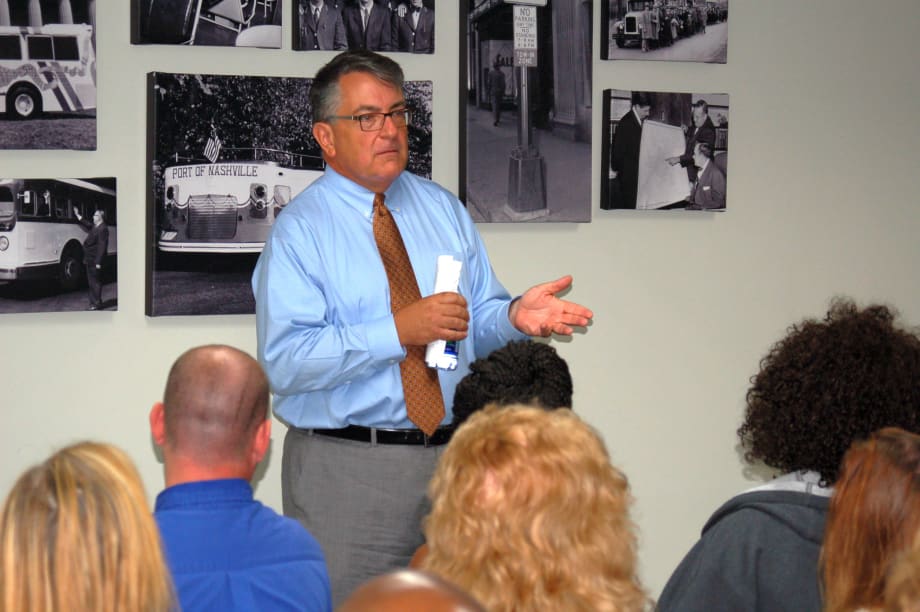
Stephen Bland is CEO for both Nashville’s Metropolitan Transit Authority (WeGo Public Transit) and the Regional Transportation Authority of Middle Tennessee. Photo: WeGo Public Transit
Stephen Bland is CEO for both Nashville’s Metropolitan Transit Authority (WeGo Public Transit) and the Regional Transportation Authority of Middle Tennessee. Photo: WeGo Public Transit
As head of the host agency for APTA’s 2018 Annual Meeting in Nashville, Tenn., WeGo Public Transit CEO Stephen Bland has been very busy. Prior to the event, METRO asked Bland about his background, what it takes to run the transit system, who inspires him, and how he likes to spend his free time.
Where did you grow up? Northern New Jersey, in the outer suburbs of New York City.
What did you study in school? I attended Indiana University at Bloomington (IU). My undergraduate degree was in Public Affairs, with concentrations in Management and Transportation Analysis. My Master’s Degree (also from Indiana) is in Public Finance.
What were your career aspirations growing up? I am one of those odd people who always wanted to get into mass transit. My earliest memory of childhood at about four or five years old was traveling to New York City with my parents to see the circus. I don’t remember the circus, I remember riding on the subway and thinking how exciting it was — all the people, the noise, the fact that they could get such a big train underground. I was enchanted.
Discuss how an early job shaped who you are. At a relatively young age, I was GM for a very small transit agency in Massachusetts. I got to drive the buses, fix the buses, conduct labor negotiations, do payroll and accounting, and everything involved in the day-to-day operation of a transportation agency. I also learned that, despite my education, I knew less than everyone there — and I do mean everyone. I quickly learned that I could only be successful by taking advantage of the knowledge and expertise of people who, on paper, reported to me. Even 30 years later, I know I’m not the smartest person here, but I am smart enough to know how much I need the people who are.
How did you first become involved in the transportation industry? At Indiana University, I was a “Smerkie,” one of many mass transit professionals who studied under Professor George Smerk. George was a Business School Professor and Director of the Institute for Urban Transportation at IU at the time. He is a true inspiration to all of us who know him. Directly, he helped me land my first summer transit internship with the transit agency in Lexington, Kentucky (working for another Smerkie). From there, I was hooked.
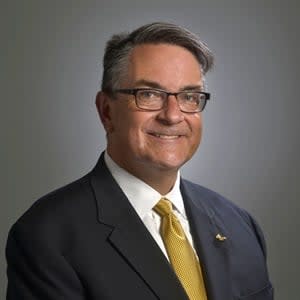
"Helping to educate and convince people about why mass transit and public transportation, in general, are a crucial part of the mobility infrastructure of a region," is one of the rewarding parts of his job, says WeGo Public Transit CEO Stephen Bland.
What does your present position entail? Pretty typical CEO responsibilities for a mid-sized transit agency in terms of Board relationship building, staff capacity building, and always looking for sufficient resources to do what we need to do. In a city like Nashville — which is rapidly growing and has historically been an auto-dominant city — it’s also about talking to as many people and groups as I can about how mass transit works, and how it can become a crucial part of the overall mobility fabric of the region. My position may be unique from others in one respect in that I’m CEO for both Nashville’s Metropolitan Transit Authority (WeGo Public Transit) and the Regional Transportation Authority of Middle Tennessee (RTA). Where WeGo’s span is traditional urban transit within the bounds of Nashville and Davidson County, the RTA takes on broader mobility responsibilities in the 10-county region surrounding Nashville. In terms of Board relationship building, the two organizations are at opposite extremes, with the MTA governed by a five-member Board appointed by the Mayor of Nashville and the RTA governed by a 39-member Board composed of 29 regional Mayors, nine Governors appointees, and the Commissioner of the Tennessee Department of Transportation. So, in terms of the CEO’s role in supporting the Board and developing a strong governance culture, I have to be a bit nimble.
Name one accomplishment or project you are most proud of. I’ll cheat and give two because I suspect you want me to talk about something specifically associated with transportation, and that’s not what stands out.
First, I’d say I’m most proud of the large number of folks who’ve reported to me over the years who chose to advance their educations, either by obtaining their college degrees or getting advanced degrees, while working with me and then moving onto bigger and better things — in and out of transit. I love to be surrounded by people who are always trying to improve themselves because they also challenge me and make me better. Of course, that wasn’t my accomplishment, it was theirs. However, I’m glad I was able to support them in achieving their goals.
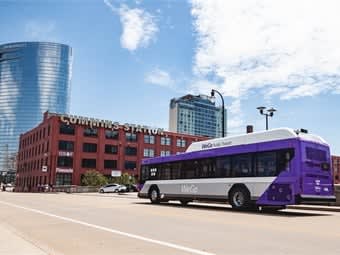
In July 2018, Nashville MTA unveiled its new name, WeGo Public Transit, and its accompanying fleet of rebranded buses. Photo: WeGo Public Transit
From a transportation perspective, I still point to starting Sunday service in York, Pennsylvania in the 90’s. The reason relates to a specific interaction with a woman I met on our first day of Sunday service. After the official ‘kickoff’ ceremony, a woman ran up to me and thanked me profusely for starting the service, which, of course, I had a limited role in doing. Because she couldn’t drive, she went on to tell me that this particular Sunday was the first time she was leaving her house in 15 years. Once I got over my disbelief, I asked her where she planned to go. She told me that it really didn’t matter, she’d go wherever the first bus took her. To me, that is the magic in what we do. Independence.
What’s most rewarding and challenging about your job? I’d say they’re both one and the same. Helping to educate and convince people about why mass transit and public transportation, in general, are a crucial part of the mobility infrastructure of a region. It can be very tough with certain audiences, but actually pretty amazing when someone who you wouldn’t think would be a ‘traditional’ transit supporter all of a sudden becomes an advocate.
What skills have helped you get to where you are? I think most people would say my analytical skills, and I agree. I can generally do a pretty good job of quickly taking sets of disparate data points, drawing conclusions about what they mean, and then, using that knowledge to ask better questions, make better decisions, and help convince people that we’re setting the right course.
What event had a profound effect on your career? In the early 1990s, an 11-year-old boy on a bicycle darted out of an alley adjacent to our bus garage and was crushed under the rear wheels of one of our buses. I arrived at the accident scene before emergency responders, and I had to inform our bus operator that the child had passed away. It’s been about 10,000 days since that accident, and I’ve remembered that scene on every single one of them. It reminds me that safety is the most important service we can provide, that sometimes events are out of our control, and that our operating employees face incredible pressures and challenges every day.
Who inspires you? Our riders. Particularly those who have very limited mobility options. In each transit CEO role I’ve held, when I first meet with the senior staff at that agency, I tell them that they shouldn’t look for job satisfaction in media headlines, ribbon cuttings, or Board proclamations. They should get on a bus (or train), particularly in a poor neighborhood, and see the impact our services have on connecting people to the things in life that matter.
What do you like to do outside of work? My wife Yvonne and I are empty nesters, so we enjoy taking full advantage of Nashville’s reputation as both an emerging foodie destination, as well as the center of the music universe. We go out to eat and watch live music of all kinds…a lot! I also play golf occasionally, but very badly.
If you weren’t in public transportation … Very hard to imagine, but I suppose City Management. When I left graduate school, I entered a City Management training program in Dallas. Ultimately, I ended up in the transit agency there and stayed in the transit industry, but most of my peers in the program are (or have been) city managers.
More Management

METRO Opens Submissions for 2026 Motorcoach Awards
Nominations are now being accepted for METRO Magazine’s Operator of the Year and Innovative Operator of the Year awards.
Read More →
New York MTA Advances Final Contract for Second Avenue Subway Expansion
Contract Four is the largest in the Second Avenue Subway Phase 2 project and includes construction of station infrastructure, tracks, and signals for the subway expansion, MTA officials said. Work on Contract Four will begin in 2027.
Read More →
Transit Agencies Highlight Safety Gains at National Summit
Leaders from 15 major transit systems shared crime-reduction results and safety initiatives while discussing the role of continued federal support.
Read More →

NITA Names New Leadership, Expands Reduced-Fare Program at First Board Meeting
The new regional transit authority appointed its first board chair and interim executive director while extending reduced fares across CTA, Metra, and Pace for eligible riders.
Read More →
Beyond the Checklist: A Structured Approach to Transit Maintenance
Reliability-Centered Maintenance helps transit agencies move beyond routine checklists to focus limited resources on the assets and failures that have the greatest impact on safety, reliability, and service.
Read More →
APTA 2026 Nominating Committee Selects Leadership Slate, Names Chair and Vice Chair Nominees
Leadership changes will help shape the association’s priorities and its representation of the transportation industry during the 2026–2027 term.
Read More →
DART Launches Major Security, Fare Enforcement Initiative
The 90-day demonstration will deploy coordinated security teams at five light rail stations while testing controlled access and gathering data to guide future investments.
Read More →
Advancing Fare Collection Through Technology and Innovation
Learn about delivering 1300 gates at 91 stations while managing fare evasion. Explore the large scale deployment, solution customization and real-world results that affect the region. Prepare for deployment in your region now.
Read More →
Game Day in Motion: Moving Millions During the 2026 World Cup
Between packed transit stations and team motorcoaches, see how agencies and operators across North America tackled the transportation demands of the 2026 FIFA World Cup.
Read More →
Surface Transportation Extension Averts Shutdown, Leaves Transit Funding Gap
The stopgap keeps federal transportation programs moving, but missing advance funding could complicate the transit and rail projects agencies are planning next.
Read More →