



Former T&I Chairman and champion of ‘intermodality’ Oberstar dies
James Oberstar, former chairman of the House Transportation and Infrastructure Committee (T&I) and long-time transportation advocate, died in May at age 79.
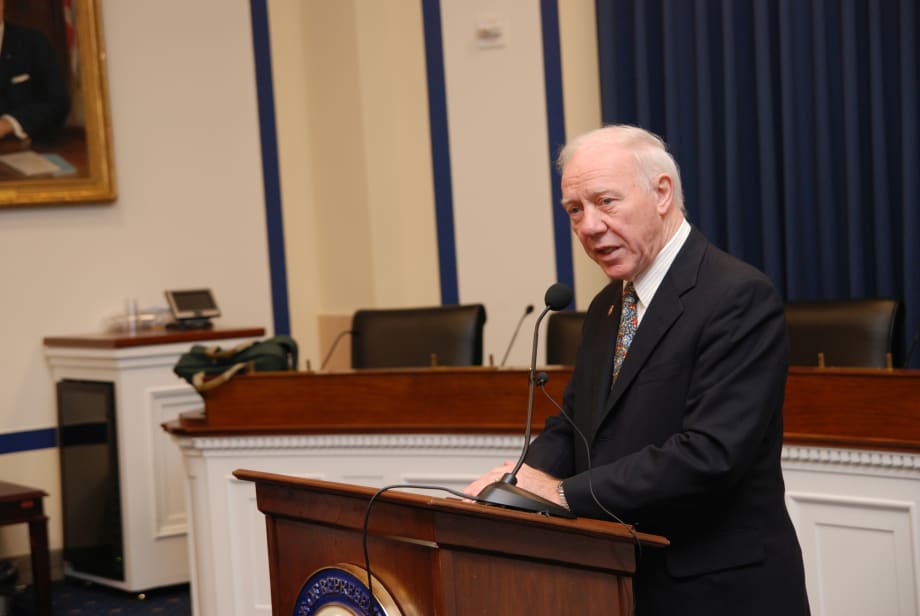
Oberstar, who was the longest-serving congressman in Minnesota history, was first elected to the U.S. House of Representatives in 1974 and was part of the T&I Committee for his entire run, becoming chairman in 2007.
He died in his sleep in his Maryland home on May 3, according to a family statement following his death.
“We are heartbroken to share the news that Jim Oberstar has passed way,” said the statement. “Jim was a loving husband, father, grandfather, friend and brother. While we mourn the loss of a good man, we also celebrate his life and his service.”
Oberstar’s legacy is visible throughout his home state, where his influence secured funding for public works projects including the Northstar commuter rail system and the rebuilding of the I-35W Mississippi River Bridge, helping to secure $250 million for the latter within days of its collapse.
At the federal level, Oberstar had an international reputation as an expert and as an advocate of public investments to spur private growth. He became known as an ardent champion of “intermodality,” reported the Washington Post.
“Congress, Minnesota, and the nation have lost a good man who dedicated his life to public service and our country’s transportation system,” said T&I Chairman Rep. Bill Shuster (R-PA) in a statement.
An avid cyclist, Oberstar authored, co-sponsored and helped to pass the $295 billion SAFETEA-LU act in 2005 and was a strong supporter of the American Recovery and Reinvestment Act of 2009.
“He was a tireless advocate for safety, consumer protections and robust federal investment so that the American public could continue to enjoy the best transportation system in the world,” said U.S. Transportation Secretary Anthony Foxx. “His personal imprint on our national transportation policies across all modes cannot be overstated. His principles and his legislative accomplishments continue to guide the work of the U.S. Department of Transportation each and every day.”
The son of an iron range miner, Oberstar excelled in school and graduated in 1956 from the College of St. Thomas in St. Paul, Minn. A year later, he received a master’s degree in European studies from the College of Europe in Bruges, Belgium. He reportedly spoke six languages, including Creole, which he learned with such fluency that he was briefly hired to teach the language to U.S. Marine and Navy officers assigned to Haiti.
Oberstar got his start in Washington, D.C., in 1963 working for his hometown congressman John Blatnik, who also led the House Public Works Committee. Since his first election in 1974, Oberstar has been credited with successfully fostering bipartisanship both in Congress and the T&I Committee.
In a 2009 interview with METRO, Oberstar discussed his frustrations with a proposal for a long-term continuing resolution that would have frozen funding at FY 2006 and cut $4 billion from infrastructure investment in FY 2007, including $480 million from transit, which would have been the first time in 10 years the highways and transit guarantees were not honored.
“This outcome was unacceptable to me, and the entire committee united to fight the proposal,” he said. “The committee worked together in a bipartisan fashion to emphasize to the Appropriations Committee and to the House leadership that the unique nature of SAFETEA-LU programs justifies unique treatment under the continuing resolution. I personally spoke with Appropriations Committee Chairman David Obey on this issue and, at my request, all 75 members of the Committee on Transportation and Infrastructure joined together in sending a letter to the bipartisan leadership of the Appropriations Committee urging the FY 2007 SAFETEA-LU guaranteed funding levels to be honored.”
Oberstar’s tenure in Congress ended after a his surprise defeat by Rep. Chip Cravaack (R-MN) in 2010.
“This is the people’s seat,” Oberstar said after the defeat. “I go in peace of mind and heart, but with sadness.”
More Management

METRO Opens Submissions for 2026 Motorcoach Awards
Nominations are now being accepted for METRO Magazine’s Operator of the Year and Innovative Operator of the Year awards.
Read More →
New York MTA Advances Final Contract for Second Avenue Subway Expansion
Contract Four is the largest in the Second Avenue Subway Phase 2 project and includes construction of station infrastructure, tracks, and signals for the subway expansion, MTA officials said. Work on Contract Four will begin in 2027.
Read More →
Transit Agencies Highlight Safety Gains at National Summit
Leaders from 15 major transit systems shared crime-reduction results and safety initiatives while discussing the role of continued federal support.
Read More →

NITA Names New Leadership, Expands Reduced-Fare Program at First Board Meeting
The new regional transit authority appointed its first board chair and interim executive director while extending reduced fares across CTA, Metra, and Pace for eligible riders.
Read More →
Beyond the Checklist: A Structured Approach to Transit Maintenance
Reliability-Centered Maintenance helps transit agencies move beyond routine checklists to focus limited resources on the assets and failures that have the greatest impact on safety, reliability, and service.
Read More →
APTA 2026 Nominating Committee Selects Leadership Slate, Names Chair and Vice Chair Nominees
Leadership changes will help shape the association’s priorities and its representation of the transportation industry during the 2026–2027 term.
Read More →
DART Launches Major Security, Fare Enforcement Initiative
The 90-day demonstration will deploy coordinated security teams at five light rail stations while testing controlled access and gathering data to guide future investments.
Read More →
Advancing Fare Collection Through Technology and Innovation
Learn about delivering 1300 gates at 91 stations while managing fare evasion. Explore the large scale deployment, solution customization and real-world results that affect the region. Prepare for deployment in your region now.
Read More →
Game Day in Motion: Moving Millions During the 2026 World Cup
Between packed transit stations and team motorcoaches, see how agencies and operators across North America tackled the transportation demands of the 2026 FIFA World Cup.
Read More →
Surface Transportation Extension Averts Shutdown, Leaves Transit Funding Gap
The stopgap keeps federal transportation programs moving, but missing advance funding could complicate the transit and rail projects agencies are planning next.
Read More →