




The VIC is America’s first and only innovation lab dedicated to advancing bus and coach technology in the electric and autonomous space. Since opening, the VIC has welcomed over 1,000 industry visitors, including transit properties, regulator, media, suppliers, utility companies, and investors, and New Flyer further invested $5 million to develop electric bus programming and production capacity.
New Flyer cuts ribbon on Alabama facility expansion
Adds an additional 76,000 square feet of space, bringing the total campus to nearly 400,000 square feet of manufacturing capacity.
November 30, 2018
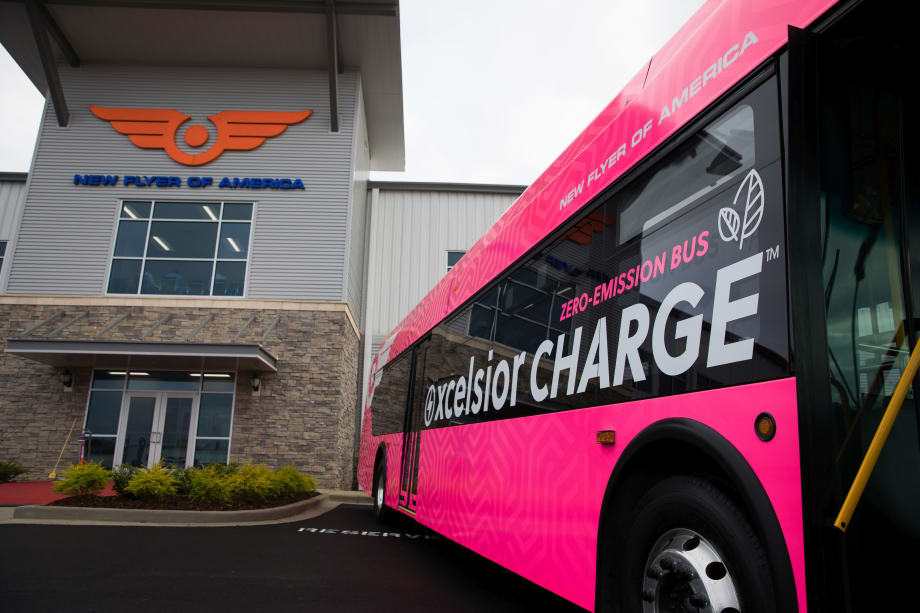
The expansion insources transit bus part fabrication, centralizes the welding process, expands workspace for the administration team, and adds Calhoun County’s first and only dine-in cafeteria amongst all manufacturers.
Cody Hensleigh Photography
2 min to read
The expansion insources transit bus part fabrication, centralizes the welding process, expands workspace for the administration team, and adds Calhoun County’s first and only dine-in cafeteria amongst all manufacturers.
Cody Hensleigh Photography
New Flyer of America Inc. cut the ribbon on a $25 million renovation and expansion of its Anniston, Alabama advanced manufacturing facility.
The ribbon cutting opens an additional 76,000-square feet of space, bringing the total campus to nearly 400,000-square feet of advanced manufacturing capacity and completing site readiness for production of battery-electric transit buses. The expansion insources transit bus part fabrication, centralizes the welding process, expands workspace for the administration team, and adds Calhoun County’s first and only dine-in cafeteria amongst all manufacturers.
Continuous improvements were also completed throughout the existing plant to improve quality and supply management, and to increase American-sourced components for New Flyer’s transit buses.
“The investment in our Anniston facility furthers New Flyer’s commitment to American jobs and manufacturing, and reiterates our ability to build and deliver safe, reliable, and technologically advanced transit buses,” said Wayne Joseph, president of New Flyer of America.
New Flyer’s Xcelsior CHARGE™ zero-emission, battery electric demonstration transit bus, also built in Anniston, was onsite for the occasion. The event follows New Flyer’s late 2017 announcement to invest into the manufacturing facility, which preceded the opening of its Vehicle Innovation Center (VIC) in Anniston in October 2017.
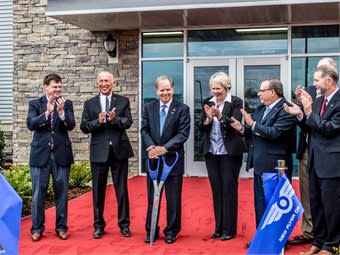
Joining New Flyer of America President Wayne Joseph in lending remarks were U.S. Senator Doug Jones, Anniston Mayor Jack Draper, Calhoun County Economic Development Council Executive Director Don Hopper, and more.
New Flyer
The expansion builds on New Flyer’s commitment to investing in American infrastructure, manufacturing, innovation, and jobs. Over the past year, jobs at its Anniston facility have grown by nearly 30% to over 750 people. New Flyer proudly employs more American workers than any bus manufacturer in North America.
The New Flyer of America Anniston campus, formerly North American Bus Industries, was acquired by New Flyer in 2013 and consists of five buildings on 36 acres. It manufactures transit buses from part fabrication to high-strength frame welding and final assembly. In 2015, New Flyer invested $20 million to transform the campus to a world-class LEAN manufacturing site capable of producing New Flyer’s Xcelsior® heavy-duty bus platform.
Combined with the $20 million invested in 2015 and $5 million spent on electric bus production upgrades and programming over the past year, the expansion marks a total $50 million invested in Anniston.
More Management

METRO Opens Submissions for 2026 Motorcoach Awards
Nominations are now being accepted for METRO Magazine’s Operator of the Year and Innovative Operator of the Year awards.
Read More →
New York MTA Advances Final Contract for Second Avenue Subway Expansion
Contract Four is the largest in the Second Avenue Subway Phase 2 project and includes construction of station infrastructure, tracks, and signals for the subway expansion, MTA officials said. Work on Contract Four will begin in 2027.
Read More →
Transit Agencies Highlight Safety Gains at National Summit
Leaders from 15 major transit systems shared crime-reduction results and safety initiatives while discussing the role of continued federal support.
Read More →

NITA Names New Leadership, Expands Reduced-Fare Program at First Board Meeting
The new regional transit authority appointed its first board chair and interim executive director while extending reduced fares across CTA, Metra, and Pace for eligible riders.
Read More →
Beyond the Checklist: A Structured Approach to Transit Maintenance
Reliability-Centered Maintenance helps transit agencies move beyond routine checklists to focus limited resources on the assets and failures that have the greatest impact on safety, reliability, and service.
Read More →
APTA 2026 Nominating Committee Selects Leadership Slate, Names Chair and Vice Chair Nominees
Leadership changes will help shape the association’s priorities and its representation of the transportation industry during the 2026–2027 term.
Read More →
DART Launches Major Security, Fare Enforcement Initiative
The 90-day demonstration will deploy coordinated security teams at five light rail stations while testing controlled access and gathering data to guide future investments.
Read More →
Sponsored•September 9, 2026
Advancing Fare Collection Through Technology and Innovation
Learn about delivering 1300 gates at 91 stations while managing fare evasion. Explore the large scale deployment, solution customization and real-world results that affect the region. Prepare for deployment in your region now.
Read More →
Game Day in Motion: Moving Millions During the 2026 World Cup
Between packed transit stations and team motorcoaches, see how agencies and operators across North America tackled the transportation demands of the 2026 FIFA World Cup.
Read More →
Surface Transportation Extension Averts Shutdown, Leaves Transit Funding Gap
The stopgap keeps federal transportation programs moving, but missing advance funding could complicate the transit and rail projects agencies are planning next.
Read More →