
Keep Reading: The Invisible Infrastructure of Passenger Flow


 MENU
MENU SEARCH
Once viewed primarily as transit operators, agencies are now leveraging land, partnerships, and long-term planning to boost ridership, expand housing, and strengthen communities.
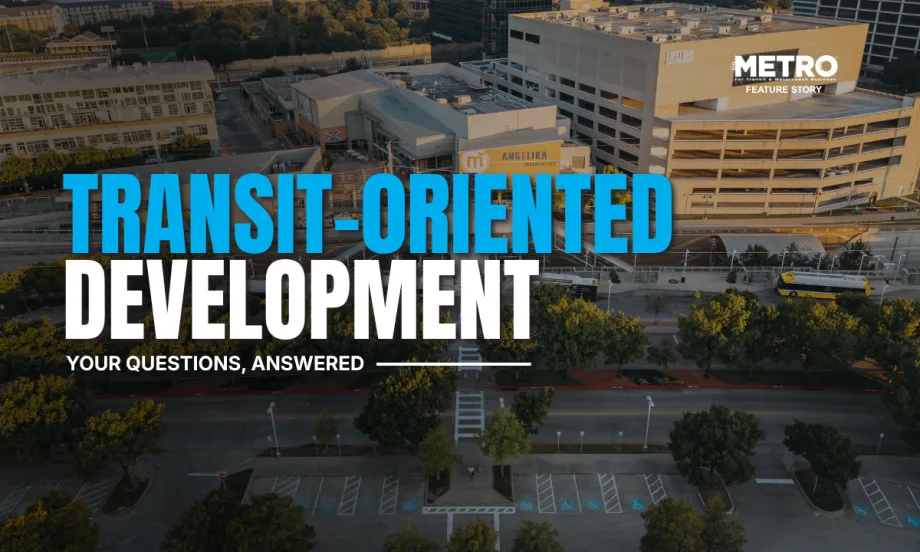
SMU/Mockingbird Station is just one of the many transit-oriented developments across the Dallas Area Rapid Transit system.
DART/METRO
*Summarized by AI
When the general population pictures public transit, they usually see buses, trains, stations, and schedules. Yes, these are hallmark aspects of the industry, but what most people don’t know is that today’s transit agencies are being asked to think beyond moving passengers from Point A to Point B.
Transit-oriented development (TOD) is hardly a new concept. Its roots stretch back to the mid-19th century, when streetcar suburbs grew alongside rail lines, connecting residents to jobs and city centers. It wasn’t called “transit-oriented development” at the time. The term was coined in the late 20th century by urban planners like Peter Calthorpe, who was the “father” of the Transit-Oriented Communities Theory, which focused on building high-density, mixed-use communities within a 10-minute walk of a transit station.
Today, though, the strategy is taking on renewed importance, and the attention isn’t happening by chance.
Federal policymakers and state governments are joining transit agencies in gathering around TOD as a strategy to address societal investment and housing concerns. In 2026 alone, the Federal Transit Administration announced $28.5 million through its Pilot Program for Transit-Oriented Development Planning, while some states are advancing major station-area development initiatives that pair transit investments with housing and mixed-use development.
As transit agencies grapple with housing shortages, changing travel patterns, financial pressures, and climate goals, TOD has evolved from an urban planning and design concept into a whole new business strategy. Underutilized park-and-ride lots, surplus agency land, and station areas are being reimagined as mixed-use neighborhoods that bring housing, jobs, retail, public spaces, and transit closer together.
“Transit agencies are responsible for moving people,” said David Zaidain, Maryland Department of Transportation’s chief of real estate and transit-oriented development. “And the best way to move the most people is to make sure that there's adequate access to transit. And the best way to do that is to have transit-oriented development.”
In this case, it’s important to remember that transit systems don’t operate in isolation. Ridership, housing availability, economic development, and community growth are deeply connected. Modern TOD is an extension of those transportation goals.
We know what Calthorpe established and the general idea of TOD, but what does it look like in practice? TOD is the concept of creating compact, walkable, mixed-use communities centered around high-quality public transportation. While individual projects vary, most combine housing, employment, retail, public amenities, and pedestrian infrastructure within easy access of rail stations or major bus hubs.
For transit agencies, the objective extends a little further than constructing buildings. Well-designed TOD creates neighborhoods where transit becomes the most convenient transportation option rather than an afterthought.
That relationship between land use and transportation has become increasingly important as agencies seek to maximize returns on significant public infrastructure investments. Historically, transit agencies focused primarily on operating buses and trains while cities and private developers determined what would be built around stations.
Many agencies now recognize that they already control valuable assets, such as strategically located land, to influence future growth. For example, surface lots that once served commuters are now viewed as opportunities to create housing, improve station access, and generate long-lasting value while strengthening ridership.
San Diego Metropolitan Transit System (MTS) has reached a similar conclusion as housing affordability pressures have intensified across Southern California. Sharon Cooney, MTS chief executive officer, said the agency has shifted its focus toward redeveloping underutilized park-and-ride lots and station areas into transit-oriented housing communities that better connect residents to transit while addressing regional housing needs.
"The entire San Diego region is challenged with a lack of affordable housing," Cooney said. "That's why MTS is focused on an approach that aligns housing development with transit access, creating housing communities designed to serve both residents and the broader region."
Rather than becoming developers, transit agencies are positioning themselves as partners in establishing community goals and selecting qualified development teams, while ensuring projects continue to support transit operations throughout their lifecycle.
As Josselyn Hazen, manager of the Santa Clara Valley Transportation Authority’s transit-oriented development, explained, retaining ownership through long-term ground leases allows agencies to preserve public control of transit property while ensuring developments continue supporting agency priorities and community needs for decades. This was evident through the agency's recently opened Tamien Station Apartments.
Similarly, Dallas Area Rapid Transit (DART) has viewed its real estate portfolio as a strategic asset capable of creating mobility-rich destinations and generating new revenue streams to support transit service.
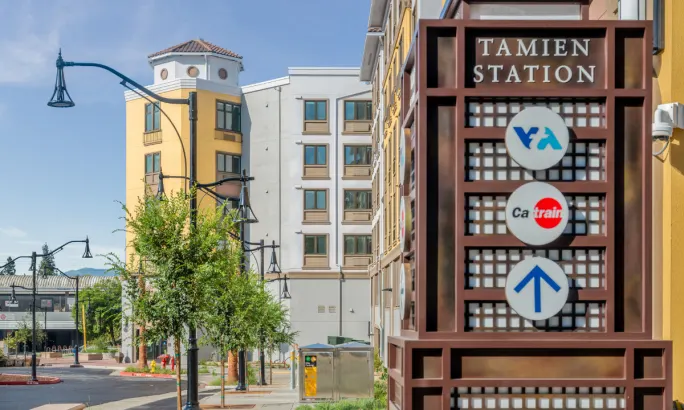
In January 2026, VTA and The Core Companies celebrated the grand opening of Tamien Station Apartments, delivering 135 new affordable homes directly adjacent to Tamien Light Rail and Caltrain stations in San Jose.
Santa Clara VTA/METRO
Although agencies approach TOD differently depending on their market, several themes consistently emerge. The first is that successful development starts with transit.
Before projects reach the market, agencies spend considerable time understanding operational requirements, future infrastructure needs, utility constraints, passenger access, and long-term service plans. That groundwork allows future development to complement transit rather than compete with it.
This strategy also guides MTS's site selection process. Cooney said maintaining reliable transit service is the agency's primary consideration before evaluating any redevelopment opportunity.
"MTS's focus for transit-oriented developments is maintaining transit operations; it's the first test when examining potential sites," she said. "These projects must prioritize the long-term performance for bus and trolley service."
The Maryland Transit Administration (MTA) has emphasized that transit infrastructure must remain central throughout project planning. The agency is advancing a regional transit-oriented development strategy around Baltimore's Metro and Light Rail network, viewing station-area development as a way to increase ridership, expand housing, and maximize the return on major transit infrastructure investments.
Understanding operational needs before selecting development partners helps agencies integrate future projects seamlessly with existing and planned transit investments while reducing uncertainty for private partners.
Remember, successful TOD is about designing development around transit. Another lesson repeated across agencies is that TOD succeeds through partnerships.
No single organization can deliver successful TOD independently:
Caitlin Holland, DART’s vice president of real estate and economic development, credited long-standing relationships with municipalities, developers, and regional partners for helping projects navigate changing market conditions over many years. Flexibility, communication, and mutual trust have proven just as important as financing or design.
"We have learned something new with every one of our projects, but the lessons we keep closest are the importance of strong relationships, trust between our partners, and meaningfully involving the community throughout the project,” Holland said.
Hazen similarly described TOD as a long-term collaboration that requires continuous coordination among transit agencies, developers, local governments, community stakeholders, and funding partners, from planning through operations.
Cooney said successful transit-oriented development begins long before construction, with agencies and partners agreeing on a common vision.
"A successful partnership starts with having a shared vision among all stakeholders," Cooney said. "Other agencies who are pursuing TODs must find partners who share a long-term commitment to the community and are willing to work collaboratively through complex planning, funding, and development challenges."
Zaidain reinforced the idea, noting that successful TOD requires public agencies, local jurisdictions, nonprofits, and private developers to work toward shared goals rather than operate independently.
Across all four agencies, collaboration is the process. Not just part of it.
Another change shows how agencies structure projects before selecting development partners. Rather than prescribing every design detail up front, agencies are establishing clear objectives while allowing developers the flexibility to respond to changing market conditions.
VTA, for example, adjusted its approach after early projects demonstrated that developers are often better positioned to refine site designs and navigate approvals based on current financing conditions and community needs. Instead of creating detailed master plans before procurement, the agency now focuses on defining expectations while allowing development teams greater flexibility in execution.
Likewise, MTA emphasizes conducting thorough site analysis before issuing solicitations, thereby reducing uncertainty for developers, attracting stronger proposals, and creating more integrated transit projects.
The takeaway? Agencies don’t need to control every design decision. They need to establish a clear vision for their TOD, understand their operational priorities, and choose partners capable of delivering them.
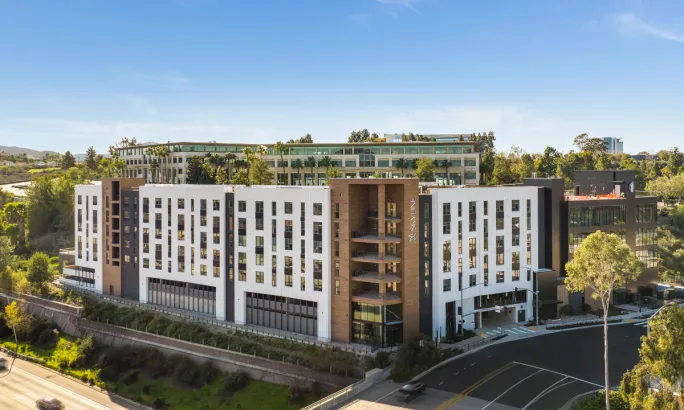
Opened in early 2026, San Diego MTS' SkyLINE brings 100 affordable homes to the Rancho Bernardo community, steps from a major BRT transit hub, showcasing the potential of transit-oriented development.
San Diego MTS
Ridership remains one of TOD’s most visible outcomes, but agencies seem to evaluate success using a much broader scorecard.
Housing production, especially affordable housing, has become a central objective for many TOD programs. Revenue generation, improved station access, walkability, public spaces, economic development, tax generation, safety, and overall community impact all factor into how agencies assess long-term value.
For DART, Holland described success as transforming underutilized property into places where people can live, work, and gather while simultaneously supporting transit operations and strengthening municipal tax bases.
That analysis looks different for VTA. According to Hazen, successful projects create housing, improve station environments, generate long-term revenue, strengthen transit use, and create welcoming places that people actively choose to visit. MTA similarly evaluates TOD through three interconnected outcomes: ridership, economic development, and housing production.
Although priorities vary across agencies in how they define public value, housing affordability, in particular, has become a defining theme shaping TOD nationwide. Transit-accessible housing is considered a mobility strategy as much as a community investment.
VTA has adopted a portfolio approach that balances affordable and mixed-income projects while maintaining long-term stewardship of publicly owned land through ground leases. Rather than discounting land values, the agency works with development partners to leverage federal, state, and local housing programs that make projects financially feasible while preserving public assets.
"TODs create a more active, walkable environment where people can live, work, and access services all in one place," Cooney said. "By developing the land, MTS will transform the transit center from a commuter facility into a destination that supports the local economy and strengthens regional connectivity."
This approach shows how transit agencies are striving to balance financial sustainability with public policy objectives.
Despite growing momentum, TOD remains a long-term undertaking. Projects often require years of planning, environmental review, financing, permitting, public engagement, construction, and the list goes on.
Every agency interviewed emphasized the importance of patience.
Strong relationships, clear communication, realistic expectations, and consistent community engagement often determine success more than any individual design feature or financing tool.
“Be patient, build relationships, and be ready,” Holland said. “The highest-quality TOD takes time, preparation, creativity, and the right partners at the table to make it happen.”
TOD has become a strategy for helping communities create neighborhoods where transit becomes a part of everyday life, but also addresses:
While interest in TOD continues to grow, Cooney noted that funding remains one of the biggest obstacles. Shrinking affordable housing funding, higher interest rates, rising construction costs, and the need to preserve transit operations can all complicate redevelopment efforts. Many MTS stations, for example, require replacement of park-and-ride facilities, adding another layer of cost to projects.
As agencies continue to balance transportation operations with community development, their role is expanding to become that of long-term stewards of public assets. When transportation, housing, land use, and partnerships are planned together, transit becomes a way of building stronger, more connected communities.
“Transit agencies have a unique opportunity because we own public land in some of the most connected and opportunity-rich locations in our communities,” Hazen said. “By setting a clear vision, selecting strong development partners, and staying actively engaged throughout the process, transit agencies can help shape projects that deliver lasting public benefits.”
Transit-oriented development (TOD) is a planning and development approach that focuses on creating vibrant, livable communities centered around public transportation options. This involves mixed-use residential and commercial areas designed to maximize access to public transit and minimize reliance on private vehicles.
*Summarized by AI
Loading data...

Management
Behind the seamless trips were months of planning, multimodal partnerships, and lessons agencies and operators can carry into the next mega-event.
Management
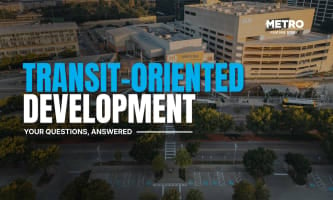
Once viewed primarily as transit operators, agencies are now leveraging land, partnerships, and long-term planning to boost ridership, expand housing, and strengthen communities.

Management
An Urban Institute evaluation found that a fare-free transit program increased ridership, reduced transportation barriers, and improved access to jobs, healthcare, and other essential services.
Security and Safety
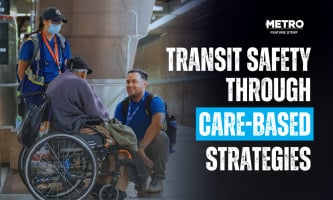
Transit agencies are redefining safety with care-based response models. See how leaders are improving trust and operations.

Management
Advances in data and analytics are giving transit agencies new opportunities to refine maintenance practices, improve efficiency and make more informed decisions about asset performance.
Technology
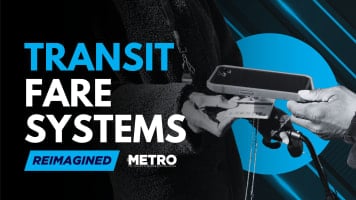
The farebox is no longer just a payment machine. Learn how agencies are using new tech and pricing strategies to rethink how riders pay for transit.
Management
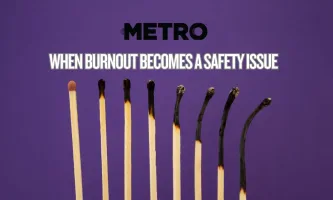
How stress, unresolved trauma, and chronic burnout can impact operator performance—and the steps agencies can take to improve safety and well-being.

Management
Mentorship programs at VTA and King County Metro are transforming the experience of new bus operators — boosting retention, improving safety, and strengthening connections among frontline workers, unions, and management.

Motorcoach
With more operators nearing retirement and investor interest on the rise, now is the time to plan your exit strategy. Here’s how to prepare your business for a successful sale that avoids leaving money on the table.