



Sacramento RT awarded $12M to expand microtransit service
The grant funding is expected to cover operational costs for the next two-and-a-half years.

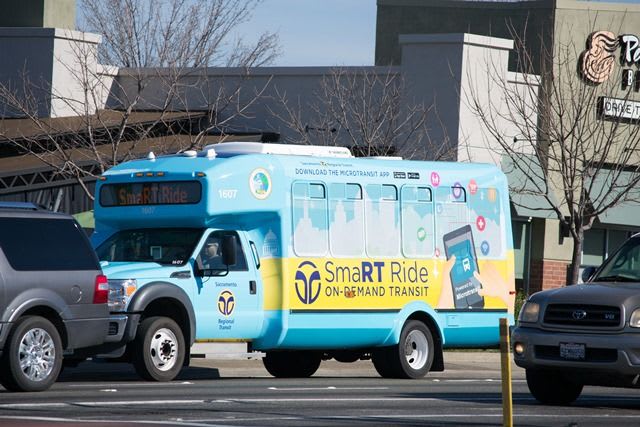
Similar to other ride-hailing services, SmaRT Ride relies on a smartphone app to schedule customized trips.
SacRT
Similar to other ride-hailing services, SmaRT Ride relies on a smartphone app to schedule customized trips.
SacRT
The Sacramento Transportation Authority (STA) recently awarded a $12 million discretionary grant to the Sacramento Regional Transit District (SacRT) to expand its SmaRT Ride microtransit service.
“We are grateful to have the support of the STA for our SmaRT Ride program, which could very well change the nation’s transit industry should innovative programs like SmaRT Ride continue to flourish,” said GM/CEO Henry Li. “Implementing new approaches to solve mobility challenges is an exciting endeavor and our SmaRT Ride service is proving to be an excellent solution.”
The STA Board of Directors voted unanimously to award the $12 million grant, which comes from Measure A funding and is guided by a Transportation Expenditure Plan.
SacRT is in the process of developing the new service, with the Historic Franklin Corridor and South Sacramento communities identified as the next phase for SmaRT Ride. Service is expected to start in late July. SacRT planners will work with the STA to identify the boundaries of each new phase of the service roll-out. The grant funding is expected to cover operational costs for the next two-and-a-half years.
SmaRT Ride has only been in operation since February 12, when it was rolled out as a pilot service in Citrus Heights. Within six weeks, the pilot was expanded to Orangevale and Antelope, with a connection to the Historic Folsom Station. Ridership on the service has jumped by more than six times since its inception, and the response from the community has been overwhelmingly positive.
Similar to other ride-hailing services, SmaRT Ride relies on a smartphone app to schedule customized trips. The app, known as Microtransit by TransLoc, is connected to proprietary software that allows bus operators to pick-up and drop-off passengers in an efficient manner. The service relies on small, neighborhood-friendly shuttle buses to easily maneuver on residential streets, and they conveniently accommodate people with disabilities.
“We initially saw the pilot service as a way to serve areas that may not have easy access to fixed-route service, but it’s also proving to help people connect to the larger SacRT transit network,” said SacRT Board Chair and Sacramento County Vice Chair Patrick Kennedy. “Interestingly, survey data indicates our residents are also enjoying the freedom to travel within their communities for shopping and dining experiences. SmaRT Ride has turned out to be a service that truly enhances one’s quality of life.”
The cost to ride is only $2.75 per trip, $1.35 for those eligible for discount fare (seniors, students, and persons with disabilities); or, riders can use their SacRT monthly pass. The low-cost makes SacRT’s SmaRT Ride more affordable than a traditional ride-hailing service, which could cost riders more than five times the amount for a similar trip.
The on-demand service is also generating a significant amount of national attention due to its innovative nature. The pilot is proving to be an exceptional model for other transit agencies who are adopting similar programs.
More New Mobility

From Hardware to Digital Partner: Luminator Charts Its Next Chapter
CEO Magnus Friberg discusses Luminator’s shift toward becoming a digital partner, the growing importance of software and interoperability, and how AI can help agencies improve operations and passenger experience.
Read More →
Biz Briefs: Alstom Lands Canadian Contract, LYT to Supply California TSP, and More
In METRO's latest installment, we take a look at recent news from Complete Coach Works, Beep, FlixBus, and more partnerships making headlines across the transportation sector.
Read More →
CharterUP’s Armir Harris on Technology, AI, and the Future of Group Mobility
In a recent episode of METROspectives, CharterUP Founder/CEO Armir Harris discussed the company’s evolution from an online charter bus marketplace into a technology platform supporting public- and private-sector mobility and much more.
Read More →
Jacksonville’s NAVI Project Charts a New Course for Autonomous Public Transportation
Through its NAVI program, JTA is showing how autonomous vehicles, intelligent infrastructure, and coordinated operations can work together to deliver everyday public transportation.
Read More →
Biz Briefs: Luminator Marks Milestone and More
From manufacturers and suppliers to transit agencies and motorcoach operators, these updates offer a snapshot of the projects, partnerships and business moves driving the industry forward.
Read More →
New Tricks for Old Bureaucracies: Joshua Schank on Making Transit Innovation Stick
Former LA Metro Chief Innovation Officer Joshua Schank discusses why good ideas aren't enough, how transit agencies can overcome resistance to change, and why today's challenges demand more innovation.
Read More →
How DART's GoPass Is Redefining Regional Mobility
Serving 14 transit agencies, GoPass simplifies multimodal travel by allowing riders to plan, pay for, and manage an entire trip through one app.
Read More →
Biz Briefs: OCTA Taps Clean Energy for Hydrogen Station, Stadler to Supply Via Rail Vehicles, and More
From manufacturers and suppliers to transit agencies and motorcoach operators, these updates offer a snapshot of the projects, partnerships and business moves driving the industry forward.
Read More →CharterUP Expands Into New Mobility and Autonomous Transportation
Vice President of New Mobility Stephen Joos discusses how CharterUP is leveraging its nationwide transportation network, technology platform, and autonomous vehicle partnerships to expand into workforce mobility, campus shuttles, and transit solutions.
Read More →
METRO Magazine Announces 2026 Innovative Solutions Awards Winners
Projects Recognized for Advancing Mobility Through Technology, Accessibility, Workforce Innovation, and Operational Excellence
Read More →