




Check Out:How Two Transit Agencies Are Using Tech to Put Riders First
Microtransit’s Next Chapter: Data, Equity, and Job Access at Scale
Via data shows microtransit boosts job access, equity, and commutes when designed to feed fixed routes, not compete with them.
January 8, 2026

If agencies can predict where microtransit will unlock opportunity and deliver value per mile, they can scale services with greater intention.
Photo: Via/METRO
6 min to read
If microtransit used to be viewed as a niche pilot or a last-mile experiment, Via’s newest data suggests it’s becoming a practical way to expand job access, shorten commutes, and deliver measurable equity gains in places traditional transit struggles to reach.
For Via, microtransit is expanding access to jobs by 54% on average in high-ridership areas like West Sacramento (CA), Wake Forest (NC), and Longmont (CO), all previously underserved by fixed routes.
Daniel Berkovits, senior VP, strategy, at Via, says the takeaway for agencies isn’t that on-demand service should replace fixed routes, but more so, the best systems are those where microtransit is deliberately designed to strengthen them.
Below is how Berkovits interprets the data, and what he believes transit leaders should do next.
Microtransit Works Best When it Fills Gaps
Berkovits says agencies get the strongest results when microtransit is treated as network support, which could mean a flexible tool aimed at parts of the map and times of day where fixed routes can’t do the job efficiently on their own.
“This strategy has allowed folks who live far from bus lines to use microtransit as a first-last mile option to easily connect with the fixed network,” Berkovits says. “This way, microtransit is a tool to grow fixed-route ridership.”
From Via’s perspective, that means microtransit should be built to solve specific coverage problems:
First- and last-mile connections to high-frequency lines.
Service for lower-density neighborhoods that can’t support fixed routes.
Late-night or weekend mobility when demand is real but scattered.
“When done right, microtransit becomes a powerful layer of the system, connecting people to high-frequency routes and helping agencies get more value out of every mile they operate,” he says.
Technology is what makes that integration seamless. Berkovits points to platforms that show riders fixed-route and on-demand options together, allowing them to plan multi-leg trips that combine microtransit with core lines.
If a bus is the most efficient option, the system should guide riders to it. If on-demand is the best fit, it should appear as an easy alternative.
Sioux Falls, South Dakota, is his go-to example, where Via has operated the city’s fixed-route, microtransit, and paratransit services as a single network since January 2024. Under the “SAM Reimagined” plan, Sioux Falls expanded microtransit citywide and directs riders to fixed routes when those routes are the most efficient way to complete a trip. Reinforcing that the goal is to grow fixed-route ridership instead of siphoning it.
Job Access is the Metric That Shows Why This Matters
Since Via’s data shows a 54% increase in job access in high-ridership areas, agencies should interpret that as more than a nice headline statistic.
In practical terms, Berkovits says “access” means the number of jobs a person can realistically reach within a workable commute. That shift can change the shape of daily life. According to Via, 43% of microtransit trips in other top-ridership communities, including Birmingham (AL), Seattle (WA), Fort Worth (TX), and Lorain County (OH), are for commuting to work.
Transportation, Berkovits notes, doesn’t just move people from point A to point B. It determines whether someone can take a job on the other side of town, attend a training program, reach a clinic, or participate in their city's economy. Whenever or however mobility expands, opportunity expands with it.
Berkovits says Via has watched this play out repeatedly: small businesses see more customers, residents apply for jobs they couldn’t reliably get to before, and neighborhoods become more connected to schools and essential services.
“In cities using Via microtransit, we’ve seen job access grow by around 40% on average,” Berkovits says.
By linking job access to commute quality, cities using Via microtransit have reported that reduced travel time is one of the biggest benefits, right alongside saving money. So for Berkovits, job access is the clearest outcome metric of microtransit’s impact because it captures equity and economic mobility in a way ridership totals alone don’t.
Measuring Success Through Social ROI
Berkovits believes the industry is entering a new measurement era in which agencies can’t afford to judge services solely by passengers per hour or cost per trip. Yes, those metrics matter, but they don’t tell city leaders whether transit is actually improving lives.
That’s why Via has pushed tools like Via Intelligence, which Berkovits describes as a vertical AI platform designed specifically for public transportation. The idea is to let agencies quantify social return on investment with outcomes like job access, school connectivity, healthcare reach, and reduced commute times alongside traditional performance indicators.
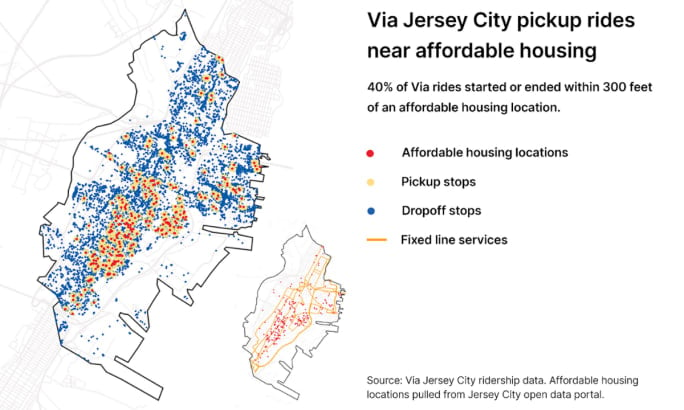
Jersey City, NJ, is a standout case, with nearly 40% of trips beginning or ending within 300 ft. of affordable housing.
Credit: Via
Berkovits says the value is in combining fixed-route and on-demand data to model real mobility patterns. Agencies can see, for instance, whether a new zone or route tweak meaningfully reduces commute times for workers in a specific corridor, or whether a first-last mile solution connects an underserved neighborhood to a job cluster that was previously out of reach.
The broader point he keeps returning to is equity plus efficiency. If agencies can predict where microtransit will unlock opportunity and deliver value per mile, they can scale services with greater intention and make stronger cases to boards, funders, and the public.
Microtransit Equity Gains are Already Visible
The data also points to who microtransit is serving, and Berkovits says the demographic is not incidental. Jersey City, NJ, is a standout case, with 80% of Via microtransit rides taken by people of color, 60% by low-income residents, and nearly 40% of trips beginning or ending within 300 ft. of affordable housing.
Additionally, riders often earn under $50,000 a year, and many don’t have access to a car. For Berkovits, those numbers reflect microtransit’s ability to connect communities that have historically been underinvested in.
However, he’s clear that equity doesn’t sustain itself automatically. Agencies have to design for it, measure it, and keep lowering barriers to entry. Berkovits’ framework for scaling equity outcomes centers on a few essentials:
Design for equity from the start: Target neighborhoods underserved by transit and set measurable goals, such as the share of trips serving low-income riders or linking to affordable housing.
Keep access inclusive: Maintain multiple booking and payment options (app, phone, cash) to serve riders without smartphones or credit cards.
Integrate with the broader network: Use microtransit to cover transit gaps, enable first- and last-mile connections to fixed routes, and make transfers seamless.
Engage communities and track results: Partner with residents to tailor service hours and destinations, and use data to monitor who’s being served.
In Berkovits’ view, the agencies that combine community partnership with data-driven planning are the ones that turn microtransit from a pilot into a lasting option.
The Misconception That Keeps Holding Microtransit Back
Asked what misconception he most wants to address, Berkovits doesn’t hesitate to say, “Microtransit is too expensive to execute effectively.” He argues that on-demand service can be cost-effective when deployed strategically and evaluated honestly against the routes it’s meant to improve or replace.
Via’s partner results are the proof he points to the most. In North Texas, Denton County Transit Authority (DCTA) replaced underperforming bus lines with on-demand microtransit, achieving a five-fold increase in monthly ridership without increasing operating costs.
In Sarasota, Florida, Breeze Transit used a similar approach, cutting the average cost per ride by roughly 50%.
Those aren’t edge cases, Berkovits says, they’re signs of what happens when service design aligns with actual demand patterns.
He ties the cost conversation back to impact, highlighting that microtransit is about transportation and economic growth. Better transit connects workers to more jobs, gives employers a wider labor pool, reduces commute strain, and supports downtown vitality without requiring parking costs or infrastructure expansion.
In other words, the financial story is inseparable from the opportunity story. Via’s new data shows that microtransit is already doing what transit agencies need most: expanding job access, shortening commutes, and delivering equity outcomes that are visible on the ground.
After tackling whether microtransit can help, a new question arises. Will agencies design it as a true partner to a broader public transit network?
Subscribe to Our Newsletter
More New Mobility

From Hardware to Digital Partner: Luminator Charts Its Next Chapter
CEO Magnus Friberg discusses Luminator’s shift toward becoming a digital partner, the growing importance of software and interoperability, and how AI can help agencies improve operations and passenger experience.
Read More →
Biz Briefs: Alstom Lands Canadian Contract, LYT to Supply California TSP, and More
In METRO's latest installment, we take a look at recent news from Complete Coach Works, Beep, FlixBus, and more partnerships making headlines across the transportation sector.
Read More →
CharterUP’s Armir Harris on Technology, AI, and the Future of Group Mobility
In a recent episode of METROspectives, CharterUP Founder/CEO Armir Harris discussed the company’s evolution from an online charter bus marketplace into a technology platform supporting public- and private-sector mobility and much more.
Read More →
Jacksonville’s NAVI Project Charts a New Course for Autonomous Public Transportation
Through its NAVI program, JTA is showing how autonomous vehicles, intelligent infrastructure, and coordinated operations can work together to deliver everyday public transportation.
Read More →
Biz Briefs: Luminator Marks Milestone and More
From manufacturers and suppliers to transit agencies and motorcoach operators, these updates offer a snapshot of the projects, partnerships and business moves driving the industry forward.
Read More →
New Tricks for Old Bureaucracies: Joshua Schank on Making Transit Innovation Stick
Former LA Metro Chief Innovation Officer Joshua Schank discusses why good ideas aren't enough, how transit agencies can overcome resistance to change, and why today's challenges demand more innovation.
Read More →
How DART's GoPass Is Redefining Regional Mobility
Serving 14 transit agencies, GoPass simplifies multimodal travel by allowing riders to plan, pay for, and manage an entire trip through one app.
Read More →
Biz Briefs: OCTA Taps Clean Energy for Hydrogen Station, Stadler to Supply Via Rail Vehicles, and More
From manufacturers and suppliers to transit agencies and motorcoach operators, these updates offer a snapshot of the projects, partnerships and business moves driving the industry forward.
Read More →CharterUP Expands Into New Mobility and Autonomous Transportation
Vice President of New Mobility Stephen Joos discusses how CharterUP is leveraging its nationwide transportation network, technology platform, and autonomous vehicle partnerships to expand into workforce mobility, campus shuttles, and transit solutions.
Read More →
METRO Magazine Announces 2026 Innovative Solutions Awards Winners
Projects Recognized for Advancing Mobility Through Technology, Accessibility, Workforce Innovation, and Operational Excellence
Read More →