



Biz Briefs: Electric Paratransit Buses in San Francisco and More
Biz Briefs covers the latest supplier news in the motorcoach and public transit industries.

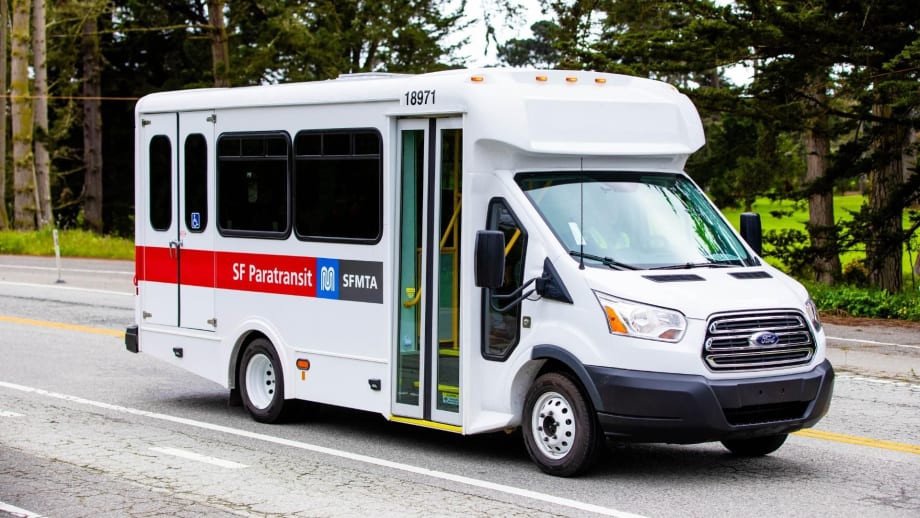
As SFMTA’s paratransit operations partner, Transdev worked closely with agency engineers and manufacturers to ensure the successful deployment of this groundbreaking vehicle.
Credit: Transdev/SFMTA
In METRO's latest installment, we take a look at the latest news from suppliers including Transdev, March Networks, and more.
Credit: METRO Magazine
Biz Briefs covers the latest supplier news in the motorcoach and public transit industries.
In METRO's latest installment, we take a look at the latest news from suppliers including Transdev, March Networks, and more.
Hyundai Rotem Tapped for Edmonton’s LRT Expansion
The City of Edmonton has named Hyundai Rotem Company as its preferred proponent to supply high-floor light-rail vehicles for use on the Capital Line and Metro Line.
Design and manufacturing of 40 high-floor light-rail vehicles are expected to begin in 2026, with delivery in 2029 and 2030.
The vehicles will replace the City’s fleet of 37 Siemens U2 vehicles, which are near the end of their service life. Additional vehicles are being procured to accommodate service growth for the Capital Line South Extension and Metro Line Northwest Extension.
The City is aiming to award the contract in early 2026.
Arcadis Selected as Lead Architect for West Alexandria, Virginia Transit Center
Arcadis has been appointed by the City of Alexandria, Virginia, as lead architect for the transformational West Alexandria Transit Center (WATC).
The new facility will anchor the four-million-square-foot WestEnd Alexandria development, currently taking shape on the historic site of the former Landmark Mall.
The WATC represents a significant leap in Alexandria’s efforts to deliver the ambitious transportation and community connectivity goals outlined in the Alexandria Mobility Plan.
The Transit Center will bring together two new Bus Rapid Transit (BRT) lines, DASH and Metrobus services, and extensive multimodal amenities. By doing so, it will provide residents, commuters, and visitors with safe, comfortable, and highly accessible connections within one of the city’s most vibrant emerging neighborhoods.
The concept weaves together modular bus shelters beneath a flourishing tree canopy, inviting parklets, and adaptive public seating to activate the streetscape and encourage positive use around the clock. The architectural approach will deliver scalable branding for BRT services across Alexandria, foster a sense of place, improve sustainability by increasing transit access, and support local economic growth by reducing congestion.
Transdev, San Francisco MTA Launch First All-Electric Paratransit Vehicles
Transdev and the San Francisco Municipal Transportation Agency (SFMTA) introduced the city’s first fully electric paratransit vehicle. The milestone supports California’s Innovative Clean Transit regulation, which requires all public transit fleets to be 100% zero-emission by 2040.
As SFMTA’s paratransit operations partner, Transdev worked closely with agency engineers and manufacturers to ensure the successful deployment of this groundbreaking vehicle.
Built by Turtle Top and powered by Optimal Electric Buses, the new bus combines zero-emission technology with the accessibility features riders depend on.
Key features include:
Capacity: Seats 12 ambulatory passengers and accommodates up to three wheelchairs (two for larger electric models).
Custom Design: Floor plan tailored to paratransit service needs.
Full-Day Operation: A six-hour Level 2 charge powers the bus for an entire shift.
Transdev’s team collaborated with SFMTA and Optimal to train five drivers and mechanics on EV-specific safety and maintenance protocols. Since its launch in September, the vehicle has been operating seamlessly on San Francisco’s challenging terrain, delivering the same reliable service riders expect.
March Networks Upgrades Cloud Video with AWS Power
March Networks announced an expansion of its long-standing collaboration with Amazon Web Services (AWS), helping customers reduce long-term video storage costs by up to 80% over five years, by deepening its use of Amazon S3 Vectors and Amazon S3 Glacier to advance both video intelligence and cloud storage.
March Networks has relied on AWS for years to deliver secure, scalable solutions across its portfolio. Today, the platform uses Amazon S3 Vectors to power AI Smart Search, enabling natural language search across millions of video images, while Amazon Glacier supports a tiered cloud storage model built for high-volume video archives and long-term retention.
By combining Amazon S3 Vectors with S3 Glacier-backed storage, March Networks helps customers find critical video evidence faster, while significantly reducing the cost and operational burden of storing video for compliance, investigations, and liability protection. This approach is already being adopted by large, multi-site enterprises with extensive video retention requirements.
Through its expanded relationship with AWS, March Networks delivers:
Faster video investigations using natural-language search powered by Amazon S3 Vectors.
Up to 80% lower video storage cost over five years using Amazon S3 Glacier-backed tiered retention.
Enterprise-grade durability and resiliency through AWS-managed infrastructure.
Instant scalability with no on-premises hardware to deploy or maintain.
Hybrid flexibility for customers transitioning to the cloud at their own pace.
More Technology

From Hardware to Digital Partner: Luminator Charts Its Next Chapter
CEO Magnus Friberg discusses Luminator’s shift toward becoming a digital partner, the growing importance of software and interoperability, and how AI can help agencies improve operations and passenger experience.
Read More →
Beyond the Checklist: A Structured Approach to Transit Maintenance
Reliability-Centered Maintenance helps transit agencies move beyond routine checklists to focus limited resources on the assets and failures that have the greatest impact on safety, reliability, and service.
Read More →
NJ TRANSIT Advances Bus Technology Upgrades Across Statewide Fleet
More than 1,500 buses now feature upgraded technology designed to improve arrival predictions and provide free Wi-Fi, with deployment expected to reach nearly 2,000 buses by the end of 2026.
Read More →

Building a Flexible Path to Transit Electrification
John Hroncich discusses BAE Systems’ modular and scalable approach, lessons learned from decades of real-world operations, and how agencies can identify electrification strategies that fit their fleets.
Read More →
Biz Briefs: Alstom Lands Canadian Contract, LYT to Supply California TSP, and More
In METRO's latest installment, we take a look at recent news from Complete Coach Works, Beep, FlixBus, and more partnerships making headlines across the transportation sector.
Read More →
From Legacy Silos to Conversational Intelligence
What if transit leaders could ask any operational question and get a trusted answer in seconds? Conversational AI is transforming how agencies use their data.
Read More →
USDOT Announces Rail Vehicle Replacement Grants, Chattanooga AV Shuttle Funding
More than $191 million in federal funding will help three transit agencies replace aging rail vehicles and support a new autonomous shuttle service in Chattanooga.
Read More →
Bus Tech Talk: Keeping Transit Technicians Ahead of the Technology Curve
LA Metro’s Obed Mejia discusses technician training, evolving maintenance technology, fleet replacement, and strategies for getting the most out of today’s transit fleets.
Read More →
Biz Briefs: RIPTA Unveils New Frontrunners, Clevland RTA Adds New Siemens, and More
In METRO's latest installment, we take a look at recent news from Siemens, Prevost, Dodge, and more partnerships making headlines across the transportation sector.
Read More →
Why Simulating Pedestrian Movement Has Become Essential for Modern Rail Stations
Pedestrian microsimulation is helping rail planners identify bottlenecks, test station designs, and prepare complex transit hubs for growing passenger volumes.
Read More →