




RELATED: UCLA students choose Uber, Lyft and bus system to get to and from campus
UCLA uses AI to improve curb safety
UCLA partnered with VIMOC Technologies to optimize curb space for efficiency and safety in the university's Gateway Plaza loop.
November 16, 2017
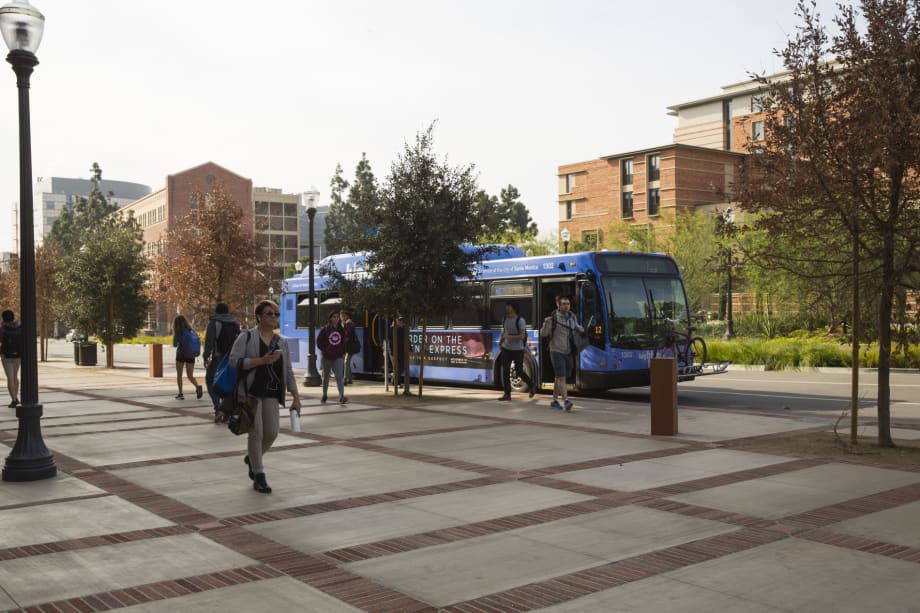
UCLA's campus has a daily population of 76,000 people and experiences 68,000 ride-hailing stops per week. Photo: UCLA
2 min to read
UCLA's campus has a daily population of 76,000 people and experiences 68,000 ride-hailing stops per week. Photo: UCLA
Correction: The original story incorrectly stated that the artificial intelligence system was installed on campus shuttles. It should have said the AI system was implemented at pick-up and ride-sharing drop-off sites.
UCLA has partnered with VIMOC Technologies to implement an artificial intelligence-enabled system at pick-up and ride-sharing drop-off sites that visually detects and classifies various forms of transportation such as buses, cars, bicycles, and pedestrians.
The Smart Multi-modal transportation system will combine public, private, and ride-sharing transportation.
“Working with UCLA has given us the opportunity to demonstrate and validate a new and effective approach for Multi-modal traffic management,” said Tarik Hammadou, CEO of VIMOC.
The system, which utilizes VIMOC's Rosella Platform, allows UCLA's soft enforcement to optimize curb space for safety and efficiency at the campus' Gateway Plaza loop.
“Gateway Plaza is a vital hub for the university’s functional transfer of our students, employees and visitors,” said David Karwaski, senior associate director of UCLA Transportation. “With the addition of over 60,000 weekly ride-hailing drop-offs and pick-ups, ensuring safe and efficient traffic flow has given us the opportunity to pursue traffic and curb space management with an entirely new perspective.”
UCLA's campus has a daily population of 76,000 people and experiences 68,000 ride-hailing stops per week.
VIMOC will continue to work with UCLA by providing AI-based solutions in pursuit of a Smart Campus environment.
“Intelligent Transportation System solutions can be effective when the gathered intelligence is highly accurate and can be presented in real-time,” said Hammadou. “Operators can then act upon this data to make significant improvements to existing structures and guide transportation behavior."
More New Mobility

CharterUP’s Armir Harris on Technology, AI, and the Future of Group Mobility
In a recent episode of METROspectives, CharterUP Founder/CEO Armir Harris discussed the company’s evolution from an online charter bus marketplace into a technology platform supporting public- and private-sector mobility and much more.
Read More →
Jacksonville’s NAVI Project Charts a New Course for Autonomous Public Transportation
Through its NAVI program, JTA is showing how autonomous vehicles, intelligent infrastructure, and coordinated operations can work together to deliver everyday public transportation.
Read More →
Biz Briefs: Luminator Marks Milestone and More
From manufacturers and suppliers to transit agencies and motorcoach operators, these updates offer a snapshot of the projects, partnerships and business moves driving the industry forward.
Read More →
New Tricks for Old Bureaucracies: Joshua Schank on Making Transit Innovation Stick
Former LA Metro Chief Innovation Officer Joshua Schank discusses why good ideas aren't enough, how transit agencies can overcome resistance to change, and why today's challenges demand more innovation.
Read More →
How DART's GoPass Is Redefining Regional Mobility
Serving 14 transit agencies, GoPass simplifies multimodal travel by allowing riders to plan, pay for, and manage an entire trip through one app.
Read More →
Biz Briefs: OCTA Taps Clean Energy for Hydrogen Station, Stadler to Supply Via Rail Vehicles, and More
From manufacturers and suppliers to transit agencies and motorcoach operators, these updates offer a snapshot of the projects, partnerships and business moves driving the industry forward.
Read More →CharterUP Expands Into New Mobility and Autonomous Transportation
Vice President of New Mobility Stephen Joos discusses how CharterUP is leveraging its nationwide transportation network, technology platform, and autonomous vehicle partnerships to expand into workforce mobility, campus shuttles, and transit solutions.
Read More →
METRO Magazine Announces 2026 Innovative Solutions Awards Winners
Projects Recognized for Advancing Mobility Through Technology, Accessibility, Workforce Innovation, and Operational Excellence
Read More →
Biz Briefs: STV teams with Amtrak, Motorcoach Operators Boost Fleet and Land Contracts, and More
From manufacturers and suppliers to transit agencies and motorcoach operators, these updates offer a snapshot of the projects, partnerships and business moves driving the industry forward.
Read More →
Biz Briefs: Masabi Teams with St. Louis Metro and More
In METRO's latest installment, we take a look at recent news from Transdev, Hitachi, and more partnerships making headlines across the transportation sector.
Read More →