



Transit, Partnerships Help Boost St. Louis Industrial Sector
With increased collaboration among the St. Louis Regional Freightway, Metro Transit, and Madison County Transit the region sees more ridership and economic development, even in the midst of the pandemic.
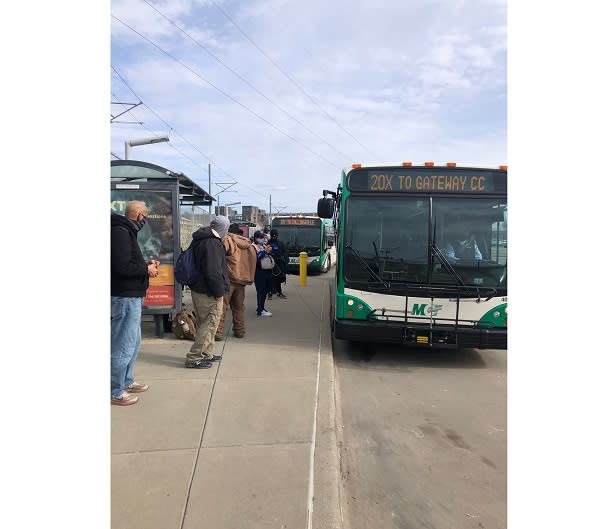
Madison County Transit’s (MCT) 20X Gateway Commerce Express serves passengers connecting to MCT from the Emerson Park MetroLink Station. The 20X has seen significant growth over the last 18 months and even during the pandemic.
MCT
Record-setting growth in the St. Louis region’s industrial sector in recent years resulted in strong demand for labor and the need for enhanced transportation options. Collaboration between the tenants in some of the region's largest industrial parks, the St. Louis Regional Freightway, St. Louis Metro Transit, Madison County Transit, and municipalities such as Madison County, Ill., and Hazelwood, Mo., has resulted in those needs being met, even during the COVID-19 pandemic.
For more than a decade, Madison County Transit (MCT) has been expanding its service in the warehouse district along Illinois Route 111, especially to the Gateway Commerce Center, where the workforce is a key contributor to the 9,500 warehouse employees in Edwardsville. In response to the growing demand, MCT introduced the 20X Gateway Commerce Express in May 2019, serving passengers connecting to MCT from the Emerson Park MetroLink Station to access the Gateway Commerce Center. The 20X has seen significant growth over the last 18 months and that growth continued even in the midst of the pandemic. To accommodate the continued rise in demand, several additional trips were added in the morning and afternoon, with the new trips producing an average ridership increase of 81% between May and October 2020.
The growth on the 20X route has been fueled by providing a direct, express route to the industrial corridor from the Emerson Park MetroLink Station, which is located in St. Clair County. MetroLink is the backbone of the region’s transit system, spanning 46 miles in eastern Missouri and southwestern Illinois and giving a larger pool of potential employees on both sides of the Mississippi River enhanced access to employment opportunities.
As demand for labor grew among major employers such as Amazon, World Wide Technology, Crescent, Hersey and others, staying up to speed on their evolving workforce needs was critical to ensuring a transit service model that delivered.
In August 2020, MCT added two new express routes from the Alton and Collinsville areas directly serving the warehouses throughout Gateway Commerce Center. The new express service reduced travel times for riders from those communities, making it possible to complete the one way trip in 25 to 30 minutes in many cases. The new 24X express route from Alton and 25X express route from Collinsville have made modest ridership gains since their inception during the pandemic.
In all, between its express routes and shuttles to and through Gateway Commerce Center, each weekday MCT operates total of 117 trips to and from the industrial park. The transit district also serves Lakeview Commerce Center and the new Gateway Tradeport Park, which is home to one of the region’s newest Amazon facilities.
Amazon has been growing on both sides of the river, opening eight separate facilities in the St. Louis area since 2016. Two of the Amazon facilities are at Hazelwood Logistics Park, which benefits from dedicated bus service provided by Metro Transit. While overall Metro Transit experienced a 50% drop in ridership across the system in 2020 due to COVID-19, the service to the Hazelwood facility was maintained, helping to ensure that the essential workers at the myriad facilities there had access to public transit. Nearby at the Hazelwood Tradeport, continued development has prompted Metro to alter a bus route in March 2021 to travel closer to the site, which will provide better access for employees in the growing industrial area.
“As transit agencies, we are committed to keeping our communities moving in the safest and most efficient way possible,” Metro Transit Executive Director Jessica Mefford-Miller said. “We will continue to adapt and be flexible as workforce transportation needs evolve, because we understand just how essential public transportation is, not only to the growing industrial parks but also to our downtown core, area hosptials, universities, grocery stores, and so many other important destinations.”
“The openness to collaborate has strengthened the business climate and resulted in a workforce competitive edge as the growing companies in the region’s various industrial parks are able to more efficiently get their employees to and from their facilities,” said Mary Lamie, vice president of multimodal enterprises for Bi-State Development and head of the St. Louis Regional Freightway. “The number one criteria for site selection is workforce availability, and Metro Transit and MCT are stepping up to provide reliable access to workforce transportation to a larger labor force, helping support and attract new manufacturing and logistics industries to the region’s bi-state market and creating opportunities for expansion for existing companies.”
More Management

METRO Opens Submissions for 2026 Motorcoach Awards
Nominations are now being accepted for METRO Magazine’s Operator of the Year and Innovative Operator of the Year awards.
Read More →
New York MTA Advances Final Contract for Second Avenue Subway Expansion
Contract Four is the largest in the Second Avenue Subway Phase 2 project and includes construction of station infrastructure, tracks, and signals for the subway expansion, MTA officials said. Work on Contract Four will begin in 2027.
Read More →
Transit Agencies Highlight Safety Gains at National Summit
Leaders from 15 major transit systems shared crime-reduction results and safety initiatives while discussing the role of continued federal support.
Read More →

NITA Names New Leadership, Expands Reduced-Fare Program at First Board Meeting
The new regional transit authority appointed its first board chair and interim executive director while extending reduced fares across CTA, Metra, and Pace for eligible riders.
Read More →
Beyond the Checklist: A Structured Approach to Transit Maintenance
Reliability-Centered Maintenance helps transit agencies move beyond routine checklists to focus limited resources on the assets and failures that have the greatest impact on safety, reliability, and service.
Read More →
APTA 2026 Nominating Committee Selects Leadership Slate, Names Chair and Vice Chair Nominees
Leadership changes will help shape the association’s priorities and its representation of the transportation industry during the 2026–2027 term.
Read More →
DART Launches Major Security, Fare Enforcement Initiative
The 90-day demonstration will deploy coordinated security teams at five light rail stations while testing controlled access and gathering data to guide future investments.
Read More →
Advancing Fare Collection Through Technology and Innovation
Learn about delivering 1300 gates at 91 stations while managing fare evasion. Explore the large scale deployment, solution customization and real-world results that affect the region. Prepare for deployment in your region now.
Read More →
Game Day in Motion: Moving Millions During the 2026 World Cup
Between packed transit stations and team motorcoaches, see how agencies and operators across North America tackled the transportation demands of the 2026 FIFA World Cup.
Read More →
Surface Transportation Extension Averts Shutdown, Leaves Transit Funding Gap
The stopgap keeps federal transportation programs moving, but missing advance funding could complicate the transit and rail projects agencies are planning next.
Read More →