



MTA Restores 24-Hour Subway Service
The subway system was closed overnight for the first time in the agency’s 116 years in May 2020, to allow the MTA to undertake an unprecedented cleaning regimen to protect employees and customers from COVID-19.
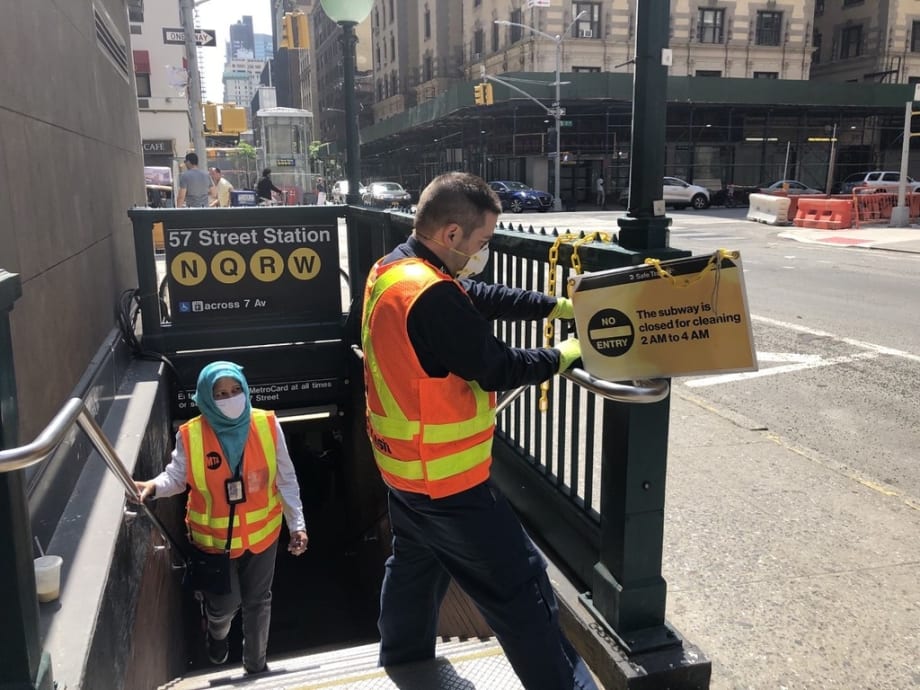
The unprecedented cleaning regimen on subways, buses, paratransit, and commuter rails will continue.
MTA
New York’s Metropolitan Transportation Authority (MTA) re-launched 24-hour subway service on Monday as the state continues its economic and social reopening.
The subway system was closed overnight for the first time in the agency’s 116 years in May 2020, to allow the MTA to undertake an unprecedented cleaning regimen to protect employees and customers from COVID-19. When it began, the closure covered 1 a.m. to 5 a.m.; on February 15 Gov. Cuomo announced a partial resumption of overnight service, reducing the overnight closure in half, from 2 a.m. to 4 a.m.
The resumption of overnight subway service comes as subway ridership is trending upward toward a recovery. On Friday, March 12 subway ridership hit the 1.9 million mark for the first time since the onset of the COVID-19 pandemic a year ago. On April 9, subway ridership surpassed the two million mark, and on May 10 surpassed the 2.2 million riders, a new single-day record. The news comes on the heels of the MTA's multifaceted communications and marketing #TaketheTrain and #TaketheBus campaigns aimed at bringing customers back to the system.
“The subway returning to 24-hour service is a signal that we are closer than we have ever been to normal life,” said Sarah Feinberg, interim president of NYC Transit. “We would not be at this point without the sacrifice and dedication of the whole NYC Transit team. It is thanks to their heroic effort throughout this pandemic — coming into work, moving essential workers, keeping the system as clean as it has ever been — that we can return New York City to the city that never sleeps.”
Prior to the pandemic, average weekday ridership totals on subways routinely exceeded 5.5 million. That figure fell by more than 90% to a low of roughly 300,000 daily trips last April as the number of COVID-19 cases peaked in the New York City area. The low point of bus ridership was 278,067 on April 12, 2020. Average weekday ridership in April 2020 was 463,763. MTA employees continued to provide service for the frontline healthcare professionals and other essential workers who needed to get to work during some of the most troubling days in New York City history.
The unprecedented cleaning regimen on subways, buses, paratransit, and commuter rails will continue. Stations will be disinfected at least twice daily and rolling stock at least once daily. Since the May 6 closure a year ago the MTA has piloted disinfecting methods such as ultraviolet light, antimicrobial sprays which will allow the disinfecting to remain at high levels. Masks are still required while riding mass transit; mask compliance on subways and buses has been nearly universal with 98% compliance on subways and 99% on buses.
In an effort to get New York fully vaccinated and reopened, under the leadership of Gov. Cuomo, the MTA partnered with SOMOS Community Care, Northwell Health, and Westchester Medical Center on eight pop-up vaccination sites throughout its operating region. Customers and MTA employees can get vaccinated at the sites. Anyone who received the vaccine at these pop-up locations received either a free seven-day MetroCard or free round-trip Long Island Rail Road or Metro-North ticket.
The effort to help get every New Yorker vaccinated comes as the MTA gets its workforce vaccinated. The MTA has stood up employee vaccination sites throughout its region. More than 30,000 employees have received at least their first dose of the vaccine.
The MTA will also continue to protect its employees and customers with personal protective equipment. So far, the MTA has acquired nearly 27 million masks to date. In addition to the over eight million masks available for customers, the authority has also made available 750,000 2-oz. bottles of hand sanitizer. Additionally, the MTA has distributed to its workforce 18.7 million masks, 20.3 million pairs of gloves, 122,000 gallons of hand sanitizer, 260,000 7-oz., and 2-oz. bottles of hand sanitizer, 13.7 million individual sanitizing cleaning wipes, 277,000 gallons of cleaning solution, and 18,000 face shields.
More Management

METRO Opens Submissions for 2026 Motorcoach Awards
Nominations are now being accepted for METRO Magazine’s Operator of the Year and Innovative Operator of the Year awards.
Read More →
New York MTA Advances Final Contract for Second Avenue Subway Expansion
Contract Four is the largest in the Second Avenue Subway Phase 2 project and includes construction of station infrastructure, tracks, and signals for the subway expansion, MTA officials said. Work on Contract Four will begin in 2027.
Read More →
Transit Agencies Highlight Safety Gains at National Summit
Leaders from 15 major transit systems shared crime-reduction results and safety initiatives while discussing the role of continued federal support.
Read More →

NITA Names New Leadership, Expands Reduced-Fare Program at First Board Meeting
The new regional transit authority appointed its first board chair and interim executive director while extending reduced fares across CTA, Metra, and Pace for eligible riders.
Read More →
Beyond the Checklist: A Structured Approach to Transit Maintenance
Reliability-Centered Maintenance helps transit agencies move beyond routine checklists to focus limited resources on the assets and failures that have the greatest impact on safety, reliability, and service.
Read More →
APTA 2026 Nominating Committee Selects Leadership Slate, Names Chair and Vice Chair Nominees
Leadership changes will help shape the association’s priorities and its representation of the transportation industry during the 2026–2027 term.
Read More →
DART Launches Major Security, Fare Enforcement Initiative
The 90-day demonstration will deploy coordinated security teams at five light rail stations while testing controlled access and gathering data to guide future investments.
Read More →
Advancing Fare Collection Through Technology and Innovation
Learn about delivering 1300 gates at 91 stations while managing fare evasion. Explore the large scale deployment, solution customization and real-world results that affect the region. Prepare for deployment in your region now.
Read More →
Game Day in Motion: Moving Millions During the 2026 World Cup
Between packed transit stations and team motorcoaches, see how agencies and operators across North America tackled the transportation demands of the 2026 FIFA World Cup.
Read More →
Surface Transportation Extension Averts Shutdown, Leaves Transit Funding Gap
The stopgap keeps federal transportation programs moving, but missing advance funding could complicate the transit and rail projects agencies are planning next.
Read More →