



More Bus Shelters: CapMetro Awards Tolar Contract for Bus Shelters
Tolar Takes the Necessary Steps to Shade Riders
Tolar Manufacturing Company celebrates 31 years by expanding their coverage and broadening the conversation around bus shelter placement and design.
by Patrick Merrick
December 19, 2022
Tolar Manufacturing Company has produced over 35% of domestic transit shelters and street furniture across North America.
Credit:
Tolar Manufacturing Company
5 min to read
In 2022, Tolar Manufacturing Company celebrated its 30th year in business. Responsible for producing over 35% of domestic transit shelters and street furniture, the company encourages broader discussions about where bus shelters should be placed within cities and communities across North America.
Their message is simple — bus shelters and bus stop amenities should be integrated into bus stops that not only serve daily riders but also communities and neighborhoods that need it most, regardless of ridership numbers.
“For years, the focus on bus shelters has been providing shelters with state-of-the-art technology at highest ridership stops,” said Gary Tolar, founder/president of Tolar. “Providing real-time information, cell phone charging, emergency communication, and other technologies are very important to and desired by many of our customers and their riders. While we do build shelters with these technologies, we firmly believe shade, lighting, and seating lay the foundation to create a positive rider experience and support Tolar’s recognition that the rider's journey begins at the stop.”
Shelter Ahead
In September, Tolar was selected by Tranzito/Vector to build 3,450 bus shelters around Los Angeles over five years for the city’s Sidewalk and Transit Amenities Program, providing comfort, safety, and critical shade.
When asked why Tolar Manufacturing was selected, Tranzito’s CEO Gene Oh said, “Tolar's reputation is unsurpassed for their quality of work and overall value. But it’s their people that made a partnership with Tolar a no-brainer. Their entire staff has been great to work with, they are honest and straightforward in their dealings, provide expert consultation balancing design with cost, and took on a true partnership attitude from the start."
The project is a collaborative partnership with Tranzito/Vector as part of a larger 20-year contract awarded by the City of Los Angeles which is dedicated to moving L.A. forward with world-class mobility hubs that also provide equitable shade.
As noted by Los Angeles Mayor Eric Garcetti in a 2019 story in The New York Times, “Maybe you haven’t thought about it this way, but the shade is an equity issue.”
He continued, “Think about an elderly Angeleno who relies on public transit to get around her neighborhood. Imagine her standing in the blistering sun in the middle of July waiting for the bus, on hot, dark asphalt. She deserves to be every bit as comfortable as her counterpart in another ZIP code in town.”
This summer also saw Tolar providing much-needed shade coverage in Texas, with 40 shelters per month shipped to Corpus Christi as part of a three-year contract.
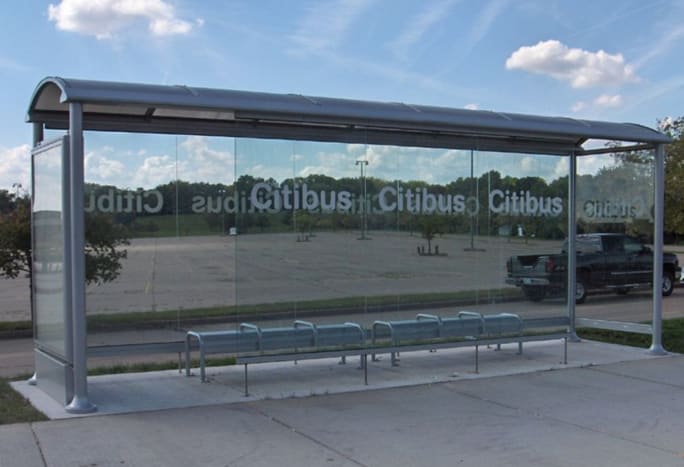
A Tolar-built shelter in Davenport, Iowa protects riders from the sun.
Credit:
Tolar Manufacturing Company
Tolar is also installing each of the shelters throughout Corpus Christi Regional Transportation Authority’s service area. Soon Tolar’s footprint in Texas will include more than 1,000 shelters across the state, in cities including Corpus Christi, Dallas, Fort Worth, San Antonio, and Austin.
The need for shelter is felt tremendously throughout Texas, with temperatures reaching record heights each summer. Bus shelters provide necessary shade during heat waves to riders who depend on public transit to make their daily commutes, as well as riders connecting with vital services such as seniors, essential workers, and students.
The Austin Chronicle reported that riders near the University of Texas at Austin can spend up to 330 minutes waiting for a bus, while this year Austin saw the hottest May and June on record with temperatures regularly exceeding 100 degrees Fahrenheit.
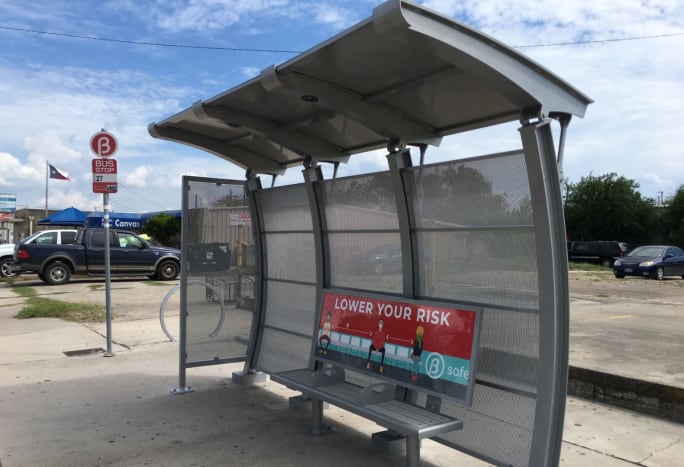
A Tolar-built shelter in Corpus Christi shades riders waiting for the bus.
Credit:
Tolar Manufacturing Company
Heatwaves like the one in Austin are not unique to Texas. In Los Angeles, official records report 599 deaths attributed to heat exposure between 2010 and 2019, while an investigation by the Los Angeles Times estimated the number of deaths is likely closer to 3,900.
Nearly 60% of bus riders in Los Angeles are Latino, while 14% are Black/African American; 49% of all riders are women, and 62% of riders have a median household income under $20,000. This leaves these communities disproportionately affected by a lack of access to bus shelters that provide critical shade.
Weather-protecting bus shelters do not just provide shade during high heat. They also provide critical passenger safety and protection from blistering winds, snow, and extreme cold weather found in cities across the Midwest, Northeast, and Northwest.
Tolar-built shelters are protecting riders from Grand Rapids, Michigan, to Davenport, Iowa, from Rochester, N.Y., to Cambridge, Mass., and from Everett, Wash. to Denver. Tolar ships hundreds of bus stop amenities each month across the country.
Providing Access
As more shelters are installed in more places, Tolar believes it is necessary to take steps to ensure no one is left unprotected and that all members of a community have equal access to much-needed shade and shelter — a vital right for all who utilize public transportation. Tolar supports these initiatives by working with clients on amenity solutions that address a wide variety of design constraints including but not limited to available right-of-way and kit-of-part solutions.
Historically, bus shelter placements are determined by factors including ridership, traffic, and sidewalk width. In 2011, the Metro Gold Line Foothill Extension Construction Authority concluded a study that identified ways to better provide access between an extended LA Metro Line and local bus riders.
The Construction Authority used the study to provide a recommendation, which included three criteria for determining bus stop locations: Convenience and Safety of Route, Spacing, and Capacity. According to the recommendation, these criteria were created to be consistent with those adopted by LA Metro.
The Tranzito/Vector Los Angeles project aims to bring shade to more than 75% of transit users by covering more than half of Los Angeles’ bus stops. Importantly, this is being accomplished through a forward-thinking set of criteria planners are using to determine bus shelter locations, such as heat index, transit usage, and economic need.
A Tolar-built shelter in Davenport, Iowa protects riders from the sun.
Credit:
Tolar Manufacturing Company
Tolar shares the vision of the Tranzito/Vector team that these criteria help not only to serve a greater portion of riders, but also help to identify and better support those riders most dependent on public transit to get to school, work, shopping, social activities, and medical appointments.
The 2022 Midterm Elections saw 14 of 19 transit initiatives pass in communities across the country adding billions in transit investment, reflecting the commitment of voters and cities to bring progress to public transit.
As Tolar continues to grow throughout North America, they are encouraged by the conversations regarding equity and access and by providing thought leadership backed by quality-built bus shelters for riders that depend on them most.
About the Author: Patrick Merrick, the Executive VP at Tolar.
Subscribe to Our Newsletter
More Technology

From Hardware to Digital Partner: Luminator Charts Its Next Chapter
CEO Magnus Friberg discusses Luminator’s shift toward becoming a digital partner, the growing importance of software and interoperability, and how AI can help agencies improve operations and passenger experience.
Read More →
Beyond the Checklist: A Structured Approach to Transit Maintenance
Reliability-Centered Maintenance helps transit agencies move beyond routine checklists to focus limited resources on the assets and failures that have the greatest impact on safety, reliability, and service.
Read More →
NJ TRANSIT Advances Bus Technology Upgrades Across Statewide Fleet
More than 1,500 buses now feature upgraded technology designed to improve arrival predictions and provide free Wi-Fi, with deployment expected to reach nearly 2,000 buses by the end of 2026.
Read More →

Building a Flexible Path to Transit Electrification
John Hroncich discusses BAE Systems’ modular and scalable approach, lessons learned from decades of real-world operations, and how agencies can identify electrification strategies that fit their fleets.
Read More →
Biz Briefs: Alstom Lands Canadian Contract, LYT to Supply California TSP, and More
In METRO's latest installment, we take a look at recent news from Complete Coach Works, Beep, FlixBus, and more partnerships making headlines across the transportation sector.
Read More →
Sponsored•September 8, 2026
From Legacy Silos to Conversational Intelligence
What if transit leaders could ask any operational question and get a trusted answer in seconds? Conversational AI is transforming how agencies use their data.
Read More →
USDOT Announces Rail Vehicle Replacement Grants, Chattanooga AV Shuttle Funding
More than $191 million in federal funding will help three transit agencies replace aging rail vehicles and support a new autonomous shuttle service in Chattanooga.
Read More →
Bus Tech Talk: Keeping Transit Technicians Ahead of the Technology Curve
LA Metro’s Obed Mejia discusses technician training, evolving maintenance technology, fleet replacement, and strategies for getting the most out of today’s transit fleets.
Read More →
Biz Briefs: RIPTA Unveils New Frontrunners, Clevland RTA Adds New Siemens, and More
In METRO's latest installment, we take a look at recent news from Siemens, Prevost, Dodge, and more partnerships making headlines across the transportation sector.
Read More →
Why Simulating Pedestrian Movement Has Become Essential for Modern Rail Stations
Pedestrian microsimulation is helping rail planners identify bottlenecks, test station designs, and prepare complex transit hubs for growing passenger volumes.
Read More →