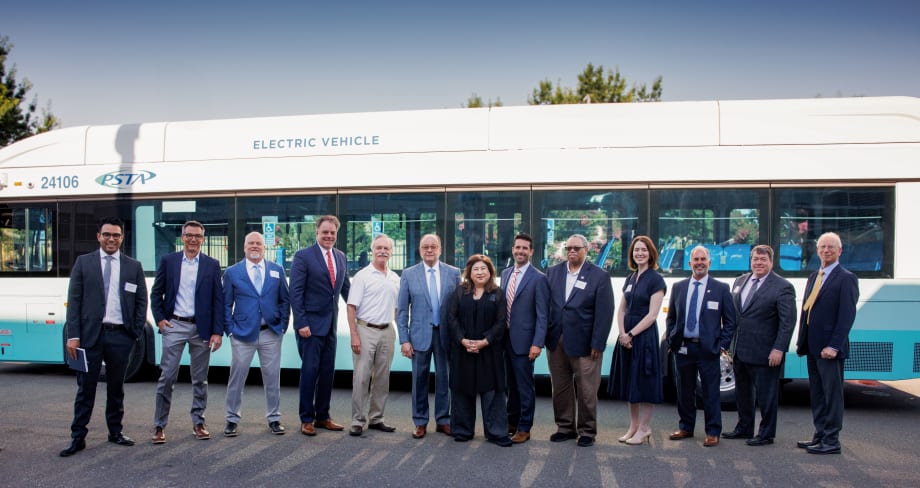
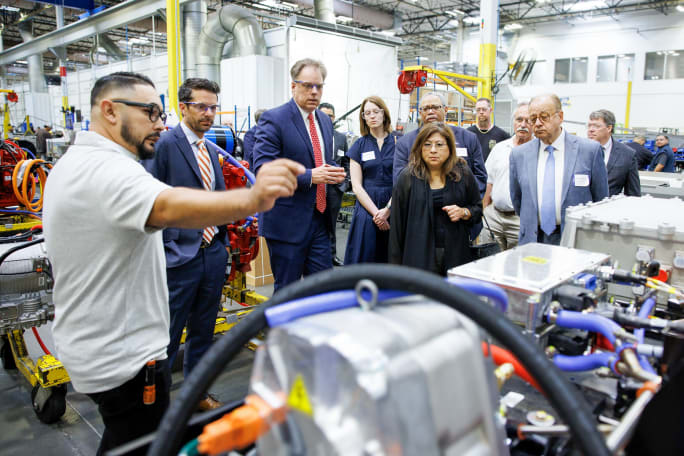
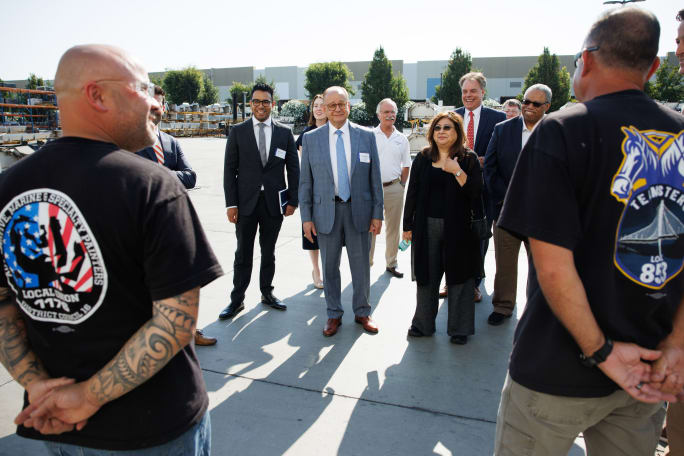
During the visit, the APTA contingent was joined by local and political officials for a walking tour of GILLIG’s state-of-the-art manufacturing facility, which highlighted the company’s commitment to producing American-built, high-quality, and reliable transit buses for the U.S. transit market.
Photo: GILLIG
2 min to read
GILLIG welcomed leadership from the American Public Transportation Association (APTA) for a facility tour and roundtable discussion at its headquarters and manufacturing plant in Livermore, Calif.
The event highlighted the pivotal role GILLIG and the broader public transportation industry play in America's economic and environmental future.
Ad Loading...
The event highlighted the pivotal role GILLIG and the broader public transportation industry play in America's economic and environmental future.
Photo: GILLIG
APTA Goes to GILLIG
Among the distinguished guests were Paul Skoutelas, APTA president and CEO; Michele Wong Krause, APTA chair; Dorval Carter, chair of the Bus Manufacturing Task Force and president of the Chicago Transit Authority (CTA); David Carol, APTA COO; and Ward McCarragher, APTA VP, Government Affairs and Advocacy. Their visit underscored the strong relationship between GILLIG and APTA and the shared commitment to advancing public transit solutions that drive economic growth and sustainability.
During the visit, the APTA contingent was joined by local and political officials for a walking tour of GILLIG’s state-of-the-art manufacturing facility, which highlighted the company’s commitment to producing American-built, high-quality, and reliable transit buses for the U.S. transit market.
The tour was followed by a roundtable discussion, during which APTA officials, GILLIG executives, and key suppliers engaged in a robust dialogue about the significance of the Bipartisan Infrastructure Law, the current state of the American public transit market, and GILLIG’s leadership in zero-emissions transit solutions.
Highlighting the significant economic benefits of investing in public transit, which sustains hundreds of thousands of jobs and fosters economic growth in communities nationwide, APTA President Paul Skoutelas (center) commented that “investments in public transportation have been shown to yield substantial returns, with every dollar generating approximately five dollars in economic benefits.”
Photo: GILLIG
The Critical Investment Needs
The dialogue emphasized the critical need for continued investment in public transportation to modernize infrastructure, support domestic manufacturing, and upskill the workforce for a zero-emission future.
Highlighting the significant economic benefits of investing in public transit, which sustains hundreds of thousands of jobs and fosters economic growth in communities nationwide, Skoutelas commented that “investments in public transportation have been shown to yield substantial returns, with every dollar generating approximately five dollars in economic benefits.”
Ad Loading...
In closing remarks, Derek Maunus, GILLIG’s president and CEO, stated that “this visit from APTA is a testament to our shared dedication to advancing the public transportation industry and addressing head-on the challenges and opportunities the current industry dynamic presents.”
“APTA thanks GILLIG for hosting our delegation and providing an informative tour of their facilities. They are an outstanding industry partner, especially during this critical moment as the industry moves forward on clean bus technology and transit agencies nationwide modernize their fleets,” concluded Skoutelas. "The strength and resilience of public transportation significantly affects the economy, supporting jobs and driving growth in numerous sectors. We must preserve, protect and nurture the U.S. bus manufacturing market if we are to advance our nation's public transportation infrastructure."
The agency is seeking manufacturers for 650 new CNG buses to replace aging vehicles, improve reliability, and advance its broader fleet modernization strategy.
John Hroncich discusses BAE Systems’ modular and scalable approach, lessons learned from decades of real-world operations, and how agencies can identify electrification strategies that fit their fleets.
LA Metro’s Obed Mejia discusses technician training, evolving maintenance technology, fleet replacement, and strategies for getting the most out of today’s transit fleets.
In METRO's latest installment, we take a look at recent news from Siemens, Prevost, Dodge, and more partnerships making headlines across the transportation sector.
In this edition, we also cover recent appointments and announcements at Pace, CamTran, MCI, and more, showcasing the individuals helping to shape the future of transportation.
Transit leaders and policymakers examine how standardized bus designs, streamlined procurement, and predictable funding could help agencies stretch budgets and deliver better service.
As chair of APTA’s Business Members Board of Governors, Ray Melleady explains how more than 850 business members are partnering with transit agencies to advance funding, innovation, and industry-wide collaboration.
Bus Business Consultants founder Brian Dickson shares lessons on leadership, organizational health, and creating options for long-term success in a changing transportation industry.
The award-winning partnership combines AI-powered detection with human oversight to improve bus reliability, accessibility, and enforcement efficiency.