



Seattle's King County Signs Pledge to Support Historically Underutilized Businesses
The mission of the Equity in Infrastructure Pledge is to build generational wealth and reduce the racial wealth gap by improving public infrastructure contracting practices to create more prime, joint venture and equity contracting opportunities for HUBs.

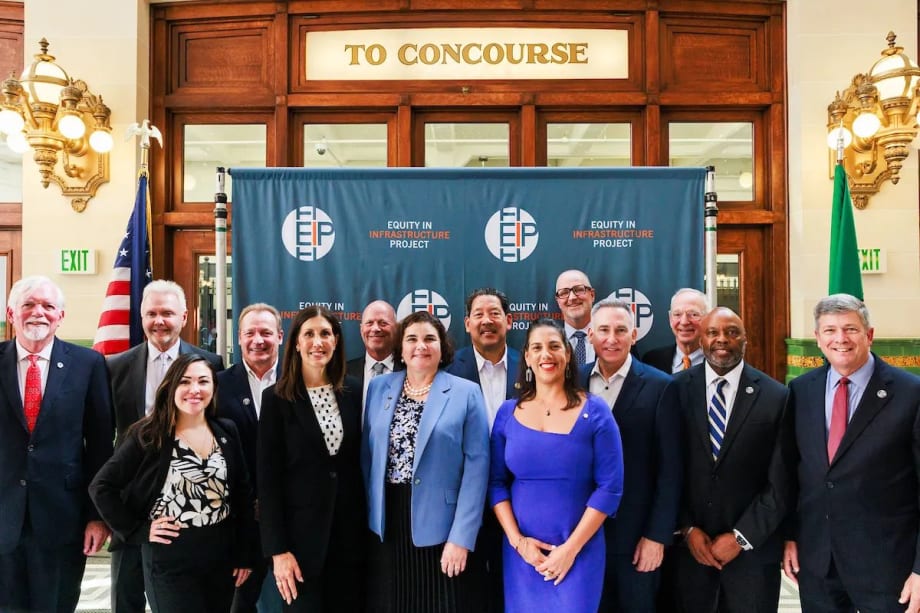
Pledge signers are heads of transit authorities, airports, ports, water districts, and engineering, financial and construction firms from across the country — representing hundreds of billions of dollars of power to improve people’s lives.
Photo: King County Metro
King County Executive Dow Constantine joined Sound Transit, the City of Seattle, and other regional transit leaders to sign the Equity in Infrastructure Pledge to improve contracting opportunities for Historically Underutilized Businesses (HUBs).
“King County is committed to advancing equity in contracting, and the Equity in Infrastructure Pledge aligns perfectly with our ongoing work to support minority and women-owned businesses,” said King County Executive Constantine. “By amplifying opportunities for historically underutilized businesses, we seek to ensure that everyone has a fair chance to participate in and contribute to our region’s prosperity. This pledge is another expression of King County’s daily commitment to becoming a welcoming community where every person can thrive.”
The Equity in Infrastructure Pledge
The mission of the Equity in Infrastructure Pledge is to build generational wealth and reduce the racial wealth gap by improving public infrastructure contracting practices to create more prime, joint venture and equity contracting opportunities for HUBs.
Providing these opportunities also creates more competition, reducing costs to public agencies and allowing them to drive more value from their infrastructure dollars.
Pledge signers are heads of transit authorities, airports, ports, water districts, and engineering, financial and construction firms from across the country — representing hundreds of billions of dollars of power to improve people’s lives.
The White House has directly called on Bipartisan Infrastructure Law grantees to sign the Pledge.
Pledge Aligns with King County’s Efforts
The pledge’s focus on increasing contract awards to HUBs aligns closely with efforts that King County has already undertaken and will continue to expand.
The county’s initial work began in 2003 with the launch of the Contracting Opportunities Program to support small contractors and suppliers by improving their access to King County contracts.
In 2021, Executive Constantine expanded this initiative by signing an Executive Order on Pro-Equity Contracting, ensuring that minority- and women-owned businesses are included in the program. These programs have sparked new ways to boost participation by minority and women-owned businesses (MWBE) in county contracts.
King County’s Equity Progress
King County has made significant progress by:
Launching a Fast Track Certification program for minority and women-owned businesses that are already certified. As a result, these businesses are now 84% of our total number of more than 3,600 small contractor and supplier-certified firms. In 2023, $77 million in county contracts was awarded to these firms, with $35 million going to MWBE firms.
Requiring equity plans from prime contractors for county-funded projects.
Expediting payments through a Cash Flow Initiative.
Partnering with organizations like Tabor 100 to support small businesses.
The Equity in Infrastructure Pledge also supports a nine-element action plan King County will implement over the next 12 months to help even more firms.
The Action Plan
The action plan aims to reduce certification barriers, improve goals and metrics, and increase partnerships with other agencies to expand successful programs, such as a mentorship initiative for minority and women-owned businesses.
The pledge aligns with King County’s ongoing commitment to advancing equity in contracting by supporting small businesses that help our communities thrive.
Metro is also taking extra steps to expand HUB opportunities by increasing outreach efforts and exploring ways to facilitate HUB participation in work that will utilize new technologies and sustainable practices.
More Management

METRO Opens Submissions for 2026 Motorcoach Awards
Nominations are now being accepted for METRO Magazine’s Operator of the Year and Innovative Operator of the Year awards.
Read More →
New York MTA Advances Final Contract for Second Avenue Subway Expansion
Contract Four is the largest in the Second Avenue Subway Phase 2 project and includes construction of station infrastructure, tracks, and signals for the subway expansion, MTA officials said. Work on Contract Four will begin in 2027.
Read More →
Transit Agencies Highlight Safety Gains at National Summit
Leaders from 15 major transit systems shared crime-reduction results and safety initiatives while discussing the role of continued federal support.
Read More →

NITA Names New Leadership, Expands Reduced-Fare Program at First Board Meeting
The new regional transit authority appointed its first board chair and interim executive director while extending reduced fares across CTA, Metra, and Pace for eligible riders.
Read More →
Beyond the Checklist: A Structured Approach to Transit Maintenance
Reliability-Centered Maintenance helps transit agencies move beyond routine checklists to focus limited resources on the assets and failures that have the greatest impact on safety, reliability, and service.
Read More →
APTA 2026 Nominating Committee Selects Leadership Slate, Names Chair and Vice Chair Nominees
Leadership changes will help shape the association’s priorities and its representation of the transportation industry during the 2026–2027 term.
Read More →
DART Launches Major Security, Fare Enforcement Initiative
The 90-day demonstration will deploy coordinated security teams at five light rail stations while testing controlled access and gathering data to guide future investments.
Read More →
Advancing Fare Collection Through Technology and Innovation
Learn about delivering 1300 gates at 91 stations while managing fare evasion. Explore the large scale deployment, solution customization and real-world results that affect the region. Prepare for deployment in your region now.
Read More →
Game Day in Motion: Moving Millions During the 2026 World Cup
Between packed transit stations and team motorcoaches, see how agencies and operators across North America tackled the transportation demands of the 2026 FIFA World Cup.
Read More →
Surface Transportation Extension Averts Shutdown, Leaves Transit Funding Gap
The stopgap keeps federal transportation programs moving, but missing advance funding could complicate the transit and rail projects agencies are planning next.
Read More →